



A Trusted Forex Broker
GCC Brokers Review Is It Legit and Safe to Forex Trade?
GCC Brokers is a licensed broker, but whether it's safe for you depends on the protections attached to your account. It holds an offshore license from the FSC Mauritius and has a UAE regulatory presence through a Category 5 license, though these protections aren't equivalent to those offered by top-tier regulators such as the FCA or ASIC.
This 2026 review examines the broker's Standard, Pro, and Zero accounts, including the $25 minimum deposit and spreads from 0.2 pips, along with leverage up to 1:500, MT5, fees, and key risks. First, we'll look at which entity may hold your account and what its licenses mean for your funds.
GCC Brokers Reviews: Is GCC Brokers Legit & Safe?
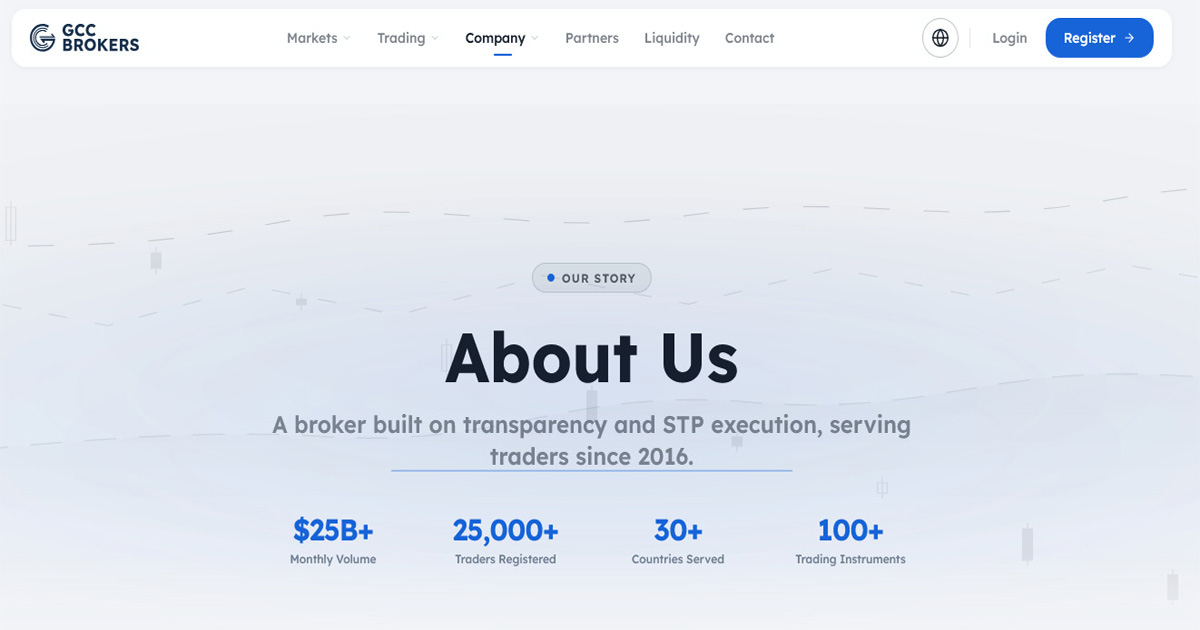
GCC Brokers Limited is a real forex and CFD broker, not a company that appeared overnight. It was founded in 2016 and focuses on traders in the Gulf, the wider MENA region, and parts of Asia. The broker holds an investment dealer license from the Financial Services Commission of Mauritius, and it offers MetaTrader 5 and several account types.
That history and licensing support its legitimacy, but they don't make trading risk-free or provide the same safeguards as a broker regulated by the FCA, ASIC, or another major onshore authority. Our assessment is medium risk: GCC Brokers may suit some regional traders, but clients should check which company holds their account and understand the limits of its protections before depositing.
What its licenses say about legitimacy
GCC Brokers Limited lists its Mauritius license as GB22200739. The FSC license is a meaningful sign of regulatory oversight, rather than proof of protection equal to that offered by top-tier regulators. In particular, the available information does not point to a compensation scheme comparable to the UK's Financial Services Compensation Scheme.
The company also has a presence in Dubai, but a local office does not automatically mean your trading account falls under UAE regulation. GCC Brokers identifies its Dubai representative office as a client-relations office that does not hold client money. Separately, a UAE Category 5 license has been reported for an associated entity, GCC Financial Services, which introduces UAE clients. It does not open trading accounts or hold funds. Check GCC Brokers' company and licensing details and ask in writing which legal entity will hold your account.
What to check before depositing
The name on your account agreement matters more than the brand on the website. Information in the market has also raised the possibility that some clients may be routed to a Saint Vincent and the Grenadines entity, which is not an investment-firm regulator. If support offers a different entity from GCC Brokers Limited, ask what protections apply and verify the details before sending money.
The UAE license update adds regional context, but it doesn't replace checking your own account terms. The reported UAE regulatory update concerns the group's structure, so don't assume it changes the regulator responsible for every client.
Before funding, confirm the legal entity and license number on your agreement, review the withdrawal and dispute procedures, and keep copies of your correspondence. Start with a demo or a small amount you can afford to lose, then test a withdrawal early. These steps won't remove market risk, but they can help you spot a mismatch between what you expect and the protections your account actually has.
Who may find GCC Brokers suitable?
GCC Brokers' regional focus, MT5 platform, and Standard account minimum of $25 may appeal to traders who want a low entry point. However, leverage up to 1:500 can magnify losses quickly, and low minimum deposits don't reduce that risk. The broker's own website presents company figures and performance claims; treat them as broker-provided information unless independently confirmed.
For US readers, one practical issue is that GCC Brokers does not accept US residents, according to the available account information. More broadly, traders who prioritize strong compensation or investor-protection frameworks may prefer a broker supervised by a top-tier regulator. GCC Brokers appears legitimate, but its offshore regulation and the need to verify your contracting entity call for care.
How GCC Brokers Trading Works on MT5
GCC Brokers offers MetaTrader 5 (MT5) as its only trading platform, with desktop, browser, and mobile access. You can use one account login across supported devices, monitor prices, analyze charts, and manage open positions. The platform is familiar to many forex traders, though you won't find alternatives such as MT4 or cTrader here.
Placing trades and managing positions
In MT5, you can open a market order at the available price or set a pending order to activate when the market reaches a chosen level. You can also attach stop-loss and take-profit instructions to manage risk and potential exits. MetaTrader's guide to executing trades explains how these order types work.
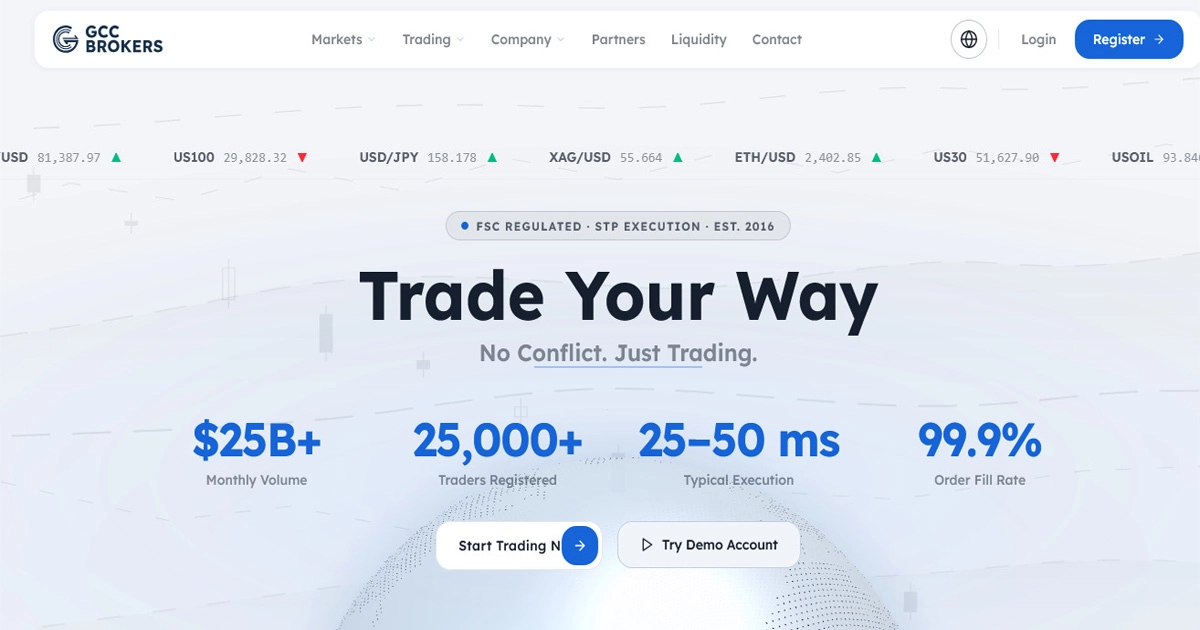
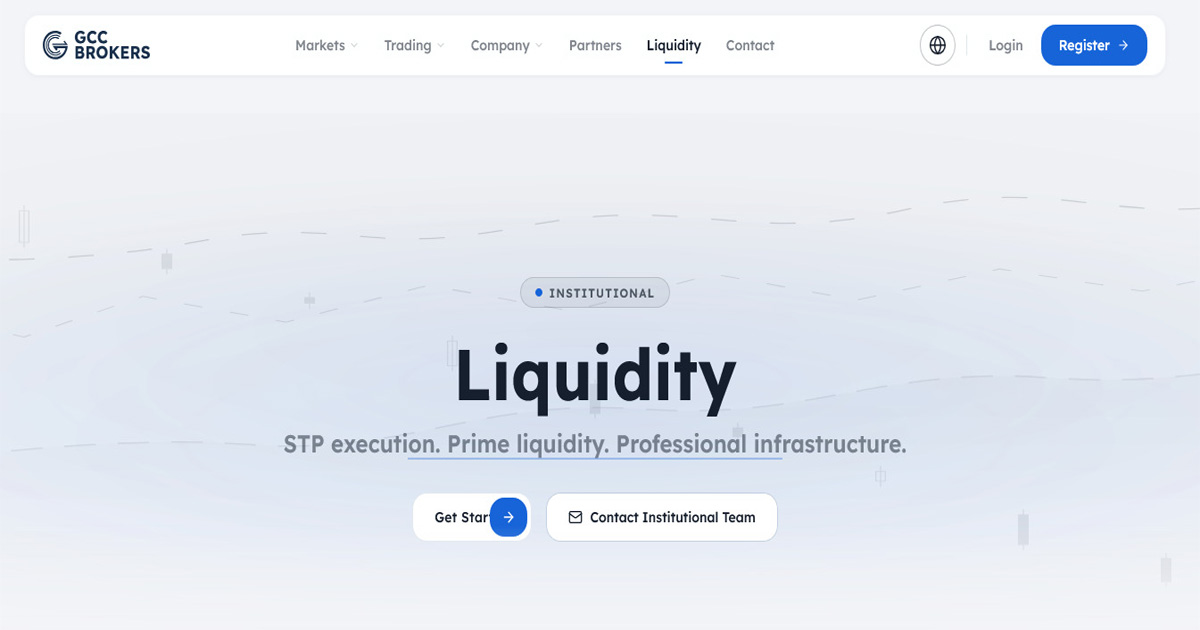
GCC Brokers says its accounts use straight-through processing (STP), with orders routed to liquidity providers and no dealing desk intervention. It also states that it does not requote and passes both positive and negative slippage to clients. Those are broker claims, not independently confirmed measures of execution quality. The company's published execution-speed and fill-rate figures should be treated the same way.
Charts, tools, and automated strategies
MT5 includes charting tools, technical indicators, multiple timeframes, and support for Expert Advisors (EAs), which can automate parts of a trading strategy. The platform's charting documentation covers its chart types and settings. GCC Brokers says it allows scalping, hedging, news trading, and EA strategies under its terms.
That flexibility doesn't prove that a strategy will execute as expected. Connection quality, market volatility, spreads, and available liquidity can affect fills. GCC Brokers' claims about liquidity-provider access, execution speed, and platform uptime have not been independently verified in the information available for this review. Traders testing an EA should use a demo account first, then monitor live fills and connection stability with small positions.
Markets available through the platform
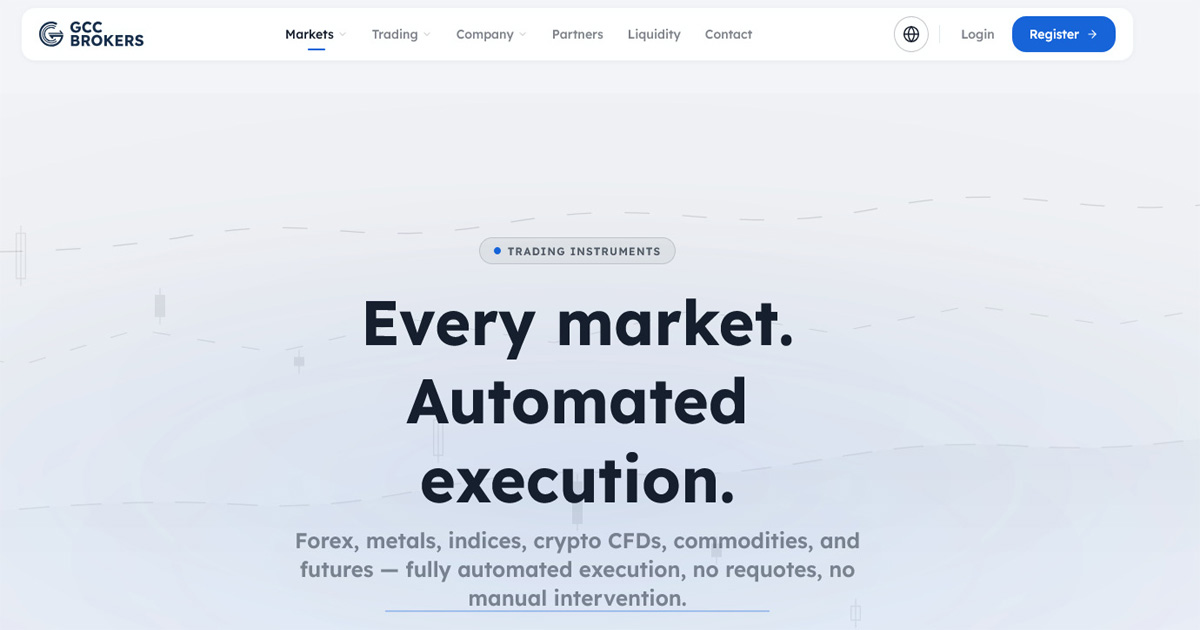
The broker lists forex pairs, precious metals, global indices, energy products, futures, and cryptocurrency CFDs. Product availability can vary by account and jurisdiction, so check MT5's instrument list and contract specifications before planning a trade. Individual stock CFDs are not listed among the available products.
GCC Brokers also promotes London Fix execution for corporate and professional clients trading gold and silver. That service is separate from ordinary spot orders in MT5, and interested clients should confirm its access requirements and order process directly with the broker.
Overall, MT5 provides the core tools for manual and automated trading, while GCC Brokers' range extends beyond forex. Since platform features are not proof of broker execution quality, evaluate order fills and connection performance on a demo before relying on them with live funds.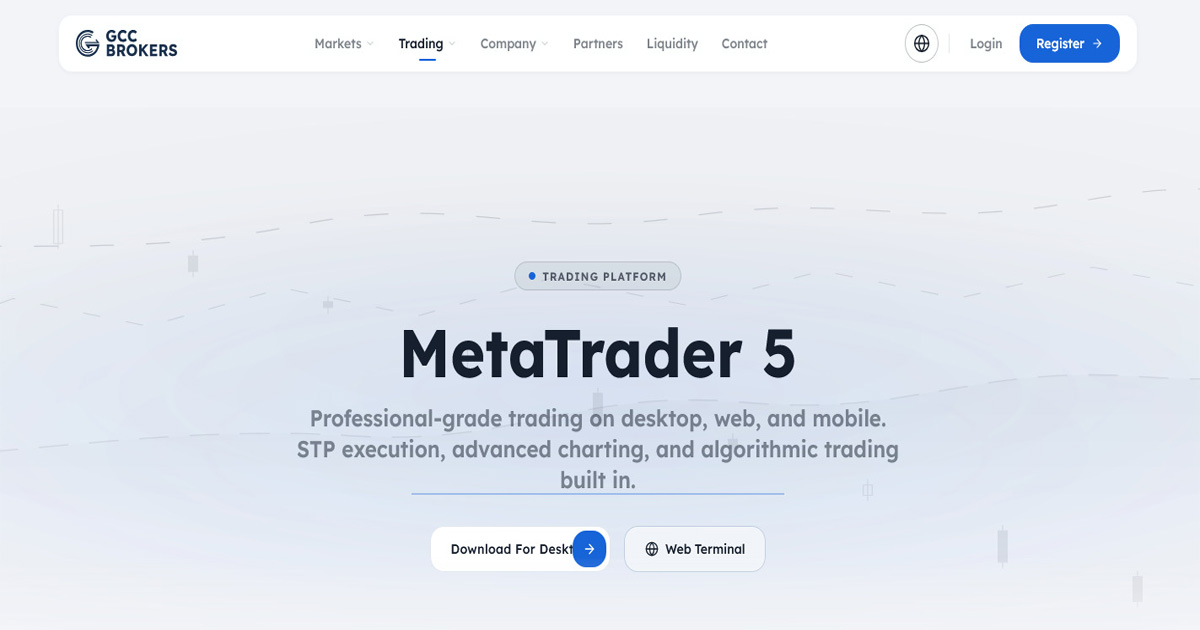
What GCC Brokers Accounts Offer, and What Is the Minimum Deposit?
GCC Brokers offers three live account types: Standard, Pro, and Zero. They all use MetaTrader 5 and share the same 0.01-lot minimum trade size, while deposits, spreads, commissions, and maximum leverage differ. The Standard account has the lowest entry requirement at $25.
Compare Standard, Pro, and Zero accounts
The figures below reflect the account conditions currently presented by the broker. Spreads are variable, and the listed amounts are minimums rather than guaranteed trading costs.
All three accounts open at 1:100 leverage by default. Clients can request higher leverage on Standard or Pro, up to 1:500, while Zero is capped at 1:200. Approval and available leverage can depend on the client's location and experience, and some instruments may have lower limits.
What the account differences mean in practice
The Standard account keeps the starting deposit low and charges no separate trading commission. Instead, trading costs are built into the spread, which starts at 1.8 pips. That can make it easier to understand costs when placing occasional trades, though wider spreads may add up for frequent trading.
With a $1,000 minimum, Pro offers spreads from 1.4 pips and also has no commission. It may suit traders who place more orders and want a lower starting spread without moving to a commission-based account. The savings depend on actual spreads and trading volume, so compare your typical costs rather than relying only on the minimum spread.
The Zero account requires $2,500 and offers spreads from 0.2 pips, with a variable commission. This structure may appeal to scalpers or automated strategies that depend on tighter spreads. However, GCC Brokers does not show an exact commission figure on its account overview, so ask support for the current rate before comparing total costs with another broker.
Check current terms before funding
The broker's account details and conditions should take priority over figures quoted in older reviews. Account terms can change, and spreads may widen during volatile markets or around major news. Overnight positions may also incur swap charges, so check the instrument specifications in MT5 before holding trades past rollover.
GCC Brokers describes its execution as STP, and its accounts support MT5 trading. Still, a low minimum deposit does not reduce the risks of leveraged trading. Start with a demo if you need to test the platform, and deposit only after confirming the account terms and the legal entity named in your agreement.
GCC Brokers Spreads, Fees, and Leverage: What Could Trading Cost?
GCC Brokers' advertised spread is only one part of your trading cost. Your total can also include Zero account commission, overnight financing, and payment-provider fees. Because spreads move with market conditions, the minimum figures shown for each account are not guaranteed or necessarily typical.
How spreads affect your trade
GCC Brokers lists minimum spreads of 1.8 pips for Standard, 1.4 pips for Pro, and 0.2 pips for Zero. These are starting points, not fixed rates. Actual spreads can be wider during volatile markets, around major news, or when liquidity is low.
The spread is built into the buy and sell prices. For example, on a USD-quoted forex pair, a 0.1-lot position typically has a pip value of about $1. At a 1.8-pip spread, that would mean roughly $1.80 in spread cost when opening the trade, before considering later price movement or other charges. The amount varies by instrument and position size.
Before placing an order, check the live bid and ask prices in MT5. You can also review GCC Brokers' contract specifications and trading charges, since current market pricing may differ from the account page's minimum.
Commission, swaps, and other charges
Standard and Pro accounts have no separate trading commission, according to the account terms summarized above. Their costs come mainly through the spread. Zero adds a variable commission, but GCC Brokers does not publish a precise rate on its account overview. Ask support for the current amount and whether it applies per side or per completed trade before comparing Zero with a spread-only account.
Positions held beyond rollover may also incur swap, or financing, charges. Rates depend on the instrument and can change, so check the current long and short values in MT5 before holding a trade overnight. GCC Brokers explains that its swap rates appear in platform specifications.
The broker says it generally covers deposit and withdrawal processing costs, but banks and payment providers may charge their own fees. A charge may also apply to withdrawals of funds that have not been used for trading. Confirm the amount and conditions before funding or withdrawing.
What leverage changes, and what it does not
Leverage is not a direct fee, but it lets you control a larger position with less margin. GCC Brokers accounts open at 1:100 by default. Clients may request up to 1:500 on Standard and Pro, while Zero is capped at 1:200. Availability can depend on location, experience, and instrument.
For example, 1:100 leverage can provide exposure of up to $100,000 for each $1,000 of margin, subject to the broker's requirements and the instrument traded. That magnifies gains and losses alike. The CFTC's forex trading guidance explains how margin lets traders control larger positions and why losses can exceed expectations.
To estimate a trade's cost, check the live spread, position size, any Zero commission, and the relevant swap rate. Then consider how much margin the position requires. A low advertised spread or deposit does not, by itself, make a trade inexpensive or low risk
GCC Brokers Pros and Cons: Who May Find It a Good Fit?
GCC Brokers has a clear regional focus, a low-cost way to open a Standard account, and MT5 tools for several trading styles. Those features may appeal to some traders, but they don't outweigh the need to check your account's legal entity, costs, and protection before funding.
Pros that may suit regional and active traders
GCC Brokers focuses on the Gulf, MENA, and parts of Asia. Its Dubai presence, multilingual support, and regional payment options may make account access more convenient for some clients in those markets. The Standard account's $25 minimum also lowers the initial barrier, while the demo account lets you test MT5 before depositing.
MT5 supports chart analysis and Expert Advisors, and GCC Brokers allows strategies such as scalping, hedging, and automated trading under its terms. The Zero account's spreads start at 0.2 pips, although commission also applies and its exact rate should be confirmed. The broker also lists copy trading and VPS access for qualifying accounts. MetaTrader's Expert Advisor tools may matter if you build or test automated strategies.
The range of forex, metals, indices, energy, and crypto CFDs may cover common trading interests. Professional and corporate clients may also find the broker's London Fix service for gold and silver relevant, subject to eligibility and current terms.
Cons and trade-offs to weigh
The main drawback is the level of investor protection. GCC Brokers Limited holds an FSC Mauritius license, but that does not provide the same protections as a major onshore regulator, and the available information does not identify a compensation scheme for clients. No formal negative balance protection policy is clearly advertised either. Confirm which company will hold your account, especially if onboarding documents name an entity other than the Mauritius-licensed firm.
Costs also need careful comparison. The advertised spreads are minimums, not guaranteed or typical rates, and the Zero account's variable commission is not stated as a precise figure on its account overview. Standard and Pro avoid a separate commission, but their spreads start higher. The FCA's warning about CFD protections is a useful reminder that trading through a less-protected entity can change the safeguards available to you.
Product choice is another limitation. GCC Brokers offers MT5 only, with no MT4 or cTrader, and does not list individual stock CFDs. US residents aren't accepted. User reviews and industry awards can offer context about reported service or recognition, but neither proves safety or establishes the service quality you should expect.
Who may find GCC Brokers a good fit?
GCC Brokers may suit a trader in its supported regions who values MT5, wants a low initial deposit, and understands the risks of offshore regulation. It may also suit experienced scalpers or EA users who have checked the full trading costs and confirmed their account entity in writing.
By contrast, traders who prioritize top-tier supervision, compensation protections, a published Zero commission, or a broader platform and stock selection should compare alternatives. For any client, test the demo, review the account agreement, and verify withdrawal terms before sending funds.
Conclusion
GCC Brokers appears to be an established broker with an FSC Mauritius license and a UAE regulatory presence, but its protections are not equivalent to those of a Tier-1-regulated broker. Its MT5 platform and flexible account options may suit some regional traders, provided they verify which legal entity will hold their account and understand the limits of its regulation.
As of October 15, 2026, review the account terms before funding, try the demo or begin with a small deposit, and test a withdrawal early. Leveraged forex and CFD trading carries a high risk of loss. This review is for informational purposes only, not financial advice.