





A Trusted Forex Broker
Anzo Capital Forex Broker Review Fees, Safety, and Platforms
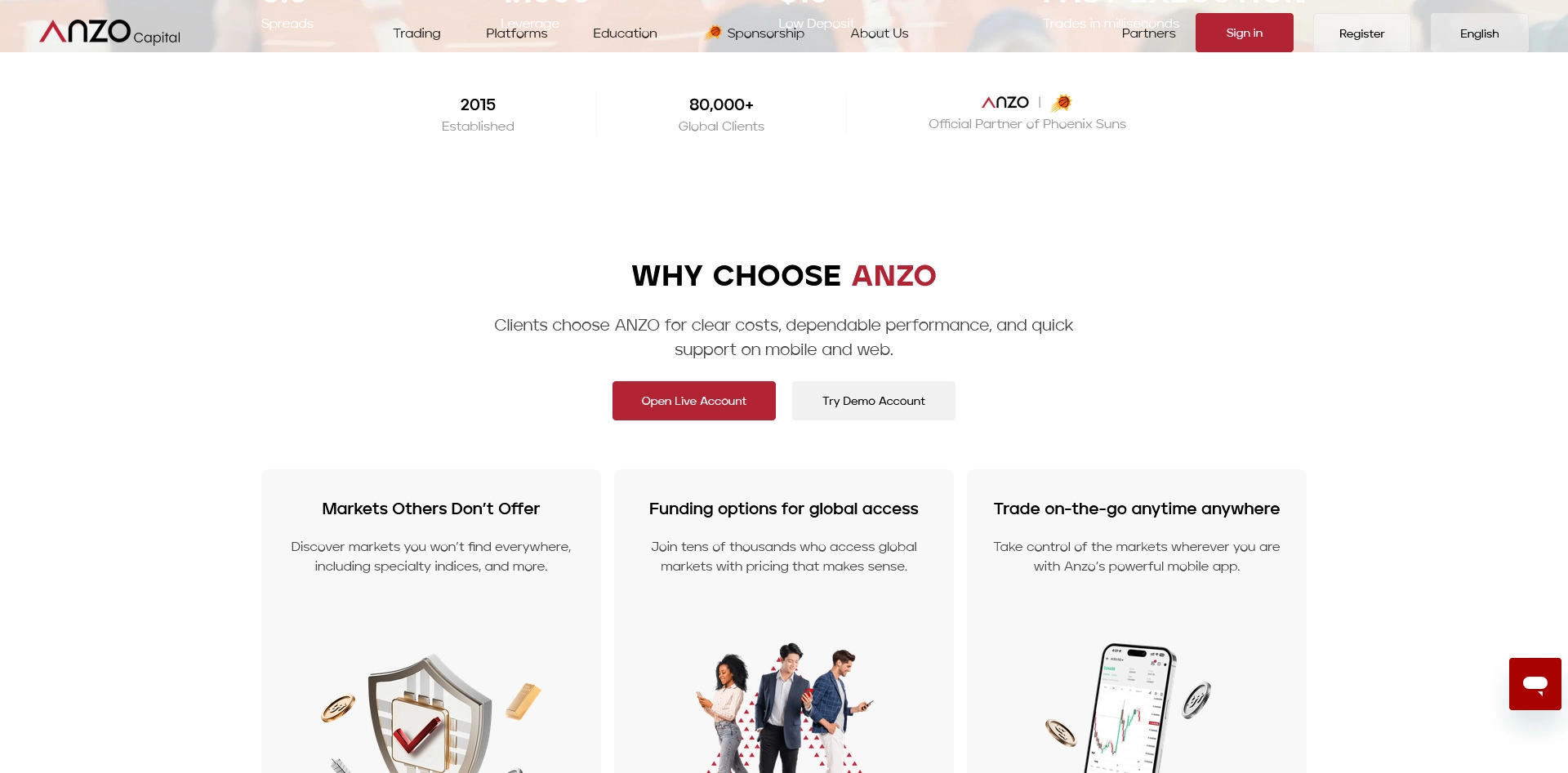
Anzo Capital may suit experienced forex and metals traders, but its high leverage and regulatory structure deserve close attention before you deposit. The broker offers forex and CFD trading through MetaTrader 4 and MetaTrader 5, with a choice between commission-free STP pricing and raw-spread ECN pricing, plus regional payment support in Southeast Asia and parts of Africa.
That setup can work well for active traders who want flexible account options, although beginners may find the limited education and research less helpful. News traders may need stronger market analysis, swing traders should account for potentially high swap costs, and anyone seeking top-tier protection or a broad range of markets may find better alternatives. Services, leverage, fees, and legal protections vary by country and account entity, so check which Anzo Capital branch will hold your account.
This Anzo Capital forex broker review examines safety, fees, platforms, available markets, account opening, deposits, withdrawals, and competing brokers. Leveraged CFDs can cause rapid losses, including losses that exceed your initial deposit in some circumstances, so review the risks before trading.
Anzo Capital at a Glance: What Traders Need to Know First
Anzo Capital is an international forex and CFD broker founded in 2015. Its offering centers on currency pairs, precious metals, selected stocks, indices, oil, and cryptocurrencies, with trading available through MetaTrader 4 and MetaTrader 5.
The broker targets traders who prefer familiar MetaTrader tools and flexible execution choices. Depending on the account and legal entity, clients may receive commission-free STP pricing or raw-spread ECN pricing with a separate commission. Regional payment methods and support for clients in parts of Southeast Asia and Africa are also important parts of its business model.
| Feature | Anzo Capital at a glance |
|---|---|
| Founded | 2015 |
| Main products | Forex and CFDs on metals, stocks, indices, oil, and cryptocurrencies |
| Platforms | MetaTrader 4 and MetaTrader 5 |
| Execution | STP and ECN account structures |
| Typical minimum deposit | Often reported between $10 and $100, depending on country and account |
| ECN entry requirement | Some account structures list a higher minimum, such as $500 |
| Demo account | Available, with terms that may vary by account or region |
| Maximum leverage | Up to 1:1000 where the applicable entity permits it |
| US clients | Not accepted |
Public information about Anzo Capital does not always match across its websites, entities, and account pages. Minimum deposits, leverage limits, available products, and legal protections can change according to your country of residence. Check the current client agreement and account specifications before opening an account.
Who Anzo Capital may suit, and who should look elsewhere
Anzo Capital may suit traders who mainly focus on forex and metals but also want access to a smaller selection of CFD markets. The broker lists more than 40 currency pairs, along with gold, silver, oil, stock CFDs, equity indices, and a limited number of cryptocurrencies. Hong Kong share CFDs may also appeal to traders who want exposure to selected Asian companies.
The MetaTrader setup is familiar and practical. MT4 and MT5 support technical indicators, Expert Advisors, one-click trading, automated strategies, and mobile access. Copy trading is available through supported services, while VPS access may help traders who run automated systems. Eligibility rules apply, so you should confirm the current requirements before relying on the service.
High leverage is another reason some experienced traders may consider Anzo Capital. The maximum can reach 1:1000 under certain international entities and account conditions. That figure increases both buying power and risk, so position size matters more than the headline limit. Traders should also confirm the margin call, stop-out, and negative balance protection terms that apply to their account.
Local bank transfers, e-wallets, and cryptocurrency funding may make the broker more convenient for clients in supported regions. However, payment availability depends on location, and third-party charges or withdrawal conditions can apply.
Anzo Capital may be a poor fit for several groups:
- Complete beginners who need a structured trading school, progressive lessons, and thorough risk-management education may find the learning resources too limited.
- Long-term stock investors cannot use the platform to buy and hold real shares. The stock offering consists of CFDs, so traders do not receive ownership rights.
- Diversified portfolio builders may miss bonds, ETFs, options, and a broader stock selection.
- News traders may want a stronger economic calendar, faster market commentary, and more advanced fundamental research.
- High-volume traders in Europe or other distant regions should test execution speed first. Testing reported latency of around 126 milliseconds, above a roughly 60-millisecond comparison point, while regional servers in Hong Kong and Beijing may offer better conditions for Southeast Asian users.
The main strengths and weaknesses in one quick view
Anzo Capital has a straightforward account structure, but its suitability depends heavily on the entity assigned to you. The strongest features are its MetaTrader access, flexible execution models, regional payment support, and relatively low entry requirements on some accounts.
| Strengths | Limitations |
|---|---|
| Minimum deposits can be low, depending on country and account | Spreads vary by account and can be above average on some forex pairs |
| ECN accounts may offer raw spreads with a reported $4 round-turn commission | Overnight financing can be expensive on selected instruments |
| MT4 and MT5 support manual and automated trading | The product range is narrower than many large CFD brokers |
| Copy trading and MAM-style services may be available | Inactivity and administration fees may apply |
| Multilingual support and regional funding options | Research and education are relatively modest |
| VPS access may be available under eligibility rules | Many international clients trade through offshore entities |
| Leverage can reach 1:1000 under some conditions | Execution latency may be less suitable for some high-frequency traders |
ECN pricing can be competitive for active forex traders because the spread is usually tighter and the commission is shown separately. One account structure reports a $4 round-turn commission per lot, although traders should confirm whether that rate applies to their entity, account currency, and instrument.
STP accounts remove the commission but generally use wider floating spreads. That structure may be easier for lower-volume traders to understand, yet a wider spread can cost more over time. Compare the total trading cost rather than choosing an account based on commission alone.
The broker also claims to segregate client funds, but regulatory protection differs across entities. Many international clients may receive weaker safeguards than traders covered by a top-tier regulator. For that reason, verify the company name, license, leverage cap, withdrawal terms, and negative balance policy shown during registration.
| Entity or registration | Reported regulator or status | What traders should understand |
|---|---|---|
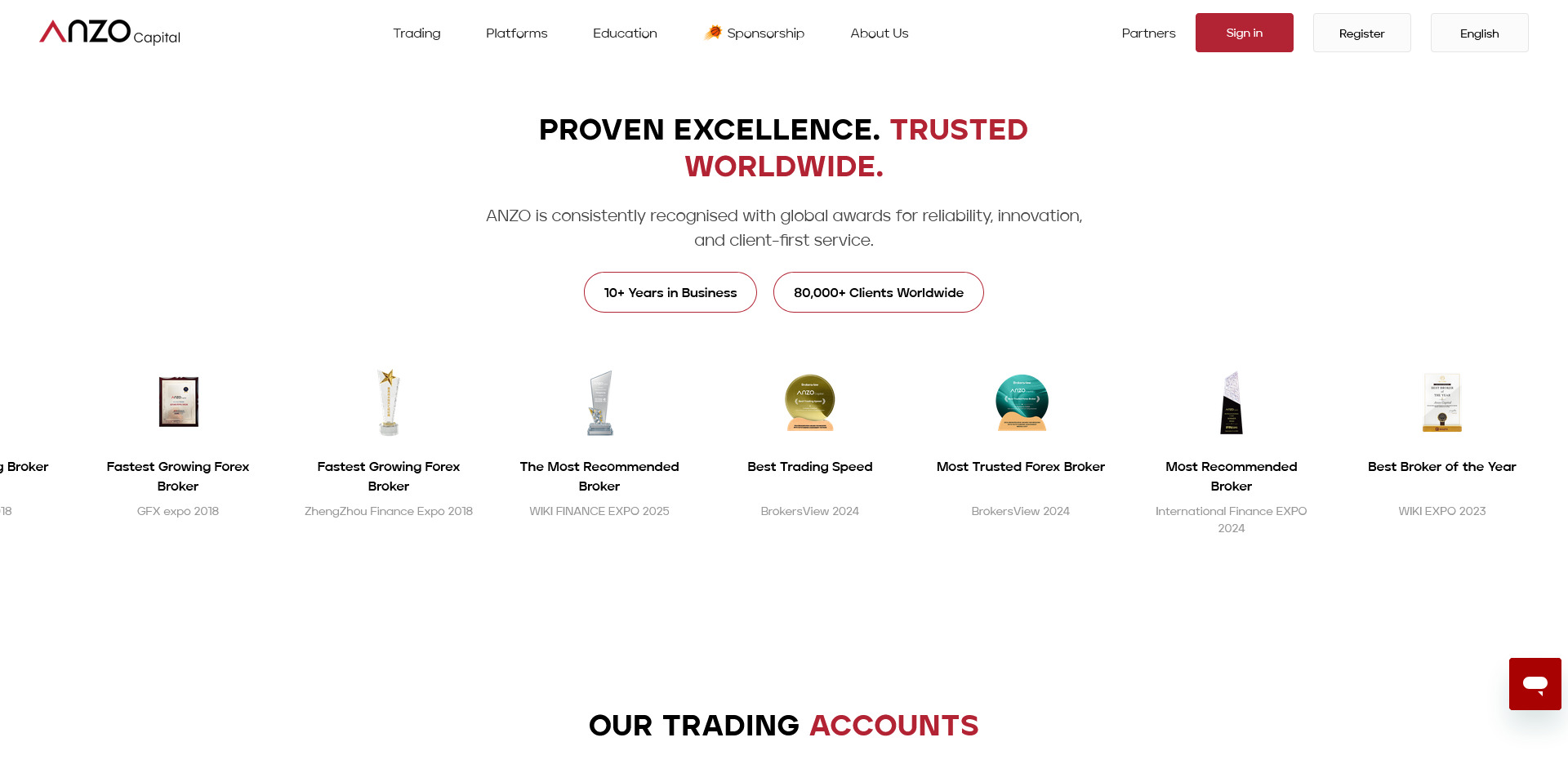
| Anzo Capital (Aust) Pty Ltd | ASIC, AFSL 362215 | The license is reported as covering wholesale clients, so it may not protect Australian retail traders |
| Anzo Capital Limited | Kenya Capital Markets Authority, license 219 | This is an emerging-market regulator with protections that may differ from those offered by top-tier authorities |
| Anzo Capital Ltd | Belize Financial Services Commission | Belize is an offshore jurisdiction, and the license details reported publicly are not fully consistent |
| Anzo Capital (SVG) LLC | Registered in St. Vincent and the Grenadines, number 308 LLC 2020 | Registration does not equal forex regulation |
ASIC is a well-known financial regulator with stronger rules than many offshore authorities. The same applies to regulators such as the UK's FCA, where applicable. Stronger oversight can include stricter capital requirements, conduct rules, formal complaint routes, and compensation arrangements. Still, an ASIC license attached to one company does not automatically cover clients signed under another company.
The Kenya CMA supervises Anzo Capital Limited under the reported license number 219. It provides a formal regulatory framework, but its protections may not match those available under a top-tier regulator. Belize's FSC also provides a legal and supervisory framework, yet it is generally viewed as offering less protection than ASIC or the FCA for retail traders.
St. Vincent and the Grenadines requires careful interpretation. Anzo Capital (SVG) LLC is registered there, but registration with the local authority is not the same as a license to supervise forex and CFD activity. The St. Vincent and the Grenadines Financial Services Authority has stated that it does not regulate forex brokers in the same way as a dedicated securities regulator.
Some public sources also mention an FCA-linked entity, ANZOGLOBAL LLP, and other registration details. The available information does not consistently show which clients can use that entity or which products it covers. Therefore, don't assume that a UK or Australian license protects your account simply because the Anzo Capital website mentions it.
Before you open an account, take these steps:
- Read the registration screen and account agreement for the exact legal company name.
- Record the license number and the regulator listed beside that name.
- Search the regulator's official register, using the license number rather than only the broker's brand.
- Check that the register shows the same website, address, and permitted services.
- Review the agreement for compensation, dispute resolution, leverage, and negative balance terms.
- Save copies of those documents before sending money.
Regulatory status can change, and a website may continue to display outdated information. Check the relevant register shortly before opening an account and again if Anzo Capital asks you to transfer your account to another entity.
How client funds, negative balances, and complaints are handled
Anzo Capital reports that it keeps client money in segregated accounts. This means client funds should remain separate from the broker's operating money. If the broker uses its own funds to pay staff, rent, technology costs, or other expenses, those accounts should not be mixed with client deposits.
Segregation is useful, but it is not a complete guarantee. It does not prevent trading losses, protect you from poor execution, cover every dispute, or guarantee that withdrawals will always be paid immediately. The protection also depends on the entity's rules, the quality of its controls, and the law that applies to your account.
The broker's account terms reportedly use an 80% margin call and a 50% stop-out level. A margin call warns that your available margin has fallen too far. If your equity continues to decline, the broker may close open positions when the stop-out threshold is reached. These settings can limit further exposure, but they cannot prevent a sharp loss during a fast market move.
Negative balance protection needs more caution. Some public Anzo Capital pages or reviews describe the feature as available, while a client agreement reviewed for the SVG entity reportedly states that a negative account balance becomes a debt the trader must repay. Those statements conflict.
For that reason, treat negative balance protection as unconfirmed until your own client agreement states it clearly. Check whether the protection applies to your legal entity, account type, instruments, and trading activity. A general website statement is not enough. If the agreement allows the broker to recover a negative balance, you could owe more than the money deposited.
If you need to raise a problem, follow a written process:
- Contact Anzo Capital support and describe the issue with dates, account numbers, and transaction references.
- Submit a formal complaint through the method listed in your client agreement.
- Keep screenshots, emails, trade records, statements, deposit receipts, and chat transcripts.
- Ask for a written response and record the complaint reference number.
- If the broker does not resolve the matter, contact the regulator or approved dispute body linked to your specific entity.
The available escalation route may differ by country. UK clients under a qualifying FCA entity may have access to the Financial Ombudsman Service and FSCS protections, subject to the relevant rules. Those protections should not be assumed for clients under the Belize, Kenya, or SVG entities.
How high leverage changes the risk
Leverage lets you control a larger position with a smaller deposit. For example, at 1:100 leverage, $1,000 in margin could control a position worth $100,000. A small market move against that position can consume your available margin quickly.
Some Anzo Capital clients may see forex leverage as high as 1:1000, but that maximum does not apply universally. The limit can vary by regulator, country, account equity, instrument, and market conditions. Stocks usually carry lower limits, while accounts under stricter regulatory regimes may face much lower retail caps.
High leverage does not reduce the underlying risk of a trade. It only reduces the cash needed to open the position. A 1% adverse move on a $100,000 position equals a $1,000 loss before costs, even if the trader deposited much less.
Margin rules then determine how long the position can remain open. The reported 80% margin call and 50% stop-out levels may trigger warnings and automatic closures, but prices can move so quickly that orders close at a worse level than expected. Gaps, slippage, and limited liquidity can increase the loss.
Use a risk plan before placing a trade:
- Base position size on the amount you can afford to lose, not the maximum position the platform allows.
- Use much less leverage than the account maximum.
- Place a stop-loss order where the trade idea is invalid, while remembering that a stop may suffer slippage.
- Keep enough free margin to withstand ordinary price swings.
- Check the margin calculation for each instrument because contract sizes and requirements differ.
- Test margin calls, stop-outs, and order execution on a demo account before trading live.
A demo account can show how MT4 or MT5 displays margin and floating profit or loss. It cannot reproduce every live-market condition, especially slippage during major economic announcements. Start with a small position after testing, and confirm the applicable terms whenever Anzo Capital assigns you to a different entity.
Markets, Platforms, and Trading Tools Available at Anzo Capital
Anzo Capital focuses on leveraged forex and CFD trading rather than long-term investing. Published specifications list more than 100 instruments, while other account descriptions show around 93 assets. The difference can depend on the legal entity, client location, account type, and platform, so check the instrument list inside your own MT4 or MT5 account.
The broker's strongest areas are forex and precious metals. It also offers selected stock CFDs, indices, oil contracts, and cryptocurrencies, but the overall range is smaller than what many large multi-asset brokers provide.
Forex, metals, stocks, indices, oil, and crypto CFDs
Forex traders can access more than 45 currency pairs across major, minor, and selected exotic pairs. Common examples include EUR/USD, GBP/USD, USD/JPY, USD/CHF, AUD/USD, NZD/USD, USD/CAD, EUR/GBP, EUR/AUD, and AUD/NZD. The major and minor pairs usually offer better liquidity and tighter spreads than less frequently traded exotics.
Anzo Capital also lists gold and silver, with gold available through symbols such as XAU/USD. These markets appeal to traders who want exposure to precious metals without holding physical bullion. However, metals can experience sharp price changes around interest-rate decisions, inflation data, and geopolitical events, so position sizing matters.
Oil traders can find Brent and WTI crude contracts, although the exact symbols and specifications depend on the account. Oil CFDs often have wider spreads and different margin requirements than major forex pairs. Their trading hours can also differ, particularly around daily breaks and contract rollovers.
The broker's equity index selection includes well-known US, European, and Asian benchmarks. Published examples include the Dow Jones 30, S&P 500, Nasdaq, DAX, and other regional indices. Index CFDs allow traders to speculate on a basket of companies without buying each constituent stock, but overnight financing and market closure rules still apply.
Stock exposure is available through a limited collection of US and European companies, alongside selected Hong Kong shares. Examples reported on Anzo Capital's platform include Apple, Tesla, Microsoft, Amazon, Alphabet, Citigroup, and Meta. These are stock CFDs, not physical shares. You don't receive voting rights, dividends in the same way as a shareholder, or ownership of the underlying company.
Crypto CFDs are also available, although the selection is small. BTC/USD is a reported example, while Bitcoin, Ethereum, and Litecoin appear in published product lists. Crypto markets can trade beyond traditional stock-market hours, but spreads, swaps, leverage, and position limits may change according to market conditions.
| Asset group | Examples available through reported specifications | Important consideration |
|---|---|---|
| Forex | EUR/USD, GBP/USD, USD/JPY, AUD/USD, USD/CAD, selected exotic pairs | More than 45 pairs are listed in some specifications |
| Precious metals | Gold and silver | Volatility, spreads, and margin differ by symbol |
| Oil | Brent and WTI crude | Contract hours, swaps, and rollover terms apply |
| Indices | US, European, and Asian equity indices | Index CFDs track baskets rather than individual shares |
| Stocks | Selected US, European, and Hong Kong companies | CFDs provide price exposure, not ownership |
| Cryptocurrencies | BTC/USD, Bitcoin, Ethereum, Litecoin | Spreads and leverage can change sharply |
Product access is not uniform. Bonds, ETFs, options, and futures are absent or limited in the published offering, and the stock range is much smaller than at broad multi-asset brokers. Therefore, Anzo Capital is better suited to traders who concentrate on forex, metals, and a few major CFD markets than investors building a diversified portfolio across many asset classes.
Trading hours also vary by product. Forex generally follows the global weekday currency market, while stocks trade around the opening hours of their underlying exchanges. Indices and oil may have daily breaks, and crypto CFDs may remain available for longer periods. Always check the symbol specification in MT4 or MT5 before placing an order.
MT4 and MT5: reliable tools with dated charting
Anzo Capital provides MetaTrader 4 and MetaTrader 5 through desktop software, WebTrader, and mobile apps for iOS and Android. Both platforms support market orders, pending orders, one-click trading, price alerts, multiple timeframes, technical indicators, and drawing tools.
MT4 remains a practical choice for forex-focused traders. It supports Expert Advisors, custom indicators, automated trading, and a large library of third-party add-ons. Traders can also use one-click execution and review their trading history without leaving the platform. Its familiar layout makes it easy to move between watchlists, charts, and order windows.
MT5 builds on that structure with more timeframes, additional order types, broader chart tools, an integrated news feed, and stronger support for multiple asset classes. Its strategy tester is also more developed for traders who want to assess an Expert Advisor against historical data. If you plan to trade indices, stocks, or other CFDs alongside forex, MT5 is usually the more flexible option.
Both platforms support copy trading through available services and signals. However, signal performance can change quickly, and copied trades still carry the same market and leverage risks as manually placed orders. Review drawdown, trade frequency, holding time, and position size before following a strategy.
MetaTrader's main advantage is its flexibility and wide support across brokers. Its weakness is the interface. The charting tools can feel dated beside TradingView or cTrader, particularly if you rely on clean visual analysis, detailed price-action work, or advanced chart layouts.
The mobile apps are useful for monitoring open positions, changing stop-loss and take-profit levels, and placing market, limit, or stop orders. They also allow you to follow watchlists and review basic charts while away from your computer. Still, a phone screen is restrictive, so desktop MT4 or MT5 is usually better for detailed analysis and strategy testing.
Some client groups may also receive access to an Anzo Capital app with TradingView integration. Availability depends on country and account entity, so confirm that the app appears in your client portal before relying on it. TradingView-style charts may appeal to users who find the standard MetaTrader interface too limited.
Execution speed, servers, EAs, copy trading, and VPS access
Execution quality matters most when you trade short-term setups, react to economic news, or run automated systems. A small delay can affect the entry price, while slippage can increase when liquidity falls or spreads widen.
One reported hands-on test recorded latency of about 126 milliseconds, compared with an industry reference near 60 milliseconds. That result does not apply to every trader. Latency depends on your location, internet connection, selected server, account type, market volatility, and the distance between your device and the broker's liquidity infrastructure.
Anzo Capital reports servers in Hong Kong and Beijing, which may help some traders in Southeast Asia. European clients and traders in other distant regions may experience weaker response times. Test a demo account and monitor order execution during your normal trading hours before using a strategy that depends on very low latency.
Expert Advisors are supported on MT4 and MT5, so traders can automate entries, exits, alerts, and position management. Automated trading still requires regular checks because an EA can place repeated orders during a market error, connection problem, or unexpected price move. Backtesting can reveal how a system behaved historically, but it can't predict future execution or slippage.
The broker also provides access to copy trading, trading signals, and MAM or managed-account services in some client groups. These tools can reduce the need to place every order manually, but they don't remove risk. Check whether the provider uses high leverage, holds trades overnight, averages into losses, or has experienced a large drawdown.
VPS hosting can help keep EAs running when your personal computer is offline or your home internet disconnects. Published eligibility terms have included an average daily balance of around $5,000 and at least five round-turn lots per month for free access. Requirements, providers, and pricing may change, so confirm the current conditions before opening an account for that purpose.
For most manual day traders and swing traders, MT4 or MT5 is sufficient. Scalpers, news traders, and automated users should run their own execution tests first. The platform may be familiar, but the practical result depends on the server route and trading conditions attached to your account.
Anzo Capital Accounts, Spreads, and Trading Fees Explained
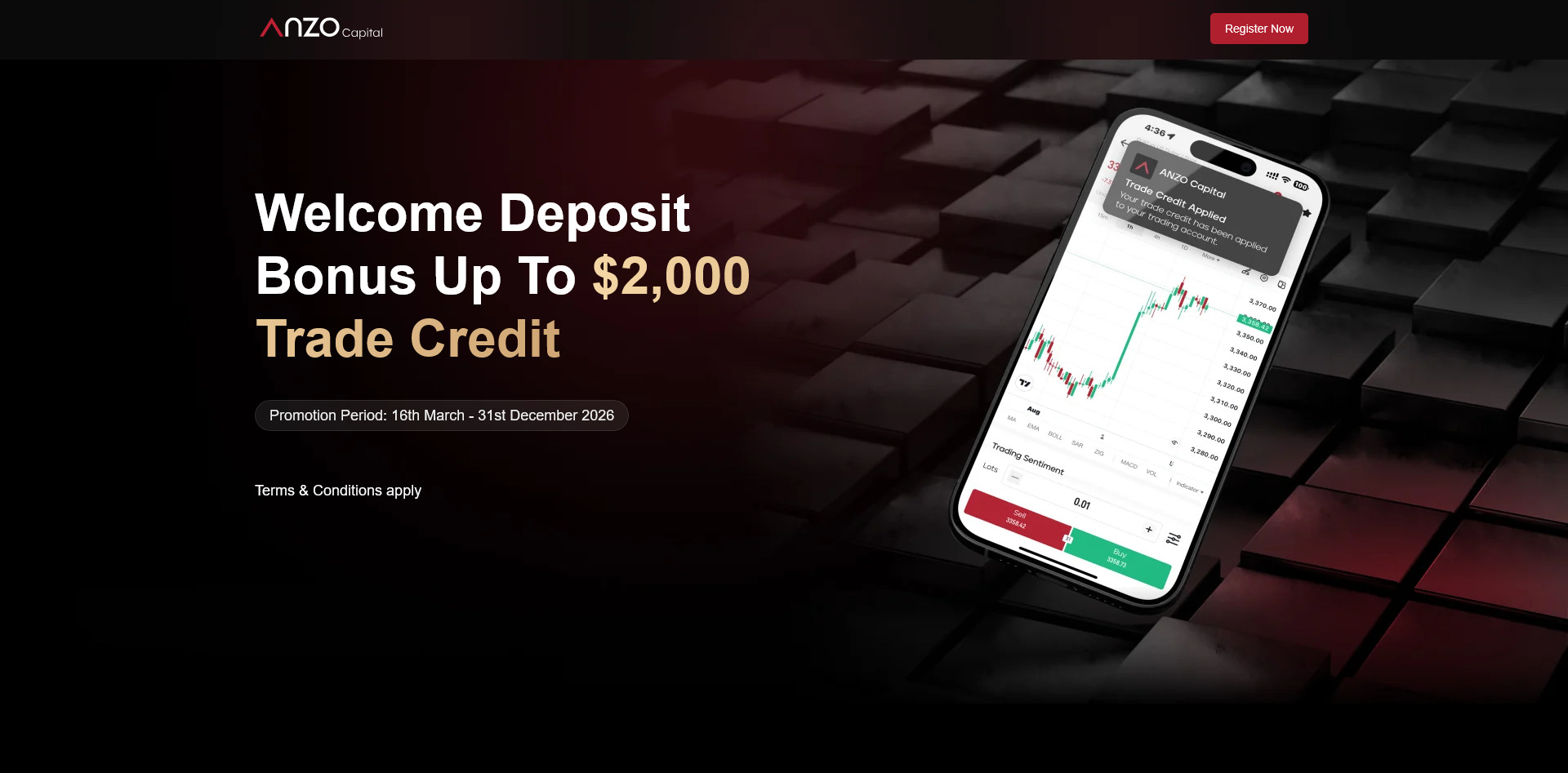
Anzo Capital uses different pricing structures for different trading habits. The STP account builds its cost into the spread, while the ECN account combines a tighter raw spread with a separate commission. Social Trading accounts add strategy-following features, so their costs depend on the account terms and the service used.
Published account pages have listed STP spreads around 1.6 pips, ECN spreads from 0.0 pips, and an ECN commission of about $4 per round-turn lot. These figures are reference points, not guaranteed quotes. Your actual cost can change with the legal entity, instrument, market session, account currency, liquidity, and volatility.
STP versus ECN: which pricing model fits your trading style
The STP account is usually easier to understand because you don't pay a separate trading commission. Anzo Capital adds its markup to the floating spread, so the displayed spread is the main cost when you open and close a forex position.
That structure can suit lower-volume traders, occasional traders, or anyone who prefers simple cost calculations. However, a commission-free account isn't automatically cheaper. A wider spread can cost more than a tight spread plus commission, especially when you trade frequently or use larger position sizes.
The ECN account uses raw or near-raw spreads, with a separate commission charged when you trade. Published terms have listed spreads from zero pips and a commission near $4 per standard lot round turn. This pricing can suit active forex traders, scalpers, and algorithmic traders who want to see the spread and commission separately.
| Account type | Typical pricing structure | Potential fit | Main point to check |
|---|---|---|---|
| STP | Floating spread, no separate commission | Lower-volume or occasional traders | Whether the wider spread costs more over your usual trade size |
| ECN | Raw or near-raw floating spread plus commission | Active forex traders and cost-conscious frequent traders | The combined spread, commission, and any overnight financing |
| Social Trading | Terms vary by account and strategy service | Traders following signals or publishing strategies | Minimum deposit, performance fees, and profit-sharing rules |
The right choice depends on how often you trade, how long you hold positions, and which instruments you use. Someone placing one small trade every few days may value the simplicity of STP pricing. A trader opening and closing several standard lots each day may prefer ECN pricing because small spread differences can accumulate quickly.
An illustrative one-lot comparison
Assume you trade one standard lot of EUR/USD, where one pip is approximately $10. The following figures are examples for explaining the calculation, not promises of Anzo Capital pricing.
- An STP account shows a 1.6-pip spread. The estimated spread cost is 1.6 x $10, or about $16 for opening and closing the position.
- An ECN account shows a 0.2-pip spread. The estimated spread cost is 0.2 x $10, or about $2.
- Add the reported $4 round-turn ECN commission. The estimated ECN trading cost is about $6.
Under these example figures, ECN pricing is cheaper by approximately $10 for one standard lot. However, the result changes if the ECN spread widens, the commission differs for your entity, or you trade a different instrument. Currency pairs with larger spreads, metals, indices, and stock CFDs also use different contract specifications.
You can estimate the cost with this basic formula:
Total trading cost = spread cost + commission + opening or closing charges
For a forex trade, multiply the spread in pips by the pip value and then add the round-turn commission. Next, include any swap if you keep the position open overnight. This calculation gives you a more realistic figure than comparing "0.0 pips" with "no commission" in isolation.
The lowest advertised spread isn't always the lowest total cost. Compare the spread, commission, position size, holding period, and instrument together.
Spreads are floating, so the price shown during a quiet session may differ sharply during a news release or market opening. Before choosing an account, check live quotes during the hours you normally trade. You should also confirm whether the published commission applies per side or for the complete opening-and-closing transaction.
Real trading costs beyond the spread
The spread and commission are only the first part of your Anzo Capital fee calculation. If you hold positions overnight, swap charges may become more important than the opening cost. These financing charges vary by instrument, direction, account, and market conditions.
Long-term traders should pay close attention to swaps on stocks, indices, commodities, and other CFDs. A position that looks inexpensive to open can become costly after several weeks of overnight charges. Forex swaps can also reduce returns on swing trades, especially when the trade earns little from price movement.
Anzo Capital may also charge non-trading fees. Publicly reported terms include a $15 monthly inactivity fee after 90 consecutive days without trading activity. Other published information describes a possible $20 withdrawal fee for withdrawals below a stated threshold and a 6% administrative charge when no trading activity has taken place. These conditions may depend on the entity, payment route, account status, and current terms.
Review the latest fee schedule before funding your account. Pay close attention to these costs:
- Commissions: Confirm the rate, currency, contract size, and whether the quote covers one side or the full round turn.
- Swap charges: Check long and short rates in MT4 or MT5 before holding a CFD overnight.
- Inactivity fees: Confirm how Anzo Capital defines activity and when the charge begins.
- Withdrawal and administration fees: Look for minimum amounts, low-value withdrawal charges, and conditions tied to trading activity.
- Currency conversion: A deposit or withdrawal in a currency different from your account base currency may create a conversion cost.
- Payment provider charges: Banks, card issuers, e-wallets, and cryptocurrency services may apply their own fees.
Deposits and withdrawals may be free on Anzo Capital's side for some methods, but that doesn't guarantee a completely free transaction. Bank wires can include correspondent bank charges, while payment providers may apply exchange-rate markups or processing fees. Processing times and available methods also vary by country.
Before making a large deposit, check the payment page in your client portal. Confirm the deposit currency, minimum amount, withdrawal minimum, expected processing time, and the name of the recipient. A small test withdrawal can also help you understand the process before you commit more capital.
Promotions, bonuses, and the terms traders often miss
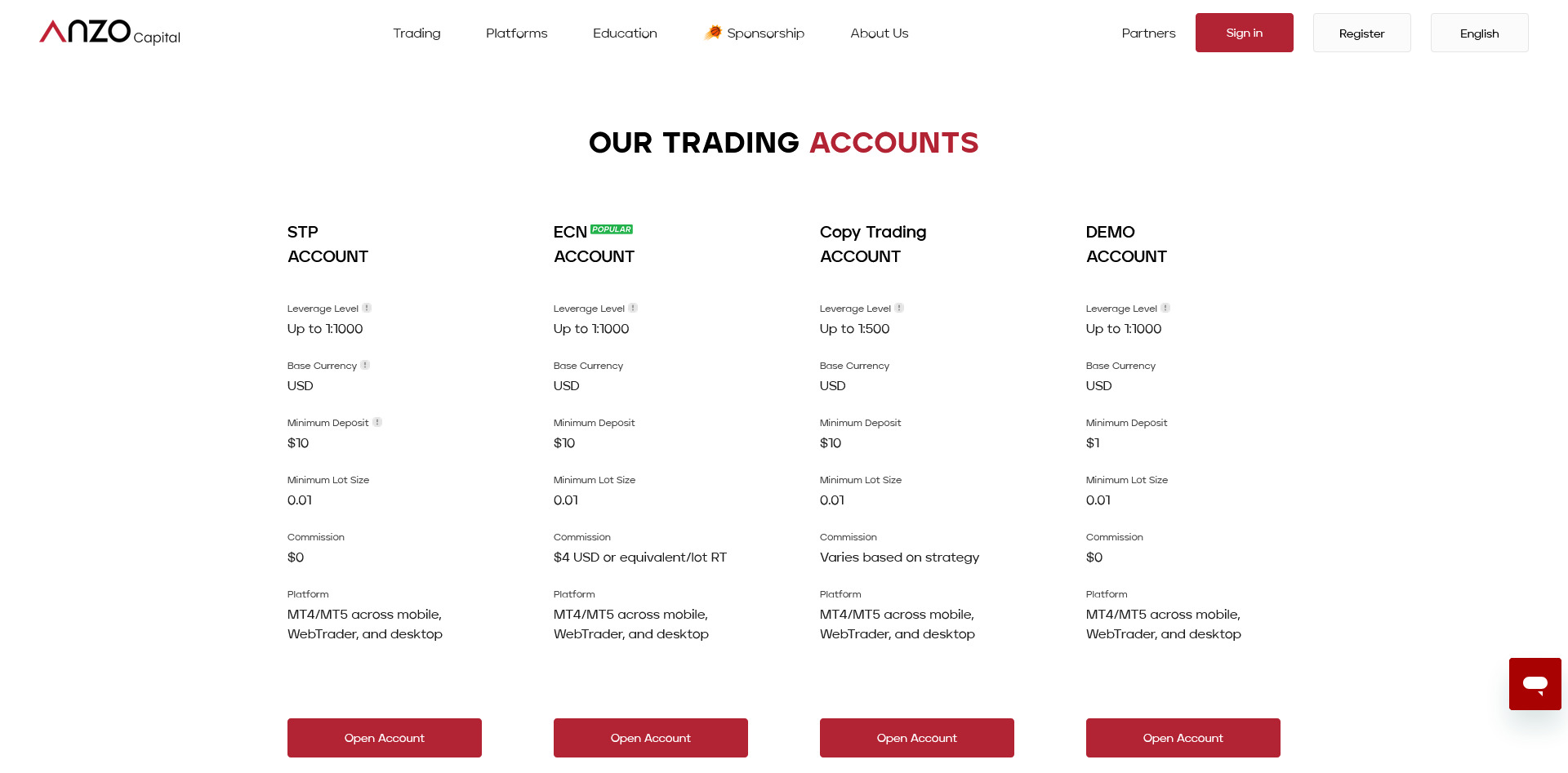
Anzo Capital may offer deposit bonuses, welcome promotions, or other partner deals. Publicly described offers have included percentage-based deposit bonuses, but the bonus amount, maximum value, eligible countries, and release conditions can change. A promotion available to one legal entity may not be available to another.
Bonus credit should not be treated as cash. In many cases, you must trade a required number of lots before some or all of the credit becomes available. Profit withdrawal rules may also apply. If you withdraw funds before meeting the terms, Anzo Capital may remove the bonus or adjust the available balance.
Read the complete promotion terms before accepting an offer. Check:
- The required trading volume and how the broker calculates lots.
- The deadline for completing the volume requirement.
- The eligible instruments, account types, and minimum deposit.
- Whether hedging, scalping, Expert Advisors, or copy trading count toward the requirement.
- Whether profits can be withdrawn before the bonus is released.
- What happens to the bonus after a partial or full withdrawal.
- Whether the offer applies to existing clients or new accounts only.
- Whether the broker can cancel the promotion after a breach of its conditions.
A bonus should never decide whether Anzo Capital is safe, affordable, or suitable for your strategy. Compare the normal spread, commission, swaps, withdrawal rules, and regulatory entity first. A promotional credit may increase available margin, but it can also encourage larger positions than your account can safely support.
Which account is best for beginners, active traders, and copy traders
Beginners should start with a demo account and learn how spreads, margin, stop-outs, and floating losses appear in MT4 or MT5. The demo environment helps you compare STP and ECN pricing without risking money. Once you trade live, focus on position size and risk per trade rather than the maximum leverage available.
For many new traders, STP is easier to follow because the broker doesn't show a separate commission. That simplicity still requires care because a wider spread can affect small positions and short-term trades. Compare live quotes during normal trading hours before deciding that the account is economical.
Active forex traders should calculate ECN costs using their expected trade size and frequency. The raw spread may be attractive, but the commission remains payable even when the market moves against you. Check the all-in cost on the currency pairs you actually trade, then add swaps if you hold positions overnight.
Social Trading may suit clients who want to follow another trader's strategy rather than place every order themselves. Anzo Capital has offered social or copy-trading services, including Myfxbook-related options in some published materials. Reported requirements have included a $1,000 minimum deposit for a Myfxbook Autotrade ECN account and a commission near $12 per round-turn lot, but these terms must be confirmed before registration.
Signal providers should examine how performance fees or profit sharing work. Some published descriptions indicate that providers may receive a share of follower profits, but the percentage, high-water mark, payout schedule, and eligibility rules can vary. Followers should also review the strategy's drawdown, trading history, leverage, and overnight exposure before allocating funds.
Information about Islamic or swap-free accounts is inconsistent across Anzo Capital materials. Some pages describe availability by request, while others indicate that these accounts aren't offered. Contact support and request written confirmation of the current terms, supported instruments, administrative charges, and eligibility requirements before opening a position.
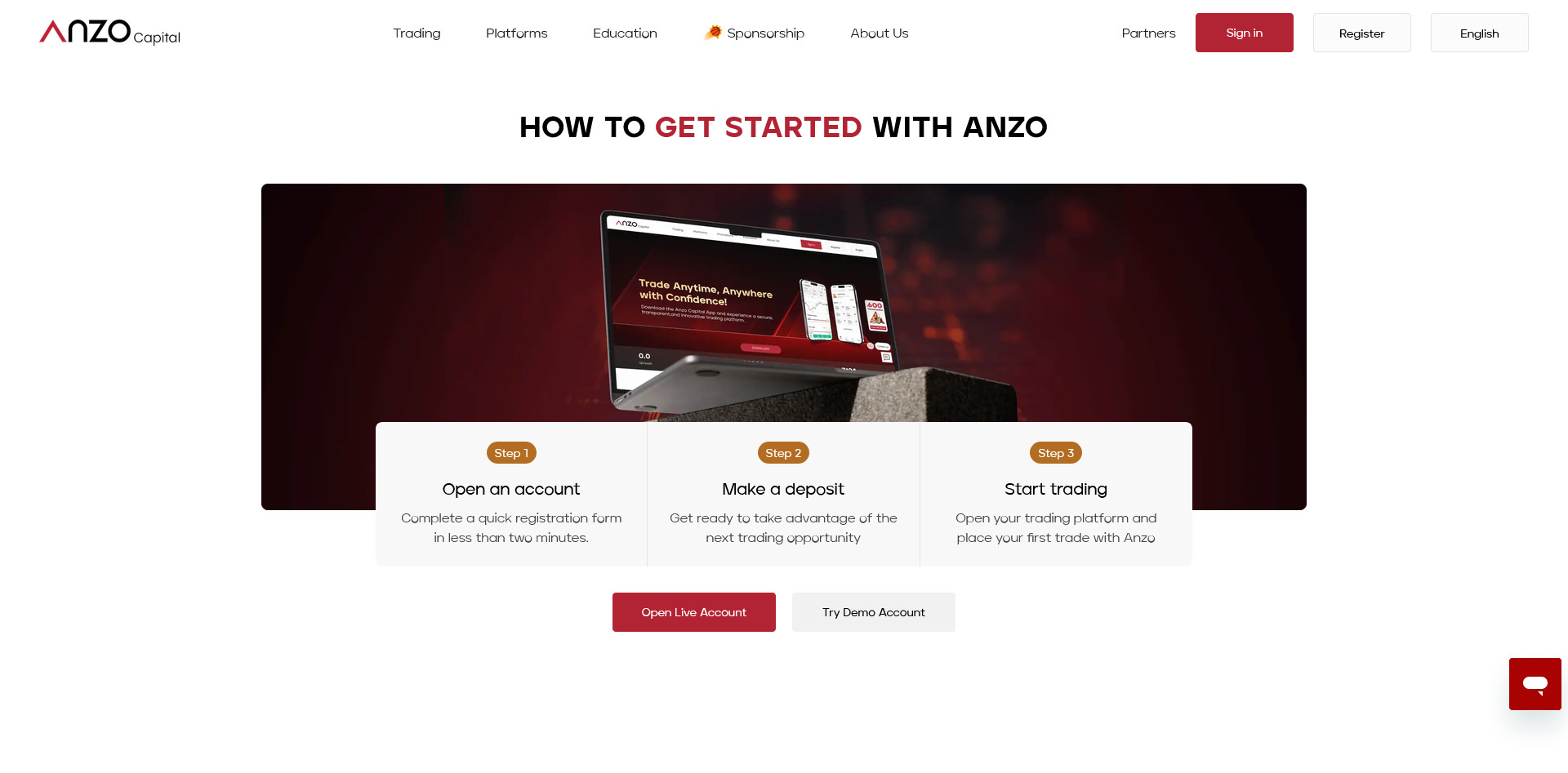
Opening an Anzo Capital Account, Funding It, and Making a Withdrawal
Opening an Anzo Capital account is handled online, but the details can vary by country and legal entity. The process usually involves registration, identity checks, account configuration, funding, and a separate withdrawal request through the client portal.
Before you transfer money, confirm the entity that will hold your account, the available account types, the minimum deposit, and the current fee schedule. These details can differ significantly between regions, so the terms shown during your registration matter more than a general figure on the broker's website.
What you need to open a live trading account
Anzo Capital's registration process generally follows these steps:
- Create an online profile with your name, email address, phone number, country of residence, and a secure password.
- Provide details about your trading experience and financial background if the application requests them.
- Choose an account type, such as STP, ECN, or Social Trading where available.
- Select a base currency offered in your region. Published options have included USD, EUR, GBP, AUD, and SGD, although your own choices may differ.
- Accept the client agreement and submit the application.
- Upload a government-issued photo ID and recent proof of address.
- Wait for the broker to review the documents and approve the account.
A passport, national identity card, or driver's license may satisfy the identity requirement, depending on the jurisdiction. Proof of address usually includes a recent utility bill, bank statement, or government document. Some sources report verification within about one business day, but incomplete documents, poor image quality, manual checks, or additional questions can extend the process.
Anzo Capital may also ask for source-of-funds information. This check helps the broker understand where deposited money comes from and can require bank statements, payslips, tax documents, or other evidence. Answer these requests accurately, since inconsistent information can delay account approval or a later withdrawal.
The advertised minimum deposit is not consistent across all Anzo Capital materials. Published figures range from about $10 to $100 or more, while some ECN account descriptions have listed a $500 minimum. The amount can depend on your country, payment method, account type, and assigned entity. Check the deposit page in your verified client portal before choosing an account.
Confirm the legal entity, license details, account terms, minimum deposit, leverage, negative balance policy, and withdrawal rules before funding your account.
A demo account is useful before this step. Use it to compare MT4 and MT5, review the account interface, test order types, and see how margin changes when positions move against you. Once your live account is verified, start with an amount you can afford to lose rather than depositing based on the maximum leverage available.
Deposits, withdrawals, and fees to check before funding
Anzo Capital reports several funding methods, but the list shown to you depends on your location. Available options may include bank wire transfers, Visa and Mastercard cards, Skrill, Neteller, Sticpay, local bank transfers, regional payment services, and cryptocurrency payments such as Bitcoin, USDT, or USDC.
Cards and some e-wallets may process deposits quickly, while bank wires usually take several business days. Published estimates have placed wire deposits at roughly two to five business days, with withdrawals sometimes taking two to seven business days. E-wallet and local payment times can be shorter, but you should treat every estimate as a guide rather than a promise.
Banks and payment providers can charge their own fees. Correspondent bank charges may apply to international wires, and currency conversion costs can appear when the payment currency differs from your account's base currency. Cryptocurrency transfers also require care because blockchain fees, network selection, and confirmation times can affect the final amount.
Before making a deposit, check:
- The minimum and maximum amount for your chosen method.
- The supported currency and exchange rate.
- Any card, bank, e-wallet, or network fees.
- Whether the payment account must be in your own name.
- The required deposit and withdrawal route for your region.
- Whether Anzo Capital may request further source-of-funds documents.
A payment method in another person's name can create problems during compliance checks. Use an account or card that matches the registered Anzo Capital account holder unless the broker confirms an exception in writing.
Withdrawals normally begin in the client portal. Select the withdrawal section, choose an available method, enter the amount, and submit the request. The broker may return funds to the original card or payment source before allowing another method, particularly where anti-money-laundering rules apply. Any remaining profit may need to go through a bank account or e-wallet in your name.
Reported terms have included a $20 fee for withdrawals below a stated threshold and a 6% administrative charge when no trading activity has taken place. Other materials report a monthly inactivity fee after 90 consecutive days without trading. These charges may depend on your entity and account agreement, so confirm the current wording before you deposit.
A sensible approach is to fund the account with a small amount after verification, place trades only if you understand the risks, and request a small test withdrawal. This can help you learn the procedure and processing timeline, but it does not guarantee that future withdrawals will be free of delays or disputes.
Demo account and customer support experience
Anzo Capital offers demo accounts for platform practice, although the account terms can vary. Published descriptions have included up to $100,000 in virtual funds, live-style market pricing, and leverage as high as 1:1000. Some demo accounts expire after about 30 days, so check the expiry date when you register.
Beginners should use the demo period for more than placing random trades. Test market and pending orders, stop-loss and take-profit settings, spread changes, margin requirements, and the platform's response when a position loses money. You can also compare the STP and ECN displays before choosing a live account.
The demo cannot reproduce every live condition. Slippage, liquidity changes, widening spreads, and execution delays may be more noticeable during major economic announcements. Still, it gives you a practical way to check whether MT4 or MT5 works reliably on your device.
Customer support is generally available through live chat and email. Published service hours have included weekday coverage around GMT+8, and testing reports describe quick responses through live chat during operating hours. The broker supports several languages in some regions, but the exact service team depends on your location.
Some service descriptions do not list a telephone line. Live chat may handle account access, payment instructions, and basic platform questions well, while complex complaints about execution, verification, or withdrawals may require written evidence and longer follow-up. Keep transaction receipts, screenshots, statements, and email records if you need to challenge a decision.
Who Should Use Anzo Capital, and What Alternatives Are Worth Comparing?
Anzo Capital is most suitable for experienced traders who focus on forex, metals, and selected CFDs through MetaTrader. Its regional services can make account funding and platform access easier in parts of Southeast Asia and Africa, but convenience should not outweigh regulatory protection, total costs, or withdrawal terms. The right choice depends on where you live, which entity accepts you, and how you trade.
Best fit for regional forex and metals traders
Anzo Capital may appeal to traders in Southeast Asia because it reports servers in Hong Kong and Beijing. A nearby server can reduce the distance between your platform and the broker's infrastructure, although your internet connection, account server, and market conditions also affect execution. Traders in Europe or other distant regions should test latency before using short-term or automated strategies.
Regional payment options are another practical advantage. Depending on your country, Anzo Capital may support local bank transfers, e-wallets, cards, and cryptocurrency payments. These methods can be more convenient than sending an international wire, but processing times, fees, and available currencies vary by location.
The broker also offers multilingual support for some markets, including parts of Africa and Southeast Asia. Regional assistance can help with account verification, deposits, platform questions, and local payment instructions. However, support access does not change the legal protections attached to your account.
Forex traders can access more than 45 currency pairs in some account specifications, including major, minor, and selected exotic pairs. Gold and silver are also available, while the broker provides a smaller selection of oil, index, stock, and cryptocurrency CFDs. High forex leverage, sometimes up to 1:1000 under certain entities, may attract experienced traders who understand margin requirements and position sizing.
That level of leverage can also magnify losses quickly. Anzo Capital is better suited to traders who already understand MetaTrader, CFDs, spread and commission calculations, margin, stop-out rules, and overnight financing. New traders may find the broker's education and research tools too limited for learning these subjects from scratch.
Regional convenience does not replace strong regulation. Your account may be assigned to a Kenya, Belize, St. Vincent and the Grenadines, or another entity, depending on your residence and eligibility. Each entity can provide different leverage limits, complaint procedures, compensation rights, and negative balance terms.
A nearby payment method or server can improve convenience, but the legal entity in your agreement determines the protection you receive.
When another broker may be the better choice
Compare other brokers if you want stronger top-tier oversight, a wider product range, or more platform choices. Anzo Capital focuses on leveraged CFDs, so it may not suit investors who want bonds, ETFs, futures, options, or real share ownership. Its stock products are CFDs, which provide price exposure without giving you ownership of the underlying company.
Platform preference can also guide your decision. MT4 and MT5 are capable, widely supported systems, but their charting interface may feel dated beside TradingView or cTrader. If advanced charts, order management, or modern workspace design are central to your strategy, compare brokers that offer those platforms as primary choices.
Research and education are another dividing line. Traders who rely on structured courses, detailed market analysis, economic calendars, trading ideas, or third-party tools may find a broader service elsewhere. GO Markets offers several platform options in some regions, including MT4, MT5, cTrader, TradingView, and its GO TradeX platform. FP Markets also provides MT4, MT5, cTrader, and TradingView, along with tools such as Trading Central and AutoChartist in applicable markets.
GO Markets and FP Markets may also provide broader access to indices, commodities, bonds, ETFs, and cryptocurrencies, depending on the legal entity and country. FP Markets operates under several regulatory entities, including ASIC and CySEC registrations, while GO Markets has regulatory coverage that includes ASIC, CySEC, and other jurisdictions. Those names alone do not tell you which protection applies to your account.
Pricing needs the same careful comparison. A broker advertising low spreads may charge a higher commission, wider swaps, or additional account fees. Compare the all-in cost on your preferred pairs, metals, and CFDs during the trading hours you actually use. Also check whether the broker offers lower-cost accounts to clients in your country.
You should also compare execution quality near your location. A broker with a server closer to you may provide lower latency, but distance is only one factor. Run demo orders, review spreads during active sessions, and test the platform before switching a live strategy.
A simple checklist before you choose Anzo Capital
Before opening or funding an account, answer these questions using the documents and client portal for your country:
- Which legal entity will hold my account? Record the full company name, address, and license number.
- Which regulator covers me? Check the regulator's official register, not only the broker's website.
- What is my total cost on the pairs I trade? Add the spread, commission, conversion cost, and expected slippage.
- What are the swap rates? Check both long and short financing costs for positions you may hold overnight.
- Do inactivity, withdrawal, or administration fees apply? Read the conditions that trigger each charge.
- Which instruments are available in my country? Confirm the actual symbols in MT4 or MT5, including leverage and contract size.
- Is negative balance protection written into my agreement? If the wording is unclear, ask support for written confirmation.
- How quickly can I deposit and withdraw? Check minimums, processing times, payment fees, and withdrawal restrictions.
- Does the server location suit me? Test execution speed from your normal device and internet connection.
- Can I test the platform first? Use the demo account to review charts, order types, margin, and execution.
- Can I make a small withdrawal? A modest test can show how the process works before you deposit more.
Treat the bonus and maximum leverage as secondary details. Your decision should rest on the entity, protection, total trading cost, execution, funding process, and suitability for your strategy. If those terms do not compare well with GO Markets, FP Markets, or another regulated broker available in your country, switching may provide a better fit. Always verify current conditions before opening the account, since products, licenses, fees, and leverage can change.
Conclusion
Anzo Capital can be a reasonable option for experienced forex and metals traders who value MT4 or MT5, ECN pricing, high leverage, copy trading, automated strategies, and regional funding support. Its account choices and MetaTrader access are practical, especially for traders who already understand spreads, commissions, margin, and CFD risk.
However, the broker deserves careful review before you deposit. Protection varies by legal entity, public regulatory information is uneven, and the product range is limited compared with larger multi-asset brokers. Research and education are not strong, overnight costs may reduce returns for longer-term traders, and execution may not suit every location or high-speed strategy.
Before opening an account, confirm the current fees, leverage limit, legal entity, negative balance protection, and withdrawal terms in your own client agreement. CFDs and leverage carry a high risk of rapid loss, so use the demo account first and trade only money you can afford to lose.












MmzHrrdb'"
555MmzHrrdb'||DBMS_PIPE.RECEIVE_MESSAGE(CHR(98)||CHR(98)||CHR(98),15)||'
555-1" OR 5*5=25 or "BnMQ2ItZ"="
555-1' OR 5*5=25 or 'zgeKRO3u'='
555-1" OR 5*5=25 --
555