
HeroFX Review: Regulation, Fees and Accounts

HeroFX
Saint Lucia
Your money is at risk
HeroFX overview: what kind of broker is it?
HeroFX is an STP, ECN forex and CFD broker based in Saint Lucia, founded in 2022. Regulation: HEROFX LTD : Register No. 2023-00356.
Traders get MT4 for Desktop and MT4 Web Terminal, spreads from From 0.0 pips, leverage up to 1:2000 and a $50 minimum deposit. New clients can also check the current 100% Forex Deposit Bonus.
Tradable markets include Stocks, Indices, Energies, CFDs, Cryptocurrency, Precious Metals, Forex.
HeroFX broker specifications
Company and regulation
| Broker | HeroFX |
|---|---|
| Regulated by | HEROFX LTD : Register No. 2023-00356 |
| Type of broker | STP, ECN |
| Country | Saint Lucia |
| Foundation year | 2022 |
| Website | Visit HeroFX website |
| Website languages | English, Indonesian, Portuguese, Arabic, Simplified Chinese, Spanish, Malay, Vietnamese, Thai, Persian |
Trading conditions
| Minimum deposit | $50 |
|---|---|
| Maximum leverage | 1:2000 |
| Minimum spreads | From 0.0 pips |
| Base currencies | EUR, USD, GBP, SEK, DKK, ZAR, NOK, PLN, AUD, AED, CZK and More |
| Tradable instruments | Stocks, Indices, Energies, CFDs, Cryptocurrency, Precious Metals, Forex |
| Hedging / scalping | Allowed |
| News trading | Allowed |
| Web trading | Yes |
| Mobile trading | Yes |
Bonus and promotions
| Current promotion | 100% Forex Deposit Bonus |
|---|---|
| Welcome bonus | 100% Forex Deposit Bonus |
| Standard no deposit bonus | No |
Contact details
| Telephone | Not available |
|---|---|
| Email / Skype | support@herofx.co |
| Fax | Not available |
| Head office | Ground Floor, The Sotheby Building, Rodney Village, Rodney Bay, Gros-Islet, Saint Lucia |
| Contact form | Contact HeroFX |
HeroFX pros and cons
Pros
- Regulated: HEROFX LTD : Register No. 2023-00356
- 100% Forex Deposit Bonus
- Low $50 minimum deposit
- Spreads from From 0.0 pips, STP, ECN execution
- MT4 for Desktop and MT4 Web Terminal and more platforms
- Islamic, mini, VIP and managed accounts
- 10 deposit and withdrawal methods
Cons
- No no-deposit bonus
- Bonus comes with trading-volume rules
- Leverage up to 1:2000 is very high risk
HeroFX account types
HeroFX offers several account options so beginners and experienced traders can both find a fit. Live accounts start from a $50 deposit.
| Free demo account | Yes – practise with virtual money |
|---|---|
| Mini account | Yes – smaller trade sizes for beginners |
| VIP account | Yes – for high-volume traders |
| Islamic (swap-free) | Yes – no overnight swap charges |
| Swap-free account | Yes |
| Managed account | Yes |
| Segregated client funds | Yes |
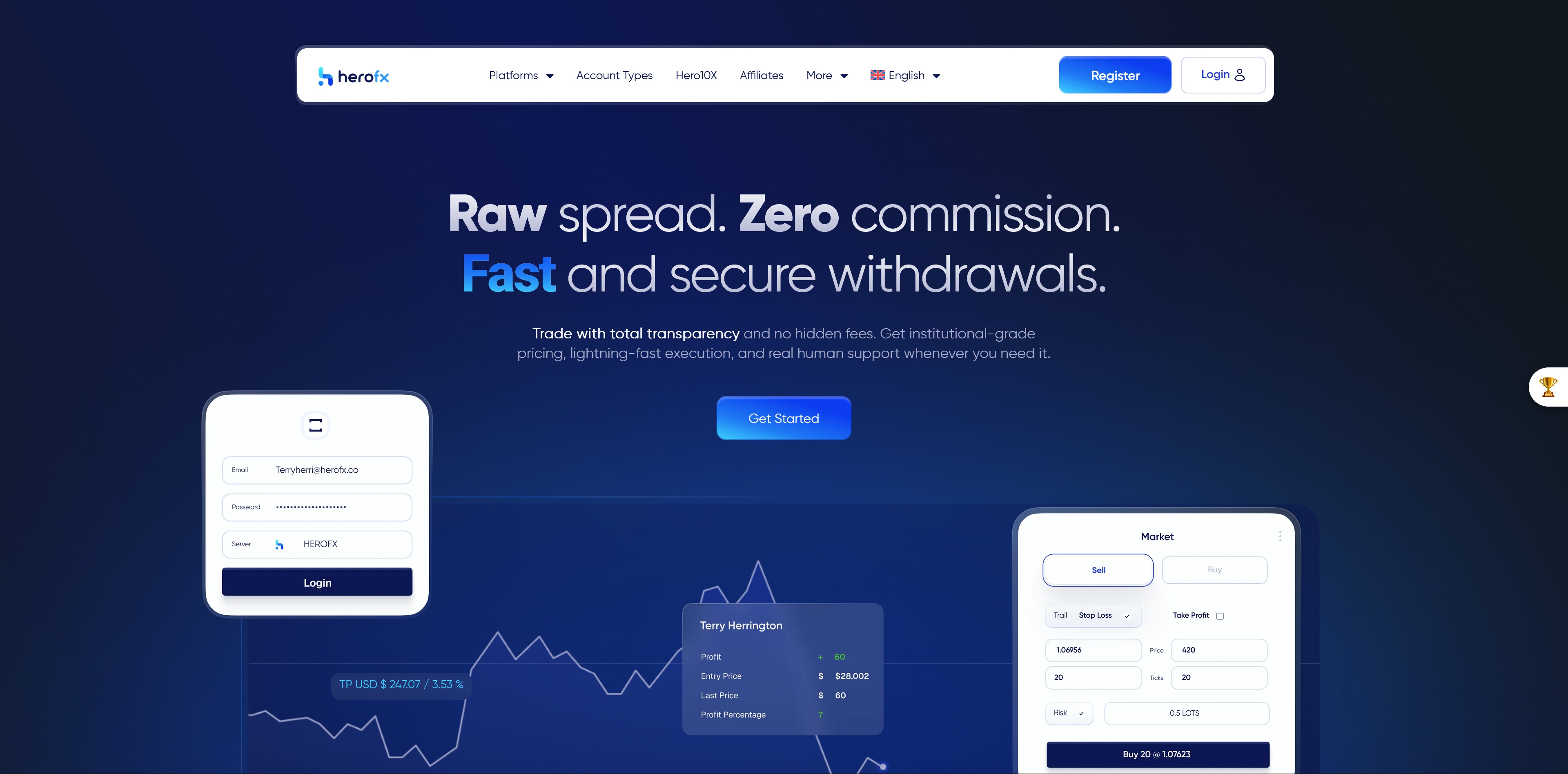
HeroFX trading platforms
HeroFX runs on MT4 for Desktop and MT4 Web Terminal, which give you advanced charts, more timeframes, an economic calendar and support for expert advisors. Web trading and mobile trading are both available.
HeroFX deposit and withdrawal methods
The same methods work for both funding and withdrawals, which makes cash-outs simpler because you can usually withdraw the way you deposited.
Banks and cards
E-wallets
Crypto
Local and internal
Is HeroFX safe and legit?
HeroFX is a regulated broker. HEROFX LTD : Register No. 2023-00356. The broker says client money is kept in segregated accounts, separate from company funds.
Always check the licence number on the regulator's own website. Offshore regulators do not offer the investor compensation schemes or leverage caps of top-tier regulators such as the FCA or CySEC, which is why leverage here can reach 1:2000.
Our verdict on safety
HeroFX suits traders who understand the risks of leveraged CFD trading. Start small, test a withdrawal early and use sensible leverage.
Risk warning: CFDs are complex instruments and carry a high risk of losing money quickly because of leverage. Only trade if you understand how CFDs work and can afford to lose your money.
Full HeroFX review
HeroFX Forex Broker Review Fees, Platforms, Safety
HeroFX is an offshore forex and CFD broker that launched in 2022 and is based in Saint Lucia. It may appeal to active traders who want high leverage up to 1:500, a low starting deposit of about $5, and access to MT5 and TradeLocker. At the same time, the big tradeoff is hard to miss, because those attractive trading conditions come with limited regulatory protection.
That matters if you're weighing low costs and flexible trading against broker safety. HeroFX offers raw-spread pricing, crypto-friendly funding, and account options that can suit scalpers and short-term traders, but it's also unregulated in the way most traders expect from top-tier brokers. Support and research tools also look thinner than what you'd get from more established names, so you need to know where the weak spots are before opening an account.
This review takes a close look at pricing, platforms, markets, deposits and withdrawals, customer support, and safety, so you can see where HeroFX looks competitive and where extra caution makes sense.
HeroFX at a glance, who it suits and where it falls short
HeroFX has a clear pitch. It targets short-term traders who care more about pricing, platform access, and high leverage than strong regulatory backing. If you already know how you trade and you bring your own research, it can look appealing. If you want deep investor protection, built-in education, and strong live support, the tradeoff is much harder to justify.
Why some active traders look at HeroFX
The biggest draw is cost and flexibility. The Raw Spread account advertises spreads from 0.0 pips, with commissions starting around $1 per lot, which is aggressive pricing for active forex traders. That matters if you scalp, trade intraday, or run systems where every fraction of a pip counts.
Platform choice also helps. You get MT5 for charting, one-click trading, and Expert Advisors, plus TradeLocker for a cleaner interface and strong chart tools. For traders who want to test ideas with small size, micro lot trading and a low minimum deposit make entry easier. HeroFX also accepts crypto funding, and it is one of the offshore brokers that still takes some US clients, which gives it a niche audience.
For the right trader, the quick appeal looks like this:
- Low entry cost for testing live conditions
- Raw pricing that may suit scalpers and algo traders
- MT5 support for automated trading
- TradeLocker charts for active chart-based trading
- Offshore access for some US-based traders
HeroFX may fit active traders who already know their strategy and want cheap execution more than broker extras.
The biggest concerns to weigh before signing up
The risk side is where HeroFX becomes a tougher sell. It is offshore and not regulated by a top-tier authority, so you do not get the same level of oversight that you would with brokers licensed by bodies such as the FCA, ASIC, or CySEC. There is also no investor compensation scheme, which matters if the broker fails or a serious dispute comes up.
You should also look closely at safety claims. HeroFX has said it offers things like segregated funds and negative balance protection, but with weaker oversight, traders need to verify what is documented and enforceable. There has also been confusion around an FCA warning tied to a very similar name, which adds another reason to check details carefully before funding an account.
Support is another weak point. Most help appears to run through tickets and basic chat tools, not fast human support during market hours. If your platform freezes or a withdrawal issue pops up midweek, that delay can feel like a real problem. Add in limited research, almost no education, and a smaller market range than larger multi-asset brokers, and HeroFX starts to look better for experienced, self-directed traders than for beginners.
Account types, fees, and leverage, is HeroFX cheap to trade
HeroFX looks cheap at first glance, but the real answer depends on which account you use and how you trade. A broker can advertise tight spreads or no commission, yet your actual cost still comes from the full package, including spread width, execution, and how often you trade.
For active traders, HeroFX has a few pricing paths that can work. For beginners, the low entry point can look attractive, although the fine print matters more than the headline.
Raw Spread, Zero Commission, and Islamic accounts explained
The main choice is between the Raw Spread account and the Zero Commission account. There is also an Islamic account for traders who need swap-free trading, plus a demo account if you want to test the platform before risking real money.
The Raw Spread account is the one most short-term traders will notice first. It offers spreads from 0.0 pips, with commissions starting around $1 per lot. That setup usually fits scalpers, day traders, and higher-volume traders, because tighter spreads can save money over many trades.
The Zero Commission account removes the trading commission, but the spread is wider. That can feel simpler if you are new, since you do not see a separate fee on each trade. Still, wider spreads can quietly cost more over time, especially if you open and close positions often.
The Islamic account is the swap-free option. It may suit traders who cannot pay or receive overnight interest. As always, check the exact conditions before using it, because swap-free does not always mean every holding cost disappears.
HeroFX also offers a demo account, which is useful here. You can test MT5 or TradeLocker, try different account setups, and get a feel for pricing without funding live first.
A few account basics matter:
- Minimum deposit starts at about $5 for some crypto funding methods, such as USDT.
- Some fiat methods have higher minimums, often around 30 EUR or more.
- There is no inactivity fee, which is a plus if you trade on and off.
- Maximum leverage goes up to 1:500.
That leverage is powerful, but it cuts both ways. It can increase gains from a small move, yet it can also increase losses just as fast. In plain terms, leverage is a multiplier. If the market moves against you, a small price move can hit your account much harder than you expect.
High leverage can make a small account feel bigger, but it can also drain it much faster.
What spreads and commissions look like in real trading
On paper, HeroFX pricing is competitive. In testing, the Zero Commission account showed EUR/USD spreads around 1 pip, while the Raw Spread account could start from 0.0 pips with very low commission.
That makes the Raw account look stronger for active trading. If you place many trades each week, paying a small commission with tighter spreads often works out better than using a wider-spread account. Over time, that gap adds up.
Still, the sticker price is only part of the story. Your true trading cost also depends on:
- Spread behavior during busy market hours
- Slippage when price moves fast
- Execution quality on entries and exits
- The market you trade, because forex, indices, metals, and crypto do not all price the same way
So, is HeroFX cheap to trade? It can be, especially on the Raw account. But low advertised commission does not automatically mean low total cost in live conditions.
What to know about the Hero10X offer before you use it
Hero10X is best viewed as a high-risk feature, not a normal account. The idea is simple: your deposit is multiplied, so a smaller payment gives you a much larger tradable balance. For example, a modest deposit can turn into a far bigger amount for trading.
That sounds appealing, especially if your account is small. The problem is the rules behind it. Reports on this offer point to a strict static drawdown limit, around 10%, which means one bad stretch can lock you out quickly.
This is not beginner-friendly. A larger balance may look like extra room, but the risk limit can be tight enough that a few poor trades end the run. For newer traders, that setup can encourage oversizing and fast losses.
If you are considering Hero10X, treat it with caution. It is much closer to a speculative add-on than a standard pricing choice.
Platforms, tools, and trading experience, how HeroFX performs day to day
HeroFX gives you two very different platform choices, and that shapes the whole trading experience. In practice, MT5 feels stronger for analysis and automation, while TradeLocker feels faster and easier for chart-focused trading across devices. Both can handle active trading, but the experience is not the same.
MT5 versus TradeLocker, which platform fits your style
If you like detail and control, MT5 is the better fit. It gives you 21 timeframes, market depth, support for Expert Advisors, and a built-in economic calendar. That makes it the more complete setup for traders who run systems, watch order flow, or plan around news events.
MT5 also supports one-click trading, which helps if you scalp or enter quickly on breakouts. The downside is the interface. It still works, but it feels older, and mobile charting can feel slower when you just want a quick check.
TradeLocker goes in the other direction. It uses TradingView-powered charts, offers a much cleaner layout, and makes order entry feel more natural on the chart itself. You also get practical risk tools, including SL/TP sliders and a position-size calculator, so managing a trade takes fewer clicks.
Another plus is device syncing. During testing, switching from phone to desktop was smooth, with positions and layouts carrying over well. That matters if you monitor trades away from your desk. Still, TradeLocker is less flexible than TradingView itself when it comes to broker access, and it doesn't match MT5 for deeper automation work.
A quick side-by-side view makes the choice clearer:
| Platform | Best for | Key strengths | Main drawback |
|---|---|---|---|
| MT5 | Technical traders, EA users, deeper analysis | 21 timeframes, market depth, EAs, economic calendar | Older interface, less convenient on mobile |
| TradeLocker | Fast chart work, active intraday traders | TradingView charts, modern layout, on-chart trading, risk tools, device sync | Fewer advanced extras, less broker-independent |
For most traders, the split is simple. Use MT5 if you build systems or want more depth. Use TradeLocker if speed and chart handling matter more day to day.
Can you use HeroFX for scalping, bots, and fast intraday trading
HeroFX does allow scalping, hedging, and automated trading, which is a real plus for active traders. If your strategy depends on quick entries, short holding times, or rule-based execution, the broker doesn't get in your way on paper.
MT5 is the obvious pick for bots because you can run Expert Advisors and manage automated setups in a familiar environment. TradeLocker is better for manual intraday trading, especially if you want to place orders straight from the chart and adjust risk quickly while markets move.
HeroFX can work for short-term trading, but the setup feels more basic than what many serious active traders expect.
That gap shows up in the extras. There is no VPS, which matters if you run automated systems and need stable uptime. You also don't get copy trading, deep broker-side analytics, or much transparency around execution quality compared with stronger competitors. So yes, HeroFX can support fast trading, but heavy users may outgrow the setup.
Research and education are very thin here
This is one of HeroFX's weakest areas. You get platform charts and tools, but very little broker-provided research or learning support around them. There isn't a strong education hub, and you won't find much in the way of webinars, platform tutorials, market commentary, or broker-led analysis.
That matters most if you're still learning. A newer trader often needs help with trade ideas, market context, and basic platform use. HeroFX leaves most of that work to you. There also isn't a strong built-in news setup or rich research package like you'd see from larger brokers that offer daily briefings, signals, or third-party tools.
More experienced traders may care less because they already bring their own process, charts, and news sources. Even so, the lack of support makes HeroFX feel lean. If you want a broker that helps you learn and stay informed inside one dashboard, this won't be enough.
Markets, deposits, withdrawals, and support, what using HeroFX is really like
HeroFX is fairly easy to understand once you get past the marketing. The broker keeps the offer simple, which can work if you mainly trade short-term setups and don't need a huge product list. Still, daily use matters more than headline features, especially when you need to fund an account, pull money out, or get help quickly.
What you can trade at HeroFX
HeroFX covers the main CFD categories, but the range is still fairly narrow by industry standards. You get about 70 forex pairs, which includes the major pairs most day traders focus on, plus a decent mix of minors and some exotics.
Outside forex, the lineup is serviceable rather than broad. Based on available platform listings, you can expect roughly:
- 9 index CFDs
- 7 metals markets
- 3 energy markets
- About 60 stock CFDs
- Roughly 12 crypto pairs
That means you can trade the basics without much trouble. If your watchlist is built around EUR/USD, gold, oil, Nasdaq, and a few large-cap stocks, you'll probably find enough here. Crypto also adds some extra variety, with pairs like BTC/USD and ETH/USD covering the most popular names.
The limitation shows up when you want more depth. Bigger brokers often offer hundreds of forex pairs, many more commodities, and thousands of share CFDs. So while HeroFX is enough for focused intraday trading, it doesn't give you much room to branch out.
Deposits and withdrawals, easy in, more awkward on the way out
Funding the account is one of the easier parts of using HeroFX. The broker supports a wide mix of payment methods, including crypto, debit cards, credit cards, Apple Pay, Google Pay, and wire transfers. Crypto is clearly the priority, with support for coins and networks such as USDT, USDC, Bitcoin, and Ethereum.
After account verification, deposits can be quick. Crypto funding may hit fast once the transfer clears, and card or wallet-based methods are more familiar for new users. The low minimum deposit also lowers the barrier if you just want to test live execution.
Withdrawals are less convenient. Before you can cash out, you need to move funds from the trading account back into the wallet area inside the client portal. That extra step isn't hard, but it feels clunky, especially if you're used to brokers that let you withdraw straight from available balance.
The main hassle is simple: money doesn't come straight out of your trading account, and payouts are still crypto-focused.
That matters because there are no direct fiat withdrawals to a bank account in the usual sense. If you want cash in your bank, you may need to withdraw in crypto first, then use a separate exchange to convert and send it on. For traders already comfortable with crypto, that's manageable. For everyone else, it's one more hoop.
How good is customer support when something goes wrong
Support is one of HeroFX's weaker points. Most contact runs through portal tickets, email, and a chatbot-style tool, which is fine for basic questions but less useful when an urgent problem pops up.
The bigger issue is the lack of clear real-time human help. There doesn't appear to be dependable phone support, and there isn't much sign of fast live chat with an actual person. Initial replies can come through fairly quickly, but follow-ups may take much longer.
That gap matters most when markets are moving fast. If you have a login problem, platform issue, or withdrawal delay during active trading hours, waiting several hours for a reply can feel like an eternity. For casual users, this may be tolerable. For active traders, it's a real weakness.
Is HeroFX safe and legit, the trust question every trader should ask
Safety is the part of any broker review that matters most, because low spreads mean very little if you can't trust the company holding your money. With HeroFX, the picture is mixed. There are some positive user reviews, decent web visibility, and clear interest from traders who want high leverage and low entry costs. Still, the main issue doesn't go away: HeroFX is offshore and not regulated by top-tier authorities.
That doesn't automatically mean it's a scam. It does mean you should treat it as a higher-risk broker than firms licensed by major regulators.
What the lack of regulation means in plain English
HeroFX is registered in Saint Lucia, but that is not the same as being licensed by regulators such as the FCA, ASIC, or CySEC. Those agencies set stricter rules for how brokers handle client money, disclosures, complaints, and risk controls. When a broker sits outside that system, you have fewer outside protections if something goes wrong.
In practical terms, the tradeoff looks like this:
- You may get fewer formal safeguards around your funds.
- You usually have less support in disputes with the broker.
- You rely more on the broker's own internal process for withdrawals, complaints, and account issues.
- You don't get the same comfort that comes with a compensation scheme at many regulated firms.
HeroFX has said it offers segregated client funds and negative balance protection. Those are good features if they are applied as described. However, they are still not a substitute for strong outside oversight. A major regulator doesn't just accept a broker's claim, it checks, monitors, and can take action when standards slip.
Registration in an offshore jurisdiction is not the same thing as top-tier regulation, and that gap matters most when problems happen.
The reputation picture also needs balance. HeroFX has some satisfied users, a mid-range Trustpilot score, and growing online traffic. At the same time, there are enough complaints and trust concerns that caution is the right approach.
A smart way to test HeroFX if you still want to try it
If you're still interested, keep your first steps small and deliberate. Start with the demo account and spend real time on MT5 or TradeLocker. Check order entry, charting, account menus, and how the client portal handles deposits and transfers.
After that, use a very small live deposit. Treat it like a test, not a commitment. Then make a small withdrawal early, even if you haven't traded much yet. That tells you more than any marketing page will.
A simple approach works best:
- Open a demo and test the platform.
- Fund a small live account only after verification is complete.
- Place a few basic trades to check execution.
- Request a small withdrawal early.
- Compare that experience with a better-regulated broker before adding more capital.
If safety is your top priority, HeroFX is hard to rank near the best options. Brokers with stronger regulation usually give you more protection, clearer dispute channels, and better peace of mind.
Conclusion
HeroFX has some real appeal for the right trader. Low entry costs, high leverage up to 1:500, raw-spread pricing, and support for both MT5 and TradeLocker make it easy to see why active forex traders look at it. It also fills a niche for certain traders who want offshore access, including some who can't use many mainstream brokers.
Still, the weak point is trust, and that matters more than a good spread. HeroFX is offshore, it isn't regulated by major authorities, and that leaves you with fewer protections if something goes wrong. On top of that, the broker is light on research and education, while support looks too limited for traders who may need fast help during market hours.
So the final verdict is mixed, but fairly clear. HeroFX may suit experienced, risk-aware traders who already have a plan, use small amounts, and test withdrawals early before adding more capital. However, it isn't a strong fit for beginners, and it doesn't make much sense for anyone who puts broker safety, deep support, and strong regulation at the top of the list.
HeroFX FAQ
What are the best Forex promotions?
Find out which forex promotion is the best for you. We have listed our top ten list of the best forex promotions available today. Check it out!
How can I find the best Forex promotions?
You can find the best forex promotions here. We have a list of the top 10 forex brokers with their latest offers and bonuses. Compare the top 10 forex brokers to find out which one is better for you! Find out about their trading platforms,
What should I look for in a Forex promotion?
best forex promotions, top forex promotions, find the best forex promotion. Find out what to look for when searching for the best forex promotion.
What are the best forex promotions for traders?
The best forex promotions can be found here. We have a wide range of products that will help you make money in the market. Find out more about our services by visiting our website today!
What are the various benefits of forex trading?
If you have been thinking about learning more about forex trading, then this article is a great place to start. Check
HeroFX user reviews
No trader reviews yet for HeroFX. Traded with this broker? Share your experience with the FxDailyInfo community on Telegram.