


A Trusted Forex Broker
RoboMarkets Forex Broker Review Regulation, Fees, and Platforms
Is RoboMarkets a safe and affordable forex broker? The answer depends on your country, the legal entity that opens your account, and whether you want forex CFDs or real stocks. European retail clients may be directed to RoboMarkets Deutschland GmbH for stock investing, while international clients can access leveraged trading through a different regional entity, so the protections, available markets, and trading conditions can vary.
This RoboMarkets Forex Brokers Review examines its regulation, account types, spreads, commissions, platforms, leverage, deposit and withdrawal process, and customer support. It also weighs the broker's main advantages against drawbacks such as regional service restrictions, limited educational content, and user reports of delayed withdrawals or platform issues. RoboMarkets supports MetaTrader 4, MetaTrader 5, TradingView, and its proprietary platforms, while account minimums and pricing depend on the entity and account type. Leveraged trading carries a high risk of loss, and negative balance protection doesn't prevent losses within your deposited funds. Before opening an account, verify the current terms, fees, and regulatory details on the official RoboMarkets website. We begin by examining who regulates each RoboMarkets entity and how that affects your protection.
What This RoboMarkets Forex Brokers Review Finds
RoboMarkets is no longer one simple broker with identical services for every customer. Its current business model depends on where you live, which company opens your account, and whether you want physical investments or leveraged trading.
The group began in Cyprus in 2012 as RoboForex (CY) Ltd, the European arm of the wider RoboForex group. It later adopted the RoboMarkets name and built a separate identity for European clients. However, the relationship remains important because RoboMarkets operates within the broader group structure rather than as an entirely unrelated company.
That structure changed significantly in early 2025. RoboMarkets Ltd in Cyprus moved away from retail leveraged forex and CFD services in the European Union and now focuses on institutional brokerage and liquidity services. European retail customers are instead directed to RoboMarkets Deutschland GmbH, which concentrates on traditional stockbroking. Customers outside the EU may be directed to other group entities for leveraged forex, commodities, indices, and CFD products.
The wider group reports serving more than 3.5 million customers across 169 countries. That figure shows the group's international reach, but it doesn't prove that every entity offers the same quality, protections, or trading conditions. You should treat the group-wide number as background information, not as a substitute for checking the company listed in your account agreement.
How Client Funds and Trading Balances Are Protected
RoboMarkets reports several safeguards for client money and account security. Each measure addresses a different risk, and none of them guarantees that your balance will remain intact.
Segregated client bank accounts keep customer money separate from the broker's operating funds. This separation can help prevent the company from using client cash to pay ordinary business expenses. It may also help with the recovery process if the broker becomes insolvent. However, segregation does not protect you from a losing trade, a price gap, incorrect position sizing, or a withdrawal dispute.
Negative balance protection can prevent an eligible retail account from falling below zero. That matters when extreme volatility causes losses to exceed the available margin. The protection normally depends on the account's legal entity, client classification, products, and contractual terms. It does not refund money you lost from your deposit, and professional or offshore accounts may have different conditions.
Encryption and account security controls help protect personal information, login credentials, and payment details from unauthorized access. Use a unique password, enable every available security feature, and contact support through the official website if you receive an unexpected payment or login request. Encryption reduces the risk of data theft, but it cannot eliminate phishing, device malware, or mistakes made after a client shares account details.
Margin monitoring tracks the relationship between your account equity and open-position requirements. If the margin level falls too far, the broker may restrict new trades or close positions. This can limit additional losses, yet forced liquidation often occurs after the account has already suffered a substantial decline.
Stop-loss orders can close a trade when the market reaches a chosen price. They are useful for setting a planned exit, but they are not guaranteed at that exact level. During fast markets, low liquidity, or weekend gaps, the order may fill at a worse price. That difference is called slippage.
RoboMarkets also reports civil liability insurance covering certain risks such as fraud, operational mistakes, omissions, or negligence. Insurance policies have defined exclusions, claim procedures, coverage limits, and eligible beneficiaries. They do not cover market losses simply because a trade moved against you.
European clients may also qualify for the Investor Compensation Fund under applicable CySEC rules. The fund is designed for eligible claims if an investment firm cannot meet its obligations. It does not function as deposit insurance, and it does not cover trading losses. Since the 2025 changes affected RoboMarkets' European business model, confirm whether your entity and account still qualify before assuming that ICF protection applies.
A protection scheme usually addresses broker failure or specific misconduct. It does not insure your trading strategy, account performance, or expected profits.
If you have a complaint, start with the broker's formal complaints process and keep copies of account statements, emails, order records, and payment confirmations. If the response is unsatisfactory, check whether the relevant regulator or financial ombudsman accepts complaints from your client category. The available route depends on the entity, country, and type of dispute.
Why Your Location Changes the RoboMarkets Experience
Your country determines the onboarding route, and that route can change the entire RoboMarkets experience.
European residents may undergo detailed identity checks, proof-of-address reviews, suitability assessments, and restrictions on leveraged retail products. Following the group's 2025 changes, European retail customers may be directed to RoboMarkets Deutschland GmbH for real stocks and ETFs instead of a leveraged forex account. Stronger oversight can mean clearer conduct rules and broader compensation protections, but it can also mean lower leverage or no retail CFD access.
Clients in the UAE and wider Middle East may be directed to a regional SCA-supervised operation. Malaysian and some Southeast Asian clients may use an entity regulated by Labuan FSA. These routes can have different account currencies, payment methods, leverage rules, and complaint channels.
Other international clients may be directed to a Seychelles entity for leveraged forex, commodities, indices, or other CFDs. Some major forex pairs may carry leverage as high as 1:2000 under an offshore account. That figure increases the size of a position you can control, but it also increases the speed at which a small market move can damage your equity. Offshore access may come with fewer compensation protections than a European account.
RoboMarkets lists restrictions affecting residents of the United States, Canada, Japan, Australia, Russia, Belarus, Ukraine, Iran, North Korea, Syria, and Cuba, among other jurisdictions. The list can change, so check the latest eligibility information during registration. Do not attempt to bypass a restriction with a false address or another person's payment method, since that can create identity, withdrawal, and compliance problems.
The safest comparison is not "RoboMarkets versus another broker" at the brand level. Compare the exact entity, regulator, license, products, leverage, compensation terms, and complaint process that apply to your address. That information tells you far more than a headline advertising low spreads or high leverage.
RoboMarkets Forex Accounts, Spreads, and Trading Costs
RoboMarkets trading costs depend on the account type, instrument, trading volume, holding period, payment method, and legal entity serving your country. A spread-only account may look simpler, while a raw-spread account can reduce costs for active traders but adds a separate commission.
European retail customers may not have access to the same leveraged forex accounts described in older reviews. Since account availability and pricing can change by entity, check the latest conditions through RoboMarkets' official contact page before opening or funding an account.
Which RoboMarkets Account Fits Your Trading Style?
RoboMarkets commonly presents its forex accounts in two broad pricing groups: standard accounts with floating spreads and no separate commission, plus ECN or Prime accounts with raw spreads and volume-based commissions.
The Pro or Standard account may suit occasional traders, beginners, or swing traders who want a straightforward calculation. Reported spreads start at about 1.3 pips, although the actual spread can widen during market openings, economic announcements, low-liquidity periods, or unusual volatility. The trading cost is built into the difference between the buy and sell price, so you don't calculate a separate commission for each completed trade.
ECN and Prime accounts take a different approach. Reported spreads can start at 0.0 pips, but the broker charges a commission based on trading volume. Prime commission has been reported from around $10 per million USD traded. That figure should be treated as an indicative starting point, not a guaranteed price for every client or instrument.
The difference becomes clearer when you match the account to your activity:
- A casual trader may prefer a standard account because the spread includes the main trading charge.
- A frequent day trader may favor Prime or ECN pricing if the lower spread offsets the commission.
- A scalper should compare live spreads and round-turn commission during the exact hours of planned trading.
- An algorithmic trader should also examine execution quality, slippage, platform stability, and available liquidity.
The stated minimum deposit is commonly around $100 across the main trading accounts. That requirement is accessible compared with brokers that reserve raw pricing for larger balances. However, the minimum deposit, account currencies, leverage, instruments, and available account types can differ by entity and country.
A demo account provides a useful first test. You can inspect platform features, place sample orders, compare spread behavior, and learn how margin changes before depositing real money. Demo results won't perfectly reproduce live execution, especially during volatile markets, but they can reveal whether the platform and account structure fit your routine.
Education is another limitation. RoboMarkets offers practical platform information and basic market resources, but beginners who want a structured course, progressive lessons, and extensive research may need to supplement the broker's materials elsewhere.
Pricing claims require careful reading. A "commission-free" account may include its cost in a wider spread. An ECN account can show a very low spread while charging a commission on every trade. Swap charges, currency conversion, data fees, and account-specific conditions can also change the final result.
When comparing an account, review:
- The average spread during the hours you trade.
- The commission on both opening and closing a position.
- Swap rates for positions held overnight.
- Conversion charges when your deposit currency differs from the account currency.
- Margin closeout rules and available negative balance protection.
- Withdrawal fees, processing times, and identity requirements.
RoboMarkets may suit experienced traders outside the EU who want MT4 or MT5, automated trading, and competitive execution costs. It may also suit European investors focused on real stocks and ETFs. EU retail traders who specifically want leveraged forex CFDs, or beginners who need a full education program, should compare other brokers before opening an account.
Is RoboMarkets Safe and Regulated for Your Country?
RoboMarkets is not governed by one global license. The legal company listed in your account agreement determines which regulator supervises you, what products you can trade, and which compensation rules may apply. Therefore, the brand name alone is not enough to judge whether RoboMarkets is safe for your situation.
Before depositing money, confirm the entity accepting you, its registered address, license number, and the protections described in your client agreement. Regulation can improve oversight and set conduct standards, but it cannot prevent losing trades, market gaps, fraud by unrelated parties, or poor financial decisions.
RoboMarkets Licenses, Entities, and Investor Protection
RoboMarkets operates through several regional companies, and those companies do not offer equal protection.
For European stock investors, RoboMarkets Deutschland GmbH is supervised by Germany's Federal Financial Supervisory Authority, known as BaFin. The entity is associated with identification number 10154068. Its service focuses on traditional investments such as real stocks, bonds, and ETFs rather than the leveraged retail forex and CFD accounts described in older RoboMarkets reviews.
Reported information also connects the German company with the Compensation Scheme of Securities Trading Companies (EdW). For eligible claims, protection may cover 90% of liabilities, subject to a maximum of EUR 20,000. That protection applies only under the scheme's rules. It does not reimburse normal investment losses, bad trades, falling share prices, or every type of claim.
RoboMarkets Ltd in Cyprus is associated with CySEC license 191/13. You can check the CySEC investment firm register rather than relying on a broker comparison page or an old review. The Cyprus company previously had a stronger connection with European retail forex and CFD services, but the group's reported business changes in 2025 shifted RoboMarkets Ltd toward institutional brokerage and liquidity services.
Other regional operations include:
- A UAE operation supervised by the Securities and Commodities Authority, or SCA.
- An Asian operation connected with the Labuan Financial Services Authority in Malaysia.
- An international operation under the Financial Services Authority of Seychelles.
These licenses should not be treated as interchangeable. A German BaFin-regulated account may provide access to a stronger statutory compensation framework than an offshore account. In contrast, a Seychelles entity may offer products and leverage that European rules restrict, but it generally does not provide the same government-backed investor compensation safety net.
Your eligibility also depends on your classification. Retail clients may receive protections that professional clients do not. In addition, leverage limits, suitability checks, margin rules, product availability, and complaint procedures can change by entity.
Check the exact company name in your account-opening email, terms of business, and client agreement. Then verify the name and license number in the regulator's own register. A genuine license record should match the company name, website domain, registered address, and permitted services. If any of those details conflict, pause before funding the account.
Spreads, Commissions, Swaps, and Currency Conversion
A floating spread changes with market conditions. For EUR/USD, the spread may be narrow during active trading hours and wider around major news, market openings, or periods of thin liquidity. A quoted minimum spread describes the best available condition, not the amount you will pay on every order.
A raw spread passes through a tighter market price, sometimes close to zero, while the broker adds a separate commission. Compare the complete round-trip cost because opening and closing a position both matter. A commission quoted for one side may effectively double when you close the trade.
For example, a raw-spread account can show a 0.0-pip entry spread but still cost more than a standard account if the commission is high or the spread widens during your trading session. On the other hand, high-volume traders may find the raw structure cheaper because they pay a small spread on each order and a known volume charge.
Overnight financing, usually called a swap, applies when you keep a leveraged position open after the broker's daily rollover time. The amount depends on the currency pair, trade direction, interest-rate differences, market conditions, and the broker's current schedule. A long EUR/USD position and a short EUR/USD position can have different swap values, and either side may receive or pay a charge.
RoboMarkets materials state that a triple swap is applied on Wednesday night to account for weekend settlement. If you hold a position through that rollover, the extra financing can outweigh several days of spread savings. Check the current swap table before holding a trade for multiple nights.
Some clients may qualify for a swap-free or Islamic account. Instead of interest-based overnight financing, selected instruments may carry a fixed administrative charge after a specified period. Swap-free treatment is not automatically available on every account or product, so confirm the eligible instruments, grace period, and administrative fee before relying on it.
Currency conversion can add another cost when your deposit, account currency, or traded instrument uses a different currency. RoboMarkets accounts may use currencies such as USD, EUR, GBP, CHF, or gold. Available information indicates that the conversion markup may remain below 1%, but the live rate and final charge can change. Confirm the applicable rate before transferring funds or trading an instrument denominated in another currency.
Deposit and Withdrawal Fees That Can Change Your Total Cost
Funding costs are only one part of the calculation. RoboMarkets supports methods that can include Visa and Mastercard cards, bank wires, Skrill, Neteller, Zimpler, and other regional payment services where available.
Deposits may carry zero broker commission, but that doesn't guarantee that your bank, card issuer, or payment provider will charge nothing. A card deposit may arrive quickly, while a bank wire can take longer because it passes through additional banking systems.
Withdrawals often have separate channel-specific charges. For example, source material reports a card withdrawal fee of about 2% plus a fixed charge, while Zimpler has been reported near 2.8%. These are examples only. Fees, limits, processing times, and available methods can change by entity, account currency, and location.
RoboMarkets has also reported a free withdrawal promotion on selected days twice each month, commonly described as the first and third Tuesday. Promotion terms may limit the number of withdrawals, payment methods, or eligible clients. Read the current conditions before treating the promotion as a permanent way to avoid withdrawal charges.
Your total funding cost can include:
- A payment-provider fee charged outside RoboMarkets.
- A broker withdrawal fee for the selected channel.
- A currency conversion markup.
- A bank intermediary charge on international wires.
- A delay caused by incomplete KYC or unmatched payment details.
Use the same payment method in your name as the one registered with the broker. Mismatched details can cause compliance checks and delay processing.
How to Estimate the Cost of a Typical Forex Trade
You can estimate a trade's cost with four basic inputs:
- Position size: Record the number of units or lots you plan to trade.
- Spread cost: Multiply the spread by the value of one pip for your position.
- Commission: Add the opening and closing commission on an ECN or Prime account.
- Holding costs: Include overnight swaps, triple-swap timing, and any currency conversion charge.
An indicative example might use a 1-lot EUR/USD position with a 1.3-pip standard-account spread. If one pip is worth about $10 for that position, the initial spread cost would be approximately $13, before swaps, slippage, or conversion. The figure is only an illustration because the live spread and pip value can vary.
For a Prime account, you would instead add the live raw spread cost to the round-turn commission. A tight spread doesn't automatically produce a lower total. The result depends on your position size and how often you trade.
Before comparing RoboMarkets with another broker, match the same:
- Currency pair and trade direction.
- Position size and entry price.
- Trading session and expected spread.
- Holding period, including rollover nights.
- Account currency and funding method.
- Commission basis, whether per side, per lot, or per million dollars.
Finally, remember that leverage reduces the margin required to open a position, but it does not reduce the actual market exposure. A 1:2000 account can let you control a large position with a small deposit, yet a small price move can still create a large gain or loss relative to your account balance. Total cost analysis should come after choosing a position size that your account can reasonably support.
Platforms, Markets, Leverage, and Trading Tools at RoboMarkets
RoboMarkets offers a different trading experience depending on your country, account type, and preferred asset. European retail clients may use the German entity for real stocks and ETFs, while eligible international clients may access leveraged forex and CFD accounts through another group company.
That distinction affects more than regulation. It can change your platform access, available instruments, leverage limits, execution conditions, automation tools, and copy trading eligibility. Check the legal entity and account agreement before assuming that a feature advertised on the wider RoboMarkets website applies to you.
MT4, MT5, TradingView, and RoboMarkets Proprietary Platforms
MetaTrader 4 remains a practical choice for forex traders who value familiar charting tools and automated trading. It includes a large selection of technical indicators, supports custom indicators, and works with Expert Advisors, commonly called EAs. Because many third-party tools and strategies are built for MT4, experienced algorithmic traders may prefer it over newer platforms.
MetaTrader 5 adds several features that suit traders who need broader market analysis. Its economic calendar places scheduled events near the trading workspace, while depth of market data can show available prices and liquidity levels. MT5 also offers more advanced strategy testing, which helps users assess an EA across historical data before considering live deployment.
TradingView integration is useful for traders who prefer chart-first analysis. Its drawing tools, layouts, alerts, and broad technical community make it easier to study price action before sending an order through a connected RoboMarkets account. Availability depends on the account and regional entity, so confirm that TradingView trading is enabled for your specific profile.
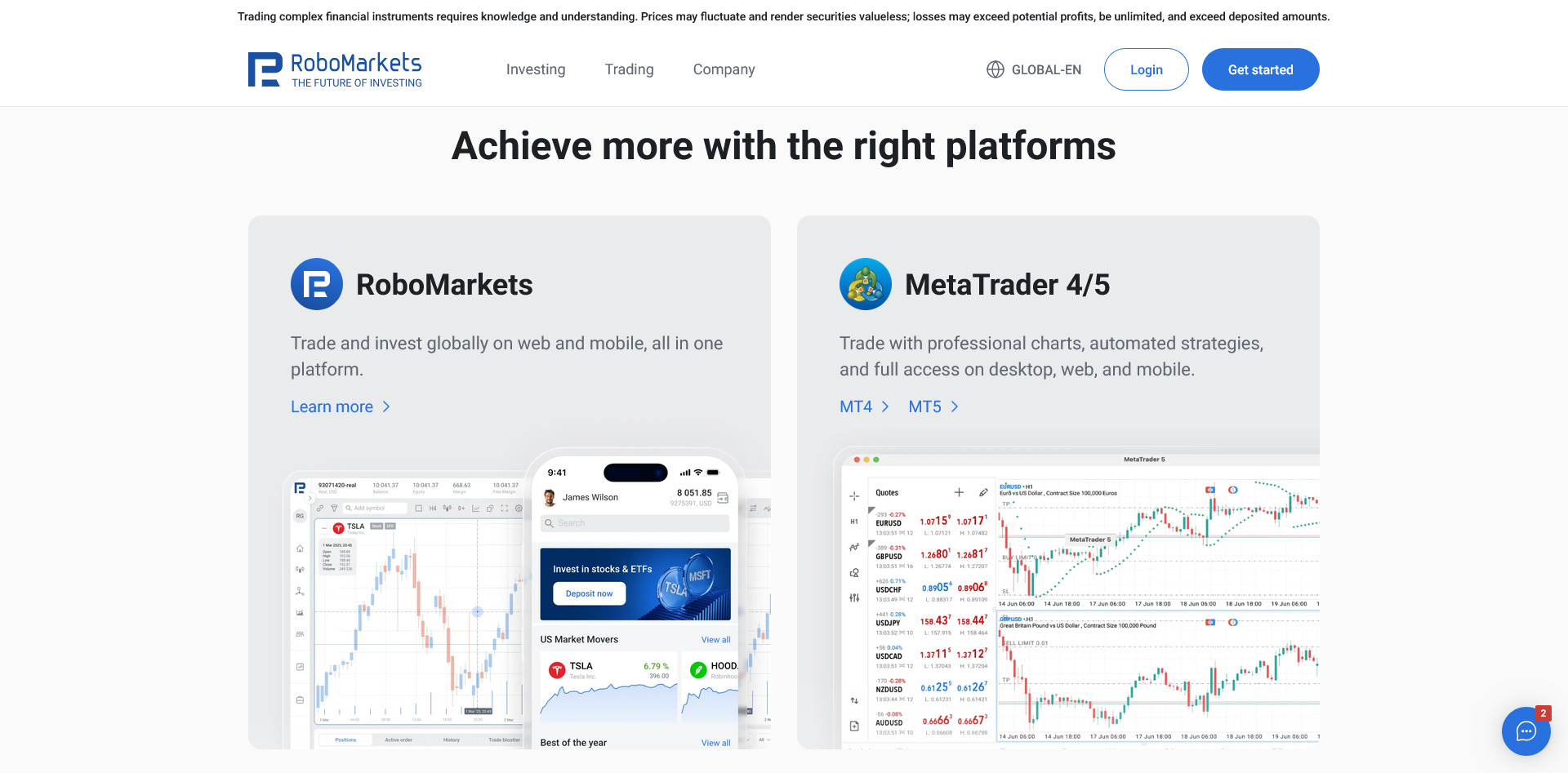
R StocksTrader is RoboMarkets' proprietary platform for real-stock investing and multi-asset analysis. It is designed for clients who want access to physical shares and ETFs, rather than only derivative contracts. Depending on the account, users can build watchlists, apply stock filters, review detailed charts, and monitor corporate actions such as dividends, earnings, and stock splits.
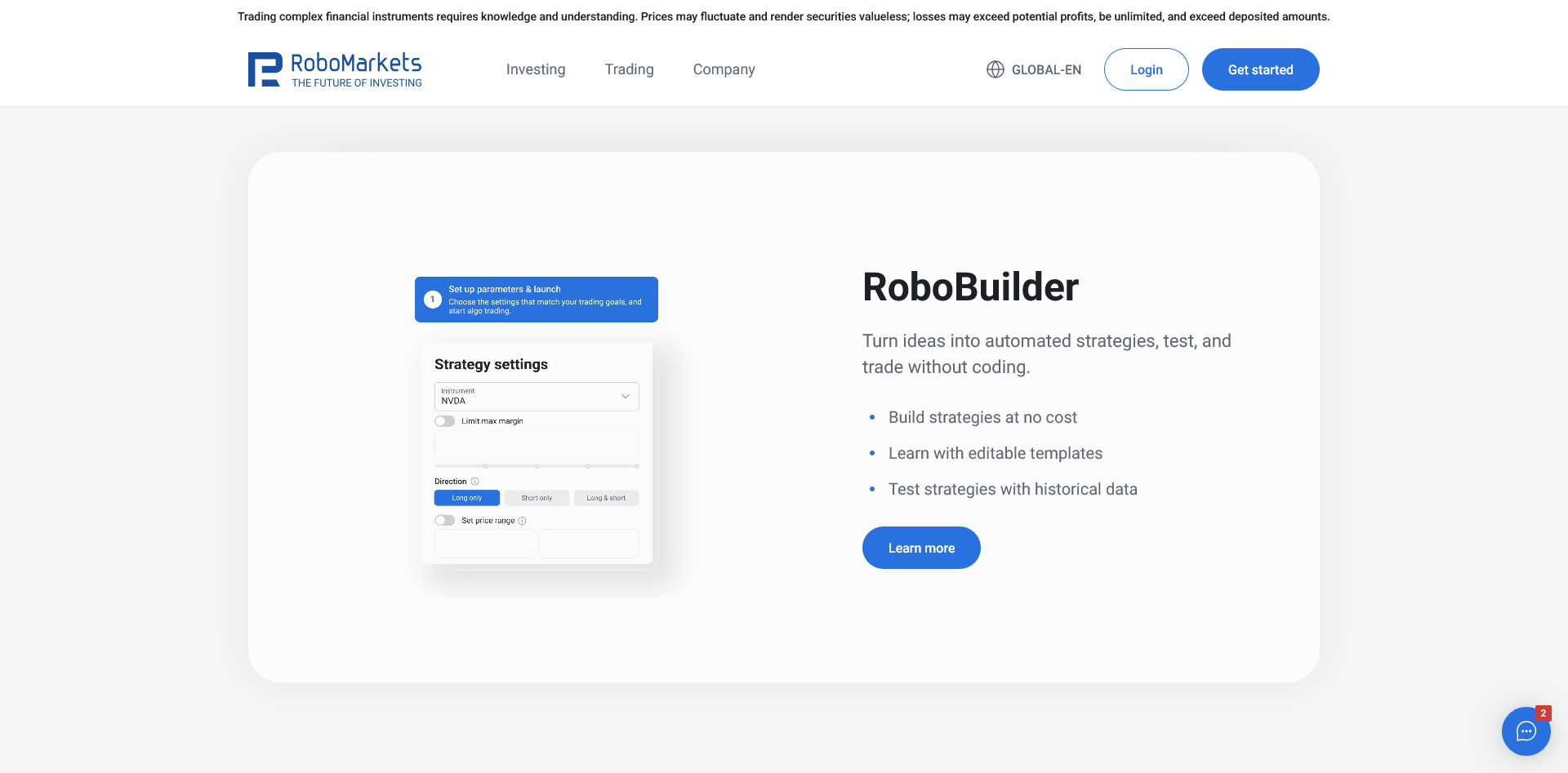
The platform also includes features for developing trading algorithms. Some users can create strategies within the proprietary environment without relying entirely on the EA ecosystem used by MetaTrader. That can appeal to investors who want automation but don't want to build their workflow around MT4 or MT5.
R WebTrader provides browser-based access without requiring a full desktop installation. R MobileTrader offers account management and trading access through a smartphone. These options are convenient when you need to check positions, adjust orders, or monitor watchlists away from your primary computer. However, mobile and web versions may not include every desktop feature, including certain analytical tools, automation settings, or advanced order controls.
Available Markets Depend on the Entity You Use
RoboMarkets and its wider group report more than 12,000 instruments across the overall offering. That number shouldn't be read as the selection available to every customer. Your country, account type, legal entity, and platform determine which products appear in your account.
The broader range may include:
- More than 40 forex pairs.
- Real stocks and fractional shares.
- Stock CFDs and ETF CFDs.
- Physical ETFs.
- Major equity indices.
- Commodities and energy products.
- Gold, silver, and other metals.
- Cryptocurrencies, where permitted.
- Bonds and other regional products.
European retail clients may focus on real stocks, ETFs, and other traditional investments through RoboMarkets Deutschland GmbH. International clients may instead receive access to leveraged forex, commodity CFDs, index CFDs, and stock CFDs through an eligible global entity. A product listed on a group comparison page may therefore be unavailable during your registration.
The difference between a physical share and a stock CFD deserves careful attention. When you buy a real share, you generally acquire an ownership interest in the company, subject to the account's terms and the market involved. Dividends, voting rights, custody arrangements, and corporate actions relate to the underlying asset.
A CFD tracks the price of an asset without transferring ownership of that asset to you. It may allow short selling and leverage, but it can also involve overnight financing, margin requirements, and rapid losses. Fractional investing lets you buy less than one whole share, yet it still differs from a CFD because the product is linked to an ownership position rather than a price-only contract.
The instrument name can look similar across platforms, but "Tesla share" and "Tesla CFD" describe different legal and financial products.
Leverage, Execution, Automation, and Copy Trading
Leverage limits depend on the jurisdiction, client classification, account type, and instrument. European stock accounts may use 1:1 funding for physical investments, while some fractional-share arrangements or permitted derivatives may have only limited financing. Certain international accounts advertise much higher ratios, with major forex pairs reported as high as 1:2000 under an offshore entity.
A high ratio lowers the margin needed to open a position, but it doesn't lower the position's actual market exposure. If you control a large trade with a small balance, an ordinary price move can consume your available equity quickly. Use the broker's margin calculator, stop-loss orders, and position-sizing controls before placing a leveraged trade.
RoboMarkets has reported a hybrid STP and ECN model for certain ECN and Prime accounts. This model can route orders to external liquidity providers, but it shouldn't be treated as a promise of perfect fills or the complete absence of execution risk. Market orders can experience slippage, rejected orders, or requotes when liquidity changes quickly.
A reported average execution speed of approximately 184.96 milliseconds is best treated as historical or indicative information. Actual results depend on market volatility, liquidity, server distance, internet quality, order type, and the time of day. Test execution in a demo account, then compare live fills against quoted prices and expected slippage.
Automation is available through MT4 and MT5 Expert Advisors, subject to the platform and entity supporting those accounts. VPS access can help keep an EA running when your computer is switched off, but it doesn't make an unprofitable strategy reliable. Algorithmic tools within R StocksTrader may also support custom strategies for eligible stock and multi-asset accounts.
Copy trading is available to some global clients, but it isn't generally the same product as a European physical-stock account. You can follow another provider's trades automatically, yet the copied position size and market conditions can produce a different result from the provider's account. Losses can increase quickly during volatile periods, and past returns, low drawdowns, or high rankings don't predict future performance.
Research, Education, and Customer Support
RoboMarkets includes practical research tools for self-directed traders. Depending on your platform, you may find an economic calendar, a corporate action calendar, stock screeners, company news, market updates, trading signals, and customizable watchlists. R StocksTrader is particularly useful for equity research because it combines filters, charts, company information, and event data in one workspace.
Educational material includes video guides, webinars, eBooks, platform tutorials, strategy content, demo accounts, and introductory signals. These resources can help you learn order types or test a workflow before risking money. Still, the library may feel less structured than the full trading academies offered by some competitors. Beginners who want a staged course with assessments and advanced lessons may need additional independent education.
Reported support channels include 24/7 multilingual assistance through live chat, phone, email, and the Members Area. That coverage can help with account access, verification, platform setup, and payment questions across different time zones. Keep records of support tickets and payment confirmations if an issue involves a withdrawal or trade dispute.
Public user feedback is limited, so a positive rating provides only a narrow view of the service. Some users praise support and platform access, while others mention verification delays, withdrawal processing times, platform problems, or swap charges. Treat ratings as one input, not a complete audit. Test the platform, read the current terms, and make a small withdrawal before committing substantial funds.
How to Open, Fund, and Manage a RoboMarkets Account
Opening a RoboMarkets account is simple at the basic registration stage, but approval depends on your country, the legal entity serving you, and the products you want to trade. European stock investors may follow a stricter BaFin-regulated process, while eligible international CFD clients may be directed to a regional or offshore entity.
Before sending money, confirm the company name, regulator, available instruments, account currency, fees, and platform shown in your agreement. A successful registration does not guarantee access to every product advertised across the wider RoboMarkets group.
RoboMarkets Registration and Verification Steps
Start by visiting the official RoboMarkets website for your country. Avoid referral pages or copied links that don't clearly identify the legal company accepting your account. Depending on your location and goals, select "Start Trading" or "Invest Now."
You will then enter basic personal information, such as your full name, residential address, date of birth, nationality, phone number, and email address. Use details that match your official documents. Even a small difference in your name or address can create delays later.
After submitting the form, check your inbox for the RoboMarkets confirmation message and follow its link. If you don't see it, inspect your spam folder and confirm that you entered the correct email address. You may need to request a new confirmation message through the registration page.
The next stage is KYC verification. RoboMarkets may request:
- A valid passport, national ID card, or driver's license.
- Proof of address, such as a recent bank statement or utility bill.
- Additional information about your employment, income, or source of funds.
- A selfie or live identity check if the verification provider requires one.
Upload clear, unedited documents with all corners visible. The name and address should match your application and payment details. Expired documents, cropped images, screenshots, and outdated bills often lead to follow-up requests.
RoboMarkets may also ask suitability and appropriateness questions. These questions can cover your trading experience, financial knowledge, investment goals, income, and tolerance for loss. Answer honestly rather than choosing responses that might unlock a preferred product. The purpose is to assess whether a complex or leveraged instrument is appropriate for your profile.
Verification can take several business days when the broker needs to review documents manually, confirm your address, check the source of funds, or complete an anti-money laundering assessment. European stock clients and customers served by tightly regulated regional entities may face more detailed checks than offshore applicants. Broker-dealer AML programs require firms to identify customers and monitor suspicious activity, as explained in FINRA's AML guidance.
Once approved, select an available account and platform. International clients may see choices such as Standard, ECN, or Prime accounts, while European retail clients may be directed toward real stocks and ETFs through RoboMarkets Deutschland GmbH. MT4, MT5, TradingView, R StocksTrader, web access, and mobile access may not all be available for every entity.
Read the client agreement, risk disclosure, order execution policy, and withdrawal terms before depositing. Confirm the legal entity in those documents, not just the RoboMarkets brand name shown on the website.
Funding the Account and Choosing a Payment Method
The reported minimum RoboMarkets account deposit is $100, although some payment methods may allow smaller individual transactions. A lower transaction limit doesn't necessarily mean that the account's minimum opening balance has changed.
Available funding options vary by country and entity. Common methods include:
- Visa or Mastercard card deposits, which may arrive almost instantly.
- Bank transfers, which can take several business days to clear.
- E-wallets such as Skrill or Neteller, where supported.
- Regional electronic payment services, which may have their own limits and fees.
Use a card, bank account, or e-wallet held in your own name. Payments from another person can trigger an AML review or prevent the broker from returning funds through the normal withdrawal route. Keep the payment receipt, transaction ID, and bank confirmation until the money appears in your trading balance.
Your account's base currency also matters. If you fund a USD account with EUR, GBP, or another currency, the bank, card provider, payment service, or broker may apply a conversion spread. Check the exchange rate and any markup before confirming the transfer. Payment methods, minimums, maximums, processing times, and fees can change by country, so rely on the funding page inside your verified Members Area.
Complete the following checks before sending a deposit:
- Confirm the legal entity and regulator in the account agreement.
- Check that the account type matches your intended market.
- Review the deposit, withdrawal, conversion, and inactivity fee terms.
- Verify that the payment account uses your exact registered name.
- Save the transaction receipt and expected processing time.
- Deposit only an amount you can afford to lose.
Withdrawals, Delays, and Steps to Prevent Problems
Electronic withdrawals may take anywhere from a few minutes to one business day after approval. Card withdrawals and bank wires can take one to ten banking days, depending on the payment method, intermediary banks, weekends, and the receiving institution.
Some users report slow withdrawals or extra requests for documents. Treat these as individual customer experiences, not proof of systemic misconduct. Delays often occur when KYC remains incomplete, the payment account doesn't match the account holder, or the broker needs information about the source of funds. FINRA explains why broker-dealers maintain written AML programs in its broker-dealer AML source tool.
Finish verification before placing trades whenever possible. Also, use the same bank details you used to fund the account, respond quickly to AML requests, and check the withdrawal fee for your selected channel. If a payment is late, contact support through the official website or Members Area and include the transaction reference, amount, method, date, and receiving bank information.
If support doesn't resolve the issue, submit a formal complaint to the RoboMarkets entity named in your agreement. Keep copies of your complaint, account statements, payment confirmations, and written replies. After the broker's internal process, you can contact the relevant regulator or financial dispute body if it accepts complaints from your client type. The correct route depends on your country and legal entity.
To close the account, withdraw or transfer any remaining balance, settle open positions, download statements, and send a written closure request through the secure Members Area. Ask the broker to confirm that the account is closed and whether any personal-data retention or outstanding fee remains.
Test the Platform Before Trading Real Money
Use a demo account before funding a live profile, especially if you have never used MT4, MT5, TradingView, or R StocksTrader. Place sample market and pending orders, then check how the platform displays spreads, margin, stop-loss orders, and take-profit levels.
Test the features you expect to use:
- Desktop, web, and mobile login access.
- Charting tools and price alerts.
- Stop-loss and take-profit placement.
- Swap calculations for overnight positions.
- Margin warnings and forced-closeout rules.
- Deposit and withdrawal instructions.
- Order confirmations, history, and account statements.
Demo execution cannot reproduce every live condition. Spreads may widen during news, fills can differ during fast markets, and liquidity may change outside normal trading hours. Still, a demo account can expose confusing order settings before real money is at risk.
After testing, start with a small amount only if you understand the account terms. Before the first live trade, confirm:
- Your position size fits your account balance.
- Your planned maximum loss per trade is affordable.
- You understand the effect of leverage on exposure.
- You have considered weekend gaps and market closures.
- You know how major news can widen spreads and cause slippage.
- You can explain the exit price before opening the position.
A live account should begin with a tested process, not a rushed deposit or an untested strategy.
Conclusion
RoboMarkets is a credible choice for European investors who want regulated access to real stocks and ETFs. It can also suit eligible international traders who prefer MT4, MT5, proprietary platforms, competitive execution, and low trading costs. However, the broker is less suitable for European retail clients seeking leveraged forex CFDs, traders who want broad cryptocurrency coverage, and beginners who need a detailed, step-by-step education program.
The most important point in this RoboMarkets Forex Brokers Review is that your experience depends on the legal entity serving your country. Safety standards, leverage, compensation protection, available instruments, fees, and platform access can differ substantially between regional operations.
Before opening an account, verify the entity's license in the regulator's register, read the latest fee schedule and withdrawal terms, and test the platform with a demo account. If you decide to trade, use only money you can afford to lose.