

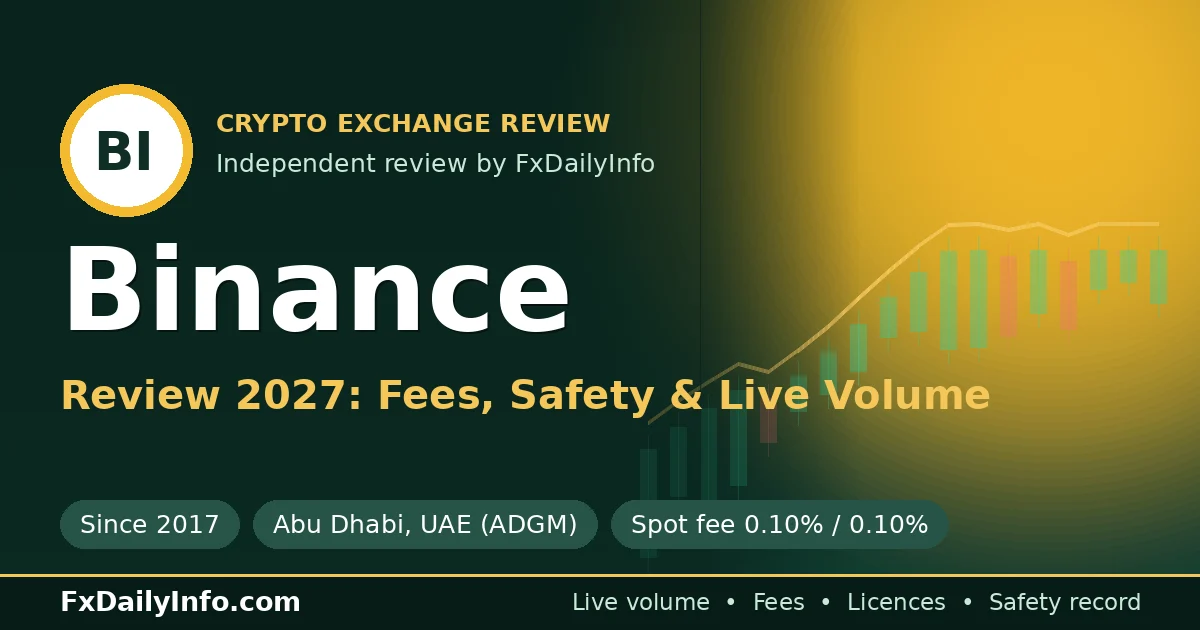
Exchange review · Global
Binance Review 2027: Is It the Right Exchange for You?
Binance is the largest crypto exchange in the world by trading volume, and for many traders it is the default place to buy, sell and hedge digital assets. It offers almost every product the industry has invented: spot markets, perpetual futures, options, savings products, a peer-to-peer marketplace and its own blockchain ecosystem built around the BNB token.
Size cuts both ways. Deep order books mean tight spreads and fast execution, but a platform this large is also the biggest target for attackers and regulators. This 2027 review explains how Binance works, what it costs, how safe it is after the record hack of October 2026, and which type of trader it suits.
What Is Binance and Who Runs It?
Binance was launched in July 2017 by Changpeng Zhao, known as CZ, and co-founder Yi He. Within six months it had become the busiest exchange in the world, mainly because it listed new coins quickly and charged a flat fee that undercut older rivals.
For years the company said it had no headquarters. That changed step by step. Its global platform now operates under the regulatory framework of the Abu Dhabi Global Market in the United Arab Emirates, and local subsidiaries hold licences or registrations in places such as Dubai, Bahrain, Australia and Japan. CZ stepped down as chief executive in November 2023 as part of a settlement with US authorities. The exchange is now led by co-CEOs Richard Teng and Yi He.
Binance does not serve residents of the United States. Americans are directed to Binance.US, a separate company with a much smaller product range.
Products and Markets on Binance
No other exchange covers as much ground in a single account. The main building blocks are:
- Spot trading in several hundred coins against USDT, USDC, BTC, BNB and a number of national currencies.
- Futures and options, including perpetual contracts with leverage. Binance is the largest derivatives venue in crypto.
- Earn products, from flexible savings to staking and structured products that pay a yield on idle coins.
- Binance P2P, where users trade directly with each other using local payment methods while the exchange holds the crypto in escrow.
- Launchpool and Launchpad, which give BNB holders early access to new tokens.
- Binance Pay and the Web3 wallet, for payments and access to decentralised apps.
The range is a strength for experienced users and a risk for beginners. Leveraged futures are one tap away from the simple "buy" screen, and most retail accounts that trade with leverage lose money. New users are better served by the basic "Convert" and spot screens until they understand order types.
- Spot fee
- 0.10% / 0.10%maker / taker, base tier
- Founded
- 201710 years in 2027
- Trust score
- 10 / 10CoinGecko, live
- Proof of reserves
- Yeslicensed or registered
Binance Fees Explained
The base spot fee on Binance is 0.10% for both makers and takers. A maker order adds liquidity to the order book (a limit order that waits), while a taker order removes it (a market order that fills at once). Paying fees in BNB gives a discount, and fees fall further as your 30-day volume or BNB balance grows through the VIP tiers.
Futures fees are lower than spot fees in percentage terms, but they apply to the full leveraged position, not to your margin, so they add up quickly. Perpetual contracts also carry a funding rate that is paid between long and short traders every few hours.
Other costs to watch:
- Deposits of crypto are free. Card purchases carry a fee that is usually far higher than a bank transfer.
- Withdrawals of crypto cost a flat network fee that depends on the coin and the blockchain you choose. Picking a cheaper network can save a lot, but the receiving wallet must support it.
- Spreads on instant "Convert" trades are built into the quoted price, so the trade is not truly free.
For most people the cheapest route is a bank transfer or P2P purchase followed by a limit order on the spot market.
Is Binance Regulated?
Binance's legal position has improved a great deal since 2023, although it still varies by country. In November 2023 the company pleaded guilty in the United States to anti-money-laundering and sanctions violations and agreed to pay about $4.3 billion. It accepted an outside compliance monitor and made identity checks compulsory for every user.
Since then Binance has collected licences in the Gulf region and other markets and has moved its global platform under Abu Dhabi supervision. The European Union is a weak spot. The EU's MiCA rules required every exchange to hold a licence from 1 July 2026, and reports at that time said Binance had not obtained one and was reducing services for EU residents. If you live in the EU, check what Binance currently offers in your country before you rely on it.
A licence in one region does not protect customers elsewhere. Your rights depend on which Binance entity holds your account, and the terms of use tell you which one that is.
Binance Security and the October 2026 Hack
On 29 October 2026 attackers gained access to Binance's internal wallet-signing systems and drained about $6.3 billion in assets from its hot wallets across several blockchains. It is the largest theft in the history of crypto. Binance paused withdrawals, said that customers would not lose money, and stated that the loss would be covered from its Secure Asset Fund for Users (SAFU) and from the company's own reserves. Withdrawals reopened in phases from 1 November 2026. The FBI attributed the attack to hackers linked to North Korea.
Two lessons follow. First, Binance was able to absorb a loss that would have destroyed most companies, and its proof of reserves reports are meant to let users confirm that balances remain fully backed. Second, no exchange is too big to be hacked. In 2019 Binance lost about 7,000 BTC in an earlier breach and also repaid users in full, so its record of making customers whole is consistent. But a record is not a guarantee.
Sensible precautions apply here more than anywhere:
- Turn on two-factor authentication with an authenticator app or a hardware key, not SMS.
- Set an anti-phishing code and a withdrawal address whitelist.
- Keep only your trading balance on the exchange and move long-term holdings to a wallet you control.
Opening an Account, Deposits and Withdrawals
Sign-up takes a few minutes, but you cannot trade until you pass identity verification with a government ID and a selfie. Higher limits may need proof of address.
How you fund the account depends on where you live. Options can include bank transfer, card, local payment apps and the P2P market. Crypto deposits are available everywhere the platform operates. Before you send a first deposit, check three things: that your country is supported, which networks the exchange accepts for your coin, and whether withdrawals for that coin are open. After the October 2026 incident, individual coins and networks were reopened at different times.
Customer support runs through live chat inside the app. Response times stretch when markets are busy, so keep records of every transaction ID.
Who Should Use Binance, and Who Should Not
Binance suits active traders who want the deepest liquidity, low fees and every market in one place. It also works well for people in regions where the P2P market is the most practical way to move between local money and crypto.
It is a weaker fit for three groups. Complete beginners may find the app crowded and the leverage products too close at hand. Residents of the US cannot use the global platform at all, and residents of the EU face an uncertain service. And anyone who wants a single regulator to turn to in a dispute may prefer an exchange that is licensed in their own country.
Binance Compared With Other Large Exchanges
Against Coinbase and Kraken, Binance is much cheaper and lists more coins, but those two offer stronger legal protection in the US and Europe. Against OKX and Bybit, the offer is similar: low fees, large futures markets and a wide coin list. The choice often comes down to which platform is licensed where you live and which interface you prefer.
A practical approach is to keep accounts at two exchanges. If one pauses withdrawals, as Binance did for three days in 2026, you can still trade and move funds through the other.
Verdict on Binance
Binance remains the most complete crypto exchange and the most liquid. Its fees are low, its product range is unmatched and it has twice shown that it will cover customer losses after a breach. The October 2026 hack is also a blunt reminder that scale does not equal safety, and the company's licence coverage still has gaps, above all in the EU and the US.
Use Binance for what it does best, which is trading. Verify that it is allowed to serve you, secure your account properly and do not treat any exchange as a vault for savings you cannot afford to lose.