




A Trusted Forex Broker
Errante Forex Broker Review What Real Traders Need to Know
Choosing a forex broker requires more than flashy promises and marketing hype.
This Errante forex broker review breaks down what matters: regulation, trading costs and platform quality.
Errante positions itself as a multi-regulated broker offering over 160 CFD instruments, dual regulation under CySEC and FSA (Seychelles), and a minimum deposit of just $50.
Sounds promising, but does it deliver?
I've tested the platforms and analyzed the fee structure in detail. I got into everything from spreads to customer support.
Here's what you need to know before opening an account with Errante.
What Is Errante and Is It Safe to Trade With?
Errante entered the forex brokerage space in 2019. The broker operates through two separate legal entities based on client location. The broker holds dual regulation: a CySEC license (number 383/20) through Notely Trading Limited in Cyprus and an FSA Seychelles license (SD038) via Errante Securities (Seychelles) Ltd. This split structure means your account gets routed to different entities depending on where you reside.
Company Background and Regulatory Licenses
Notely Trading Limited serves as Errante's EU-facing entity. The Cyprus Securities and Exchange Commission authorized it as a market maker. The CySEC license grants passporting rights across 10 European countries: Germany, Italy, Spain, Netherlands, Poland, Portugal, Austria, Croatia, Greece, and Ireland. You'll trade under EU regulatory oversight if you're based in these jurisdictions.
Errante routes accounts through its Seychelles entity for clients outside the European Economic Area. The FSA (SC) license SD038 operates under a different regulatory framework with notably lighter requirements. Both entities use the errante.com domain, but the legal protection you receive depends entirely on which entity holds your account.
Demo Account and Islamic Account Options
Errante's demo account doesn't expire, but it closes after 90 days of inactivity. You receive a $10,000 virtual balance that mimics conditions on the Standard, Premium, and VIP accounts. The demo works on both MT4 and MT5 platforms.
Islamic accounts operate swap-free, but with specific limitations by instrument type. Major forex pairs remain swap-free for up to 7 nights. Minor forex pairs get only 1 night swap-free. Precious metals like gold and silver extend to 7 nights, while indices and energy markets cap at 3 nights. Cryptocurrencies receive 3 nights swap-free.
The full swap gets charged retroactively for the entire holding period after these durations. This means if you hold a minor forex pair for 3 nights on an Islamic account, you'll pay swap fees for all 3 nights, not just the third night. The swap-free option is available upon request across all four live account types.
Clients can open a maximum of two trading accounts per currency. Accounts inactive for more than 12 months become dormant and incur fees.
Trading Platforms: MT4, MT5, and cTrader
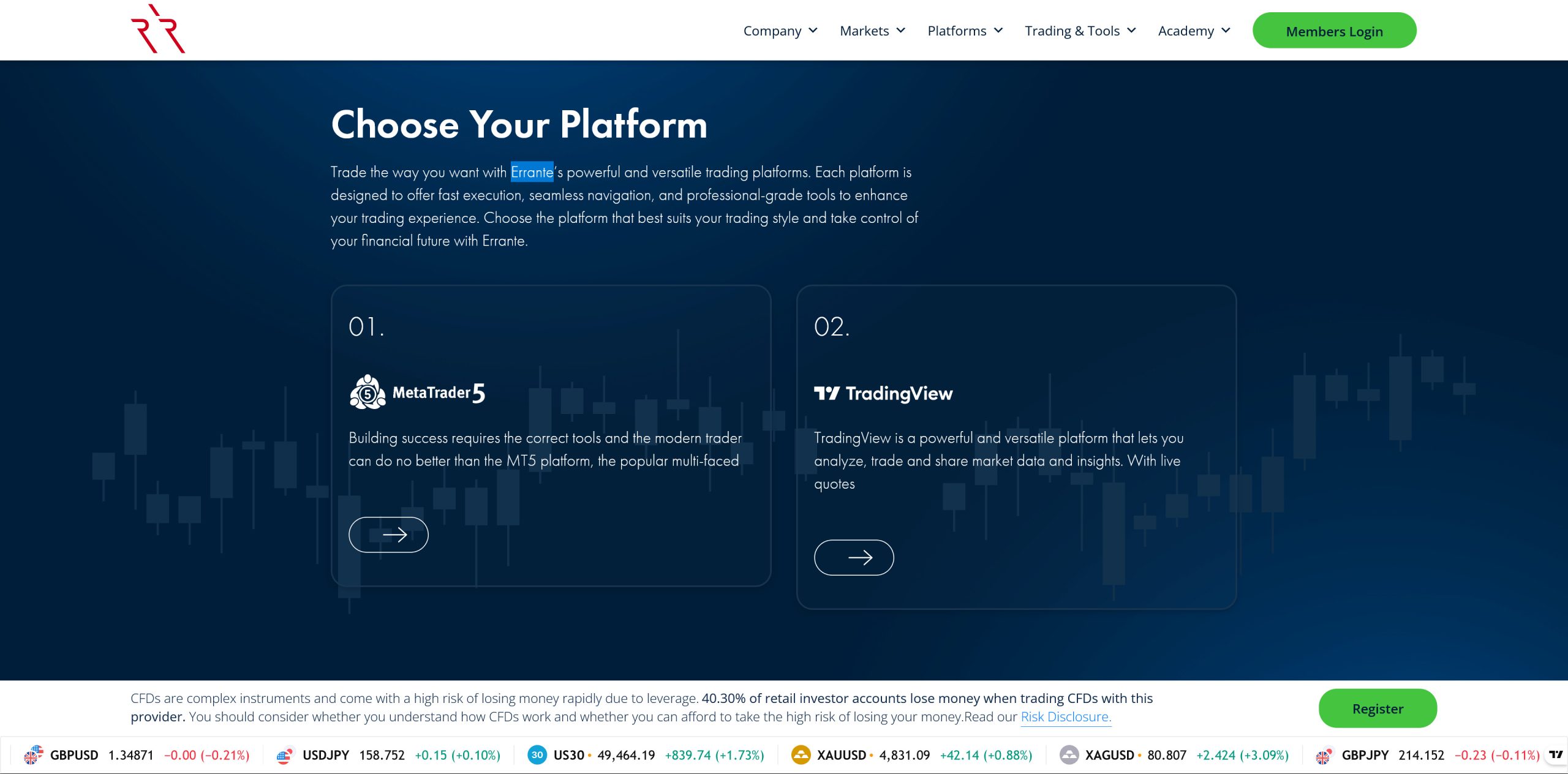
Errante gives you access to three industry-standard platforms: MetaTrader 4, MetaTrader 5, and cTrader. Each serves different trading styles. Understanding what separates them helps you pick the right tool.
MetaTrader 4 and MT5 Features
MetaTrader 4 remains the most popular platform since its 2005 release. Errante's MT4 implementation supports automated trading through Expert Advisors, which analyze markets and execute trades based on predefined strategies. The platform uses the MQL4 programming language. Traders can create, debug, and test custom trading robots with it.
Copy trading functionality lets you replicate trades from experienced traders in real time. Your account links to the trader you're copying, and their positions configure in your account at the scale you set. The signals feature gives access to strategies from other traders, many available for free.
MetaTrader 5 brought major upgrades when it launched in 2010. The platform supports 21 timeframes compared to MT4's 9. You get more granular analysis options. MT5 uses MQL5 programming language, which offers more advanced development capabilities than MQL4. The platform handles multi-asset trading beyond forex and covers stocks, commodities, futures, and options.
MT5 has two additional order types unavailable on MT4: buy stop limit and sell stop limit. The platform also supports partial order filling policies. MT5 allows direct fund transfers between accounts on the same server for traders managing multiple accounts.
Both platforms come with preinstalled technical indicators and trading robots. MT4 offers 30 built-in indicators while MT5 has 38. The execution types differ, with MT5 supporting four execution methods versus MT4's three.
cTrader Platform: Advanced Charting and Order Types
cTrader operates on an Electronic Communication Network model and provides direct market access without dealing desk intervention. The platform uses C# programming language rather than MQL. Developers get more flexibility when building automated strategies through cAlgo.
The charting capabilities stand out with 70+ built-in indicators, substantially more than either MetaTrader version. cTrader offers 26 timeframes and eight chart types: Bar, Candlestick, Line, Dot, Heikin Ashi, HLC, Renko, and Range charts.
Order management happens on charts through Quick Trade buttons. You can execute market orders instantly or drag the buy/sell buttons onto the chart to place pending orders. The platform displays pending orders, positions, and protections on price levels. You modify them by dragging badges along the price axis.
Depth of Market functionality has three view options: Standard, Price, and VWAP. This shows exact liquidity levels and supply-demand information for each instrument. The platform supports advanced order types that cover limit, stop, stop-limit, trailing stops, and One Cancels the Other (OCO) orders.
Chart trading has features like price alerts set on charts, position badges showing real-time profit/loss and pip movement, and advanced protections that cover server-side trailing stops. Sub-millisecond execution speeds make the platform suitable for scalpers and high-frequency strategies.
Errante Account Types: Which One Fits Your Trading Style?
Errante structures its offering around four live account tiers. Each targets different capital levels and trading approaches. I'll walk through what separates these accounts beyond just the minimum deposit requirements.
Standard Account: Entry-Level Trading
The Standard Account requires a minimum deposit of $50. This makes it available to traders testing the broker or working with limited capital. Spreads start from 1.5 pips on major pairs, with no commission charged on trades. You get access to all asset classes, including forex, stocks, indices, commodities, and cryptocurrencies.
Leverage reaches up to 1:1000 on this account, though EU clients under CySEC regulation face the mandatory 1:30 cap on major forex pairs. The minimum trade size sits at 0.01 lots. This translates to $1,000 worth of currency for micro lot traders. Maximum position size is capped at 50 lots per trade.
The margin call triggers at 100% equity, with stop-out occurring at 20%. Both account currencies, USD and EUR, are available. You can request swap-free status if you need it for religious purposes.
Premium and VIP Accounts: Better Spreads and Perks
Premium accounts start at $1,000 minimum deposit and bring spreads down to 1.0 pips. The real difference here isn't just tighter pricing. Premium account holders receive daily market summaries, customized customer support, and improved educational materials.
VIP accounts require $5,000 upfront and tighten spreads further to 0.8 pips. The standout benefit: zero fees on all deposit and withdrawal methods. This alone can offset the higher deposit requirement for traders moving funds on a regular basis. VIP clients also receive free VPS hosting. This matters if you run algorithmic trading or expert advisors that need constant server uptime.
Both Premium and VIP accounts maintain the same 1:1000 leverage, 0.01 lot minimum trade size, and identical margin requirements as the Standard account. Neither charges trading commissions. The 50-lot maximum position size applies across all three spread-based accounts.
Tailor Made Account: For High-Volume Traders
The Tailor Made account targets serious traders with $15,000 minimum capital. Spreads start from 0.0 pips, but you'll pay a $6 round-turn commission per standard lot. A typical EUR/USD trade works out cheaper than the spread-only accounts once you factor in the raw pricing.
Lower leverage applies to this account type, though the specific ratio depends on your trading profile and instruments. Maximum position sizes may also be reduced from the standard 50-lot limit. Margin calls and stop-outs remain at 100% and 20%.
The customization aspect matters here. You can work with account managers to configure setups for high-frequency trading, request specific VPS configurations, or negotiate leverage on particular instruments. To name just one example, some traders opt for raw spreads with minimal commission, while others prefer higher leverage on select markets.
Mobile Trading Apps for Android and iOS
Errante's cTrader mobile app has 65 technical indicators, four chart types (Standard Time Frames, Tick, Renko, Range), and five chart view options (Candlesticks, Bar, Line, Dots, Area). The app has eight drawing tools that cover trend lines, Fibonacci retracement, and price channels.
Quick Trade mode makes one-click trading execution possible. Market Sentiment Indicator shows positioning from other traders. The app supports push and email alerts for price levels and trade events, with an order filled sound notification when trades execute.
Recent updates added an account equity chart for tracking performance over time, candle countdown timers showing remaining time before current candle closes, and enhanced crosshair with measure mode displaying pip and period distances.
TradingView Integration
Errante offers TradingView integration through cTrader accounts only. The connection is free, though TradingView's premium features need a separate subscription. You get access to 400+ built-in indicators, 110+ drawing tools, and community-shared indicators. The platform supports order creation on charts, bracket management, future order previews, and drag-to-modify functionality.
Errante Spreads, Commissions, and Trading Costs
Actual trading costs tell a different story than advertised spreads. I tested Errante's pricing during London and New York trading sessions to see how the numbers hold up under real market conditions.
Live Spread Testing: EUR/USD, Gold, and Bitcoin
I tested spreads on November 8, 2025. EUR/USD spreads measured 1.5 pips in the morning session and widened to 1.6 pips by afternoon. This sits above the 1.08 pips industry average. The gap becomes more pronounced on gold. Spreads reached 30 pips in the morning and 31 pips in the afternoon, compared to the 23 pips standard.
Bitcoin spreads proved especially wide at $62.50, nearly double the $34 industry standard. Stock CFDs performed competitively in contrast. Apple spreads came in at 0.24 points versus the 0.33 average, while Tesla registered 0.45 points against 0.50. The Dow Jones 30 ranged from 0.9 to 1.9 basis points and beat the 3.3 industry standard.
Crude oil spreads of 0.04 to 0.05 pips slightly exceeded the 0.03 average. GBP/JPY measured 2.5 pips in the morning and 2.8 pips later, marginally above the 2.44 industry figure.
Commission Structure Across Account Types
The Standard, Premium, and VIP accounts operate commission-free. Costs are built entirely into spreads. Spreads start from 1.8 pips on Standard, drop to 1.0 pip on Premium, and tighten to 0.8 pips on VIP accounts.
The Tailor Made account flips this model with raw spreads from 0.0 pips but adds a commission charge. Sources show the commission at $5 per lot round turn, though ECN account data indicates $3 per lot. Total execution cost for one standard lot during peak hours: $4 on the Tailor Made account versus $12 on commission-free Standard accounts.
Overnight Swap Fees and Holding Costs
Holding positions overnight incurs swap charges that exceeded industry standards across instruments I examined. Long positions on EUR/USD cost $13.20 per night while shorts earn a $3.20 credit. GBP/JPY reverses this pattern with a $11.20 credit on longs but a $36.50 charge on shorts.
Gold carries steep overnight costs: $55 for long positions and a $24.50 credit for shorts. These swap rates apply to one full base currency contract of 100,000 units.
How Errante's Fees Compare to Competitors
Withdrawal fees add up on top of trading costs. E-wallet withdrawals through Skrill or Neteller carry a 1% fee, while cryptocurrency withdrawals range from $50 to $100 depending on the asset. Bank transfers and card withdrawals remain free.
Accounts with insufficient trading activity face additional charges. The broker defines activity as at least 2 lots of forex or metals positions held for 5 minutes per $1,000 deposited. Withdrawals within 72 hours of deposit trigger a 5% fee, dropping to 3% after that window.
Dormant accounts incur a $15 fee after 150 days of inactivity, followed by $5 monthly until reactivation or zero balance. No deposit fees apply, and the broker covers wire transfer or card processing costs.
Trading Instruments: Forex, Stocks, Crypto, and More
Asset variety determines whether a broker fits your diversification strategy or locks you into limited markets. Errante offers access to over 160 CFD instruments across five asset classes.
50+ Forex Pairs Available
The forex selection has 50 currency pairs that cover majors, minors, and crosses. Major pairs like EUR/USD, GBP/USD, and USD/JPY trade with leverage up to 500:1. Other forex pairs cap at 200:1. This leverage differentiation matters when you calculate margin requirements across your portfolio.
The broker structures forex pairs into standard categories. Majors involve currencies from leading economies and see the highest trading volume. Minors combine secondary currencies without the US dollar. Crosses exclude the dollar entirely and pair currencies like AUD/JPY or EUR/GBP directly. Each category carries different liquidity profiles and spread characteristics during trading sessions.
Stock CFDs and Indices Selection
Errante provides access to 59 individual stock CFDs and has shares from Amazon, Alibaba, and Google. Equity CFDs trade with 20:1 leverage, much lower than forex but appropriate given stock volatility patterns.
The indices lineup covers major global benchmarks. You can trade UK100, NASDAQ, S&P 500, and Dow Jones. Regional indices like Australia 200, Germany 30, France 40, Spain 35, Hong Kong 50, and Japan 225 are available too. Indices carry 100:1 leverage and sit between forex and equities in the risk spectrum.
Trading hours vary by index. The US30, US100, and US500 operate from 01:02 to 23:59 GMT+3 Monday through Friday. Spain 35 runs a shorter session from 09:00 to 21:00. These timing differences affect overnight holding strategies.
Cryptocurrency Trading 24/7
Crypto markets operate continuously and run 00:00 to 24:00 every day, weekends included. The selection extends beyond Bitcoin and has Ethereum, Litecoin, and Ripple. Newer assets like Cardano, Algorand, Aave, Avalanche, Axie Infinity, Binance Coin, Dogecoin, Polkadot, Solana, and approximately 20 additional tokens are available.
Cryptocurrency leverage reaches 1000:1, the highest ratio across all asset classes. Contract sizes vary a lot by coin. Bitcoin trades in single-unit lots. Dogecoin requires 1,000 units per lot and Cardano scales to 10,000 units. These size differences impact position calculations when you trade smaller-cap cryptocurrencies.
Commodities and Energy Markets
Energy trading covers Crude Oil (USOIL), Brent Oil (UKOIL), and Natural Gas (NATGAS) with 100:1 leverage. Standard contract sizes sit at 1,000 barrels for oil products and 10,000 units for natural gas. Energy markets close Friday at 23:55 and reopen Monday at 01:00 GMT+3.
Agricultural commodities have Cotton, Coffee, Cocoa, and Sugar futures. These instruments trade with conservative 20:1 leverage. Contract specifications differ: Coffee futures represent 1,000 pounds per lot, while Sugar scales to 10,000 pounds.
Metals trading covers spot Gold, Silver, Platinum, and Palladium with 100:1 leverage. The instrument specifications show that metals provide portfolio diversification beyond traditional forex exposure.
Deposits and Withdrawals: Methods, Fees, and Processing Times
Moving funds in and out of your account reveals how smoothly a broker operates beyond the trading interface. Errante supports multiple payment channels, but the fee structure and withdrawal restrictions need attention.
Accepted Payment Methods
Bank wire transfers accept EUR, USD, and GBP through both SWIFT and SEPA networks. Credit and debit cards work through Visa and Mastercard for instant funding. E-wallet options include Neteller, Skrill, and Sticpay, with Advcash also available in some regions.
Cryptocurrency deposits extend beyond Bitcoin and include Ethereum, XRP, USDT across three networks (TRC20, ERC20, BEP20), USDC, and BinancePay. Each crypto option carries different minimum requirements and network fees. USDT-TRC20 requires just $50 minimum while USDT-ERC20 starts at $100. Accounts denominate in EUR and USD only. This limits flexibility compared to brokers offering 5-10 base currencies.
Minimum Deposit Requirements
The entry point sits at $50 or €50 across all account types. This applies the same whether you fund through bank transfer, cards, e-wallets, or cryptocurrencies. Errante covers deposit fees on its end, though your bank may charge intermediary fees for wire transfers. The broker rejects third-party payments and requires funds to originate from accounts matching your registered name.
Withdrawal Fees for E-Wallets and Crypto
E-wallet withdrawals through Neteller, Skrill, and Sticpay carry a 1% fee. Card withdrawals to Visa and Mastercard remain free. Bank wires cost $20 for USD accounts, €5 for EUR accounts, and £10 for GBP accounts, though your receiving bank may add charges.
Cryptocurrency withdrawal fees vary widely. Bitcoin charges 0.0001 BTC per transaction. Ethereum costs 0.0004 ETH. XRP withdrawals run $1. USDT fees depend on the network: $2 for TRC20, $5 for ERC20, and $1 for BEP20. USDC charges $1.
Minimum withdrawal amounts create another layer. Cards and e-wallets require $20[262]. Bank wires need $100[262]. Cryptocurrency minimums range from $50 for XRP and USDT-TRC20 up to $100 for Bitcoin and Ethereum[262].
The penalty structure for insufficient trading activity deserves emphasis. Withdrawals within 72 hours of deposit without enough trading trigger a 5% fee. After 72 hours, the penalty drops to 3%[272]. Enough activity means opening at least 2 lots of forex or metals positions for 5 minutes per $1,000 deposited[262].
Processing Times and Potential Delays
Deposits via cards, e-wallets, and cryptocurrencies process instantly, though they may take up to one hour. Bank transfers require 2-4 working days.
Withdrawal processing operates Monday through Friday, 9:00 to 18:00 GMT+3[262]. All requests receive handling within 24 hours of submission. Cards return funds within 1 working day, but your bank needs an additional 4-8 business days to credit your account. E-wallets credit instantly after processing. Bank wires take 2 working days domestically or up to 5 days internationally.
Withdrawals must return to your deposit source. Card withdrawals cap at your initial deposit amount, with profits withdrawn through bank transfer or e-wallets. Account verification requires proof of identity and residency documents dated within six months before processing any withdrawal.
Copy Trading, VPS, and Additional Tools
Errante provides supplementary tools that extend your trading capabilities without requiring third-party services. These go beyond core platform functionality.
How Copy Trading Works at Errante
Errante's CopyTrade tool lets you monitor successful traders and replicate their strategies either manually or automatically. The system ranks CopyTrade Providers according to their trading performance and gives you metrics to assess before copying. You select traders whose approach lines up with your risk tolerance, then link your account to mirror their positions.
The flexibility here is important. You can follow or unfollow as many CopyTrade Providers as you want. If a trader's performance deteriorates or their strategy no longer fits your goals, disconnecting takes seconds. The tool works across all account types, though note that your capital remains at risk whatever copying method you select.
Copy trading works well for short-term strategies like day trading and swing trading. Forex and cryptocurrency markets see the most use. The service doesn't guarantee profits, and past performance from any CopyTrade Provider doesn't predict future returns.
Free VPS for VIP Account Holders
VIP account holders receive complimentary VPS hosting. This virtual private server runs continuously and keeps your Expert Advisors and automated strategies active even when your computer is off. Algorithmic traders running MT4 or MT5 robots need uninterrupted server access to prevent missed trades during signal generation.
The VPS benefit becomes affordable when you think over commercial VPS services that charge $30-50 monthly. VIP accounts require $5,000 minimum deposit, but frequent traders often recoup this through zero withdrawal fees and the included VPS alone.
Trading Calculators and Market Calendar
Errante offers two calculators on its platform. The Margin Calculator computes exact margin requirements before opening positions and lets you adjust position sizes to match available capital. You input the instrument, trade size, and leverage to see margin needs.
The Swap Rates Calculator shows overnight holding costs for both long and short positions across all instruments[311]. This helps you calculate multi-day position expenses before committing capital.
An economic calendar tracks upcoming news events and data releases. The calendar displays event times, expected impact levels, and previous figures for comparison. Traders reference this to avoid holding positions during high-volatility announcements or to position for expected market moves.
Research tools remain limited, with only daily market commentary from Errante's analyst team. The broker doesn't provide in-depth technical analysis, proprietary research reports, or advanced market scanning tools that some competitors offer.
Customer Support and Educational Resources
Support responsiveness often reveals more about a broker than marketing materials ever could. I tested Errante's customer service channels to see how they handle real-life trader questions.
24/5 Support Channels: Live Chat, Email, Phone
Errante operates customer support 24/5 in 11 languages through live chat, email, and telephone. My testing showed live chat connected within 20 seconds. This lines up with other reviews reporting response times under a minute. The team responded well, though they don't deal very well with specific questions about why spread information wasn't published on the website.
You can reach the support desk at +347 25 253300 or email info@errante.eu. The broker maintains social media presence on Facebook, Instagram, Twitter, LinkedIn, YouTube, and Telegram for general updates. The quick response times impressed me, but the team's inability to address technical pricing questions raised concerns about support training depth.
Errante Academy: Free Courses and Webinars
Errante Academy provides free educational content including ebooks on technical trading strategies, forex basics, and trading psychology. The platform offers certification upon course completion that you can add to your professional profile.
The webinar schedule runs in multiple languages covering topics like trading basics and technical analysis. Past sessions get archived for on-demand viewing. Registration is free for all website visitors.
Here's the catch: advanced training videos need a $300 deposit to unlock. Beginner materials remain available without funding your account. Serious educational content sits behind this paywall. The quality of available materials rates well, but the deposit requirement contradicts the "entirely free service" claim.
Limited Research Tools and Market Analysis
Research offerings remain thin. Errante provides daily market commentary written by in-house analysts, but that's where the analysis ends. You won't find proprietary research reports, advanced market scanning tools, or detailed technical analysis that some competitors offer as standard features.
Conclusion
Errante gets the basics right with dual regulation, low entry barriers at $50, and solid platform choices. The CySEC license provides strong protections for EU traders, but the Seychelles entity offers nowhere near the same safety.
What holds me back from a stronger recommendation: spreads on EUR/USD and Bitcoin run substantially above industry averages, the withdrawal fee structure penalizes casual traders, and research tools barely exist beyond daily commentary.
Errante works for traders who prioritize regulated access over competitive pricing. I'd recommend it for EU-based beginners who value investor protection, but experienced traders will find better execution costs elsewhere.
Key Takeaways
Here are the essential insights every trader should know about Errante before opening an account:
• Dual regulation creates unequal protection: EU clients get CySEC oversight with €20,000 investor compensation, while non-EU clients trade under weaker Seychelles regulation with no compensation scheme.
• Spreads exceed industry benchmarks significantly: EUR/USD at 1.5-1.6 pips vs 1.08 industry average, and Bitcoin spreads at $62.50 vs $34 standard - making this broker expensive for frequent trading.
• Withdrawal fees punish inactive traders: 5% penalty within 72 hours of deposit without "significant activity" (2 lots per $1,000 deposited), plus 1% fees on e-wallet withdrawals.
• Platform selection covers all trading styles: MT4/MT5 for automated trading, cTrader for advanced charting with 70+ indicators, plus free VPS for VIP accounts ($5,000+ deposit).
• Limited research tools despite educational offerings: Only daily market commentary available, with advanced training materials locked behind a $300 deposit requirement.
Errante suits EU-based beginners who prioritize regulatory protection over competitive pricing, but experienced traders seeking tight spreads and comprehensive research should consider alternatives.
FAQs
Q1. How can I verify if Errante is a legitimate forex broker? You can verify Errante's legitimacy by checking their regulatory licenses. They hold a CySEC license (number 383/20) for EU clients and an FSA Seychelles license (SD038) for non-EU clients. You can confirm these registrations directly with the Cyprus Securities and Exchange Commission and the Financial Services Authority of Seychelles on their official websites.
Q2. What is the minimum amount required to open an account with Errante? Errante requires a minimum deposit of $50 or €50 to open a Standard account. This same minimum applies across all payment methods including bank transfers, credit cards, e-wallets, and cryptocurrencies, making it accessible for traders starting with limited capital.
Q3. Does Errante charge fees for deposits and withdrawals? Errante doesn't charge deposit fees, but withdrawal fees vary by method. E-wallet withdrawals (Neteller, Skrill, Sticpay) carry a 1% fee, while card withdrawals are free. Bank wire transfers cost $20 for USD accounts, €5 for EUR accounts, and £10 for GBP accounts. Cryptocurrency withdrawal fees range from $1 to $5 depending on the network used.
Q4. What trading platforms does Errante offer? Errante provides three professional trading platforms: MetaTrader 4, MetaTrader 5, and cTrader. MT4 and MT5 support automated trading through Expert Advisors and offer extensive technical indicators, while cTrader features advanced charting with 70+ built-in indicators and direct market access for faster execution.
Q5. Are there penalties for withdrawing funds shortly after depositing? Yes, Errante charges a 5% fee on withdrawals made within 72 hours of deposit if you haven't completed "significant trading activity" (at least 2 lots of forex or metals positions held for 5 minutes per $1,000 deposited). After 72 hours, this penalty reduces to 3% for accounts without sufficient trading activity.