
Bitcoin Circulating Supply Explained Mined vs Lost vs Available BTC
Bitcoin crossed 20 million mined coins in March 2026, but that number isn't the BTC available to buy. Learn the real layers of Bitcoin supply
Direct link: Bitcoin Circulating Supply Explained Mined vs Lost vs Available BTC
20 Million Bitcoins Mined — So Why Can't You Buy Them All? Inside the Hidden Layers of BTC Supply
On 9 March 2026, Bitcoin quietly crossed a milestone that crypto fans had been counting down to for years: 20 million BTC issued. Headlines celebrated. Social feeds filled with "only 1 million left!" posts.
But here is the question almost nobody asked: if 20 million bitcoins exist, how many of them could you actually buy today?
The honest answer is surprising — nobody knows exactly. And understanding why is one of the most useful things a crypto trader or investor can learn. The number you see on price websites is not a shelf of coins waiting for buyers. It is a historical tally. Let's peel it apart, layer by layer.
Layer 1: The Ceiling — 21 Million (Roughly)
Bitcoin's code caps total issuance at approximately 21 million BTC. No central bank, company or developer can simply decide to print more. This hard limit is the foundation of Bitcoin's "digital gold" story.
But the ceiling is not reached all at once. New coins are released slowly, on a schedule that gets stingier over time — and the very last fractions are not expected to be issued until around the year 2140.
Quick fact: Each bitcoin divides into 100 million units called satoshis, so even a small slice of the supply can be owned.
Layer 2: The Mined Supply — Where New Coins Come From
Every new bitcoin is born through mining. When a miner adds a valid block to the blockchain, they receive a block reward made of two parts:
| Reward component | Does it create new BTC? |
|---|---|
| Block subsidy (newly minted coins) | ✅ Yes — this is the only way supply grows |
| Transaction fees (paid by users) | ❌ No — fees just move existing BTC from users to miners |
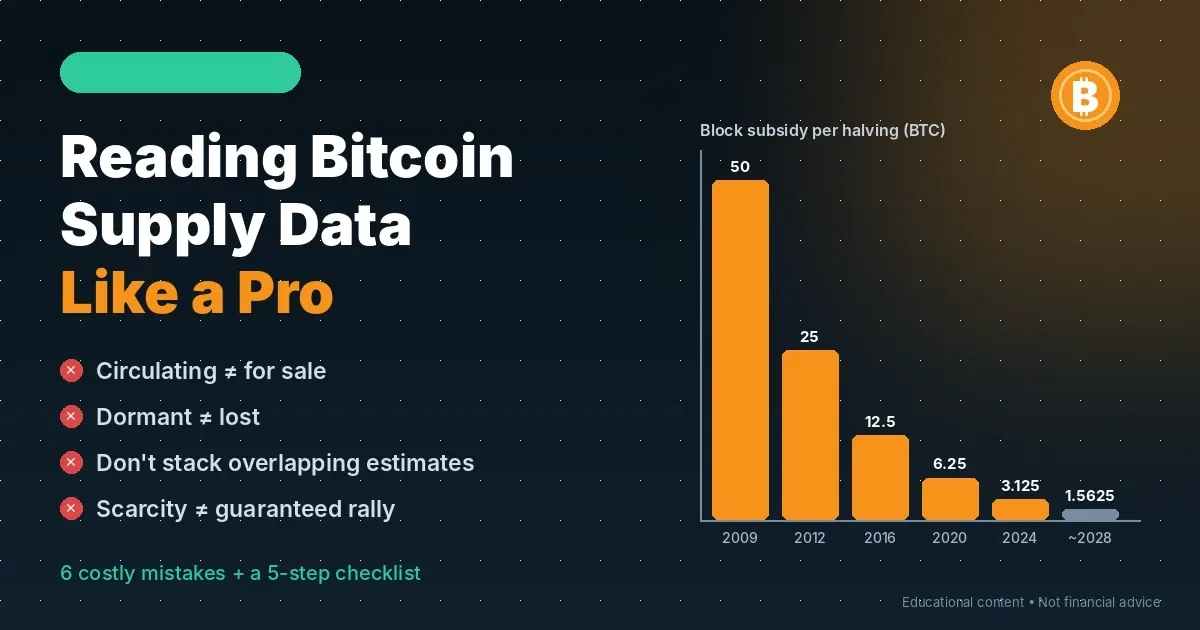
The subsidy shrinks by half every 210,000 blocks — the famous halving, which happens roughly every four years:
| Era | Block subsidy |
|---|---|
| 2009 (launch) | 50 BTC |
| 2012 halving | 25 BTC |
| 2016 halving | 12.5 BTC |
| 2020 halving | 6.25 BTC |
| April 2024 halving | 3.125 BTC (current) |
| Next halving (expected ~2028) | 1.5625 BTC |
Because blocks don't arrive at exactly ten-minute intervals, halving dates are approximate — but the quantity of future issuance is fully predictable. That combination of transparency and scarcity is rare in finance.
Key point: Once a miner receives fresh BTC, it joins the circulating-supply count — whether the miner sells it immediately, holds it for a decade or loses the wallet next week.
Layer 3: The Lost Coins — Still Counted, Never Spent
This is where things get interesting.
Imagine someone mined 50 BTC on a laptop in 2010, then threw the hard drive away. Those coins still sit on the blockchain at their address. Anyone can see the balance. But without the private key, no valid transaction can ever be signed — so the coins are frozen forever.
Here's the twist: lost bitcoins are almost always still included in circulating supply. Why? Because the blockchain cannot tell the difference between:
- an owner who lost their private key,
- an owner who passed away without sharing access,
- a patient holder who simply hasn't sold in 12 years,
- a custodian's cold-storage wallet, or
- coins deliberately kept as a strategic reserve.
A handful of coins sit in outputs that are provably unspendable by design. But for the vast majority of "lost" coins, there is no proof — only educated guesses. That's why every lost-Bitcoin figure you read online is an estimate, and different researchers reach different totals depending on their assumptions.
⚠️ Stolen ≠ lost. If a hacker controls the keys, those coins are perfectly spendable and can flow back into the market at any time.
Layer 4: Dormant and Illiquid Coins — Sleeping, Not Dead
Two more labels often get confused with "lost":
🛌 Dormant Bitcoin simply hasn't moved on-chain for a chosen period — one year, five years, seven years, whatever threshold an analyst picks. Dormancy measures time, not intent. The owner may be fully in control and ready to sell tomorrow.
🔒 Illiquid Bitcoin is a behavioural label. Analytics firms classify wallets (or groups of wallets) as illiquid when they historically keep most of what they receive. But behaviour can change — a long-term holder who decides to take profits instantly turns "illiquid" coins into liquid ones.
And remember, a wallet that doesn't move isn't necessarily inactive economically. Bitcoin held by a custodian for an ETF can sit still on-chain while shares of that fund change hands thousands of times a day on the stock market.
Layer 5: The Available (Liquid) Supply — The Number Everyone Wants
So what about the coins that are realistically "out there" to trade? Here's the uncomfortable truth: Bitcoin has no official "available supply" figure. The term can mean several different things depending on who's measuring:
- Exchange supply — BTC sitting in wallets identified as belonging to exchanges. Easier to trade, but not the same as coins for sale.
- Liquid supply — BTC held by entities that move coins frequently, based on each provider's wallet-grouping model.
- Free float — circulating supply minus coins judged locked, strategic, long-dormant, burned or lost.
- Short-term holder supply — coins that moved recently, a hint of activity rather than a promise to sell.
That's why two respected data firms can publish completely different "available BTC" numbers without either being wrong — they're answering different questions.
The Overlap Trap: Why You Can't Just Subtract
A common mistake goes like this:
20M mined − X lost − Y dormant − Z illiquid = "real" supply.
The problem? These categories overlap. A lost coin is almost certainly dormant and illiquid too. Subtract all three separately and you count the same coins two or three times — producing an artificially tiny number that fuels misleading "supply shock" headlines.
Unless a methodology explicitly removes overlaps, never stack these estimates on top of each other.
What the 20 Million Milestone Really Told Us
Crossing 20 million meant one thing: cumulative issuance passed 20 million under the subsidy schedule, leaving less than about 1 million BTC to be created over the next century or so.
It did not mean:
- ❌ 20 million BTC are accessible to their owners
- ❌ 20 million BTC are available to buy
- ❌ 20 million BTC sit on exchanges
- ❌ every coin will someday return to the market
- ❌ the final million will be mined quickly
It was an issuance milestone — nothing more, nothing less.
The Bottom Line
Think of Bitcoin's supply as a set of nested circles:
- Maximum supply (~21M) — the hard cap
- Mined / circulating supply (20M+) — everything issued so far
- Accessible supply — mined coins minus the truly lost (unknown)
- Liquid / available supply — coins likely to trade soon (model-dependent)
Each inner circle is harder to measure than the one outside it. The smartest market participants don't chase a single magic number — they ask which number they're looking at, who calculated it, and when.
In our companion article, we'll turn this knowledge into a practical toolkit: how traders should read Bitcoin supply data and the six mistakes that trip up even experienced investors.
Risk disclaimer: This article is for educational purposes only and is not financial advice. Cryptocurrencies and CFDs are highly volatile and carry a significant risk of loss.