
Retail forex trading is legal in the UAE, but only through licensed firms, so the broker's license matters more than its marketing. Onshore brokers fall under the SCA, while the DFSA covers DIFC in Dubai and the FSRA covers ADGM in Abu Dhabi. Offshore licenses, or look-alike labels such as CMA, are not UAE licenses and leave you without local protection.
The article lays out a license-check routine and a seven-step start: set a budget you can afford to lose, verify the license, prepare KYC documents, register, choose a cent or standard account, practice on a demo, then fund and place a small trade. It also explains how to compare brokers on client money, costs, withdrawals, and support, and how to spot red flags.
Other topics include MT4 versus MT5, app testing, spreads, swaps, the dangers of high leverage, swap-free Islamic accounts, and trading styles that suit UAE hours. Beginners are advised to risk 1 to 2 percent per trade and keep a journal. A ValeTax no deposit bonus is presented as a low-cost way to test a broker, provided you read the withdrawal conditions first.
You have probably heard that Dubai is full of traders, but you want a straight answer before you put money anywhere. Is forex trading in Dubai, UAE legal, and who is allowed to offer it to you? Plenty of brokers advertise to UAE residents, and not all of them are properly licensed.
Here is the short answer. Yes, retail forex trading is legal in the UAE, but only through firms that hold the right license. In Dubai that usually means the Securities and Commodities Authority (SCA), the DFSA in DIFC, or the FSRA in Abu Dhabi Global Market. Always check a broker's license number on the regulator's public register before you register or deposit.
This article walks you through how the rules work, what to look for in a regulated forex broker in the UAE, and how to open your first account step by step. At ValeTax, we help beginners test live trading with a no deposit bonus, so we also cover the basics of account types, leverage, and risk, and how to start small without overreaching.
Why forex trading in Dubai and the UAE matters
Dubai is one of the few places where forex trading in Dubai, UAE is a mainstream activity rather than a niche hobby. The country combines a large international population, a serious financial sector, and a currency system built around the US dollar. Those three facts shape which brokers you meet, when you trade, and what risks you face.
A financial hub with a global trading crowd
The UAE hosts two financial free zones, DIFC in Dubai and ADGM in Abu Dhabi, and each has its own regulator. That means UAE forex trading sits inside a real regulatory structure, not a gray area. It also means global brokers compete hard for your attention, and the marketing is loud.
Expats from dozens of countries live here, and many earn in one currency and send money home in another. That gives them a natural reason to follow exchange rates, and many start looking at forex to understand how those rates move. The catch is that a crowded market attracts unlicensed operators. If you search for a forex broker in UAE, you will see offshore firms with polished websites and no local license. Before you ask which is the best forex broker in UAE, ask which ones are licensed at all.
In the UAE, the license behind a broker matters far more than the ads in front of it.
Trading hours that fit a UAE day
The forex market runs 24 hours a day, five days a week, and the UAE sits in a convenient spot. The country stays on UTC+4 all year with no daylight saving, so session times are easy to plan around. London and New York, where most volume trades, land in your afternoon and evening. That suits anyone with a day job, because you can trade after work instead of watching charts at your desk.
| Session | Approx. Dubai time, Dubai operates on Gulf Standard Time (GST), which is UTC+4. It remains on this time zone all year round as it does not observe Daylight Saving Time (DST) | Pairs often traded, Which pair is best for trading? |
|---|---|---|
| Tokyo | 04:00 to 13:00 | USD/JPY, EUR/JPY |
| London | 12:00 to 21:00 | EUR/USD, GBP/USD |
| New York | 17:00 to 02:00 | EUR/USD, USD/CAD, XAU/USD |
These times shift by an hour when the UK and the US change their clocks.
Liquidity usually peaks when London and New York overlap, roughly 17:00 to 21:00 Dubai time. Spreads tend to be tighter then, and price moves are cleaner. Beginners do well to stick to that window and avoid thin overnight hours, when spreads can widen without warning.
The dirham peg, gold, and tax
Because the dirham is pegged to the US dollar at about 3.6725, you will not find AED pairs worth trading. Most UAE traders focus on USD pairs and gold. A USD account also keeps deposit conversion simple for dirham earners. Dubai is a major physical gold market, so XAU/USD already feels familiar to many local traders.
Personal income tax is not charged on individuals in the UAE, which is part of the appeal. Corporate tax rules and the treatment of trading as a business can differ, so confirm your own position with a local accountant. Low tax does not lower market risk. Most retail CFD accounts lose money, so treat forex trading in UAE as a skill you build slowly, with small positions first.
Is forex trading legal in the UAE?
Yes, retail forex trading is legal, but the law attaches to the firm, not to you. Only licensed firms may sell leveraged forex and CFDs to UAE residents, so the real question is whether your broker holds the right license. If you are asking how to do forex trading in UAE the legal way, that check comes first.
What the law allows
Licensed brokers can offer leveraged products inside a regulated framework. Onshore, the SCA oversees them. Inside DIFC it is the DFSA, and inside ADGM it is the FSRA. A licensed broker must meet capital, conduct, and client-money rules, and you get a formal complaints route if a dispute turns ugly.
Individual traders are not the target of these rules. Authorities focus on companies that solicit or manage client money without approval. That is why a regulated forex broker in the UAE is worth more than a flashy platform.
The offshore gray zone
Many brokers that advertise to UAE residents hold licenses only in offshore jurisdictions. Opening an account with one is not automatically illegal for you. Still, you lose local protection, and a UAE regulator has little power to recover your funds if the broker stops paying withdrawals.
Treat the difference seriously, because an offshore license is not a UAE license. Fewer rules apply to how your deposit is held, how complaints are handled, and what the broker may promise in ads.
A broker's offshore license is not a UAE license, and the difference shows up when you need your money back.
A quick legality check
Run these steps before you register with any broker, including ours:
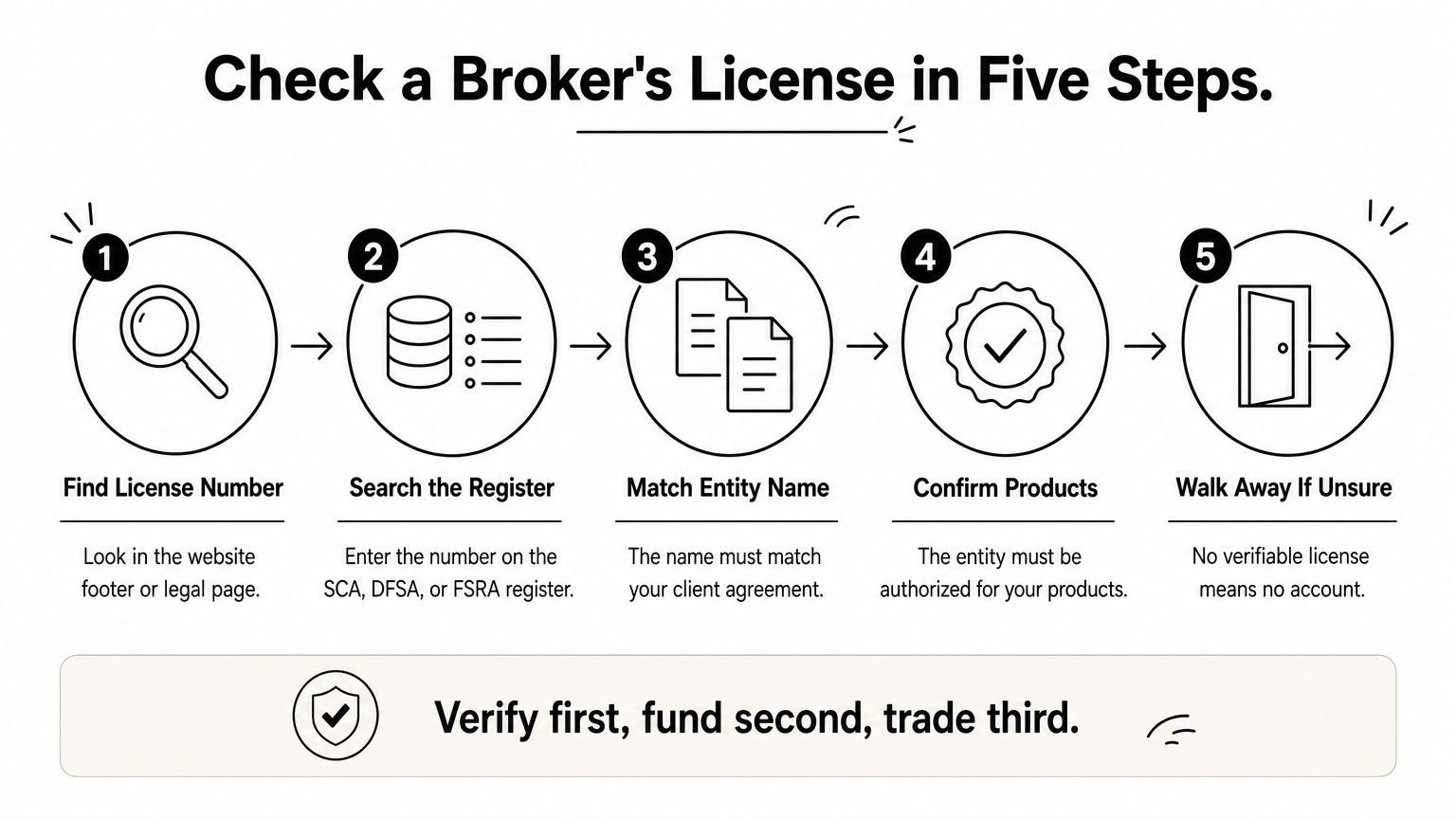
- Find the license number on the broker's website footer or legal page.
- Search that number on the regulator's public register (SCA, DFSA, or FSRA).
- Confirm the legal entity name matches the one in the client agreement.
- Confirm the entity is authorized for the products you plan to trade.
- Walk away if the broker cannot show a verifiable license for your country.
This section is general information, not legal advice. Rules and enforcement priorities change, so confirm the current position with the regulator or a licensed advisor before you deposit.
Who regulates UAE forex brokers: CMA, DFSA and FSRA
Three names come up again and again when you check a UAE forex broker, and each one covers a different territory. Mixing them up is the most common beginner mistake, so start with the map.
The three regulators at a glance
| Regulator, Securities and Commodities Authority | Where it applies | Register to check |
|---|---|---|
| SCA (Securities and Commodities Authority) | Onshore UAE, (United Arab Emirates)including mainland Dubai | SCA website |
| DFSA (Dubai Financial Services Authority) | DIFC in Dubai | DFSA public register |
| FSRA (Financial Services Regulatory Authority) | ADGM in Abu Dhabi | FSRA public register |
Think of it by address. A firm licensed by the DFSA is authorized to operate from DIFC, and a firm licensed by the FSRA is authorized in ADGM. The SCA covers the rest of the country, so it is the federal body most relevant to onshore retail brokers.
A note on the "CMA" label
You may see "CMA" in search results or broker marketing as shorthand for the UAE regulator. The federal body is the SCA. Several other Gulf countries have a Capital Market Authority with a similar name, so a CMA license from another country is not a UAE license. If a broker shows only the letters CMA, ask which country and which register.
What this means for your choice
A license from one regulator does not transfer to another. Each authority licenses specific legal entities and specific activities. That is why the entity name and the permitted products matter as much as the logo in the footer.
A regulator's name on a broker's website proves nothing until you find the same entity on that regulator's register.
Tighter regulation can also change what you get. Regulated firms often face limits on retail leverage and bonuses, so the terms may look less generous than offshore offers. That trade-off is real. When you compare the best forex broker UAE traders talk about, ask any firm, including ValeTax, which entity holds which license and which clients it covers.
How to start forex trading in Dubai step by step
Opening an account takes about a day if your documents are ready. The order of the steps matters more than the speed, because a license check done after you deposit is a check done too late. This is the sequence we recommend for anyone starting forex trading in UAE for the first time.
The seven steps
Work through these in order, and do not skip ahead to funding. Each step protects the next one, so a rushed beginner usually pays for it later.
- Set a budget you can afford to lose. For many beginners that is $100 to $500, or less.
- Verify the broker's license on the SCA, DFSA, or FSRA register.
- Gather your KYC documents: Emirates ID or passport, plus proof of address.
- Register and complete verification. Most brokers confirm within one to two business days.
- Choose an account type. A cent or standard account suits a first-timer.
- Practice on a demo account for a week or two.
- Fund the account and place one small first trade.
Verify the license first, fund second, trade third.
Documents and funding
Proof of address trips up many UAE residents. A tenancy contract (Ejari), a DEWA or Etisalat bill, or a recent bank statement usually works, though each broker sets its own rules. Scan the documents clearly, because blurry uploads are the most common cause of verification delays.
Fund the account only through licensed payment options in your own name. Third-party payments often get rejected at withdrawal. A USD account also saves you repeated conversion, since the dirham is pegged to the dollar.
Your first week of trading
Spend the first days on a demo account to learn the platform, order types, and stop-losses. Then move to a small live account and risk only 1 to 2 percent per trade. On a $200 account, that is $2 to $4 per position. Stick with liquid pairs such as EUR/USD, and keep a simple trade journal noting your entry, exit, and reason.
If you would rather not fund the account at first, a no deposit bonus can give you live market exposure with no deposit of your own. We cover how that works later in this guide.
How to choose a regulated forex broker in the UAE
Most of the risk in forex trading in Dubai, UAE is decided before your first trade, when you pick a broker. Licensing is the filter, and everything else is a tiebreaker. Use the criteria below to cut a long list down to two or three firms.
Five criteria that matter
Rank brokers on facts you can verify, not on ads. Check the license first, then compare the rest side by side.
| Criterion | What to look for |
|---|---|
| License | The exact legal entity on the SCA, DFSA, or FSRA register, authorized for retail leveraged products |
| Client money | Segregated accounts at a named bank |
| Costs | Published spreads, commissions, and swap fees |
| Withdrawals | Stated timelines, payouts to your own name, no surprise fees |
| Support | Live chat or phone during UAE (United Arab Emirates) hours, ideally in English and Arabic |
The best forex broker in UAE for you is the licensed one whose costs and withdrawal rules you have actually read.
No single best forex broker UAE list fits everyone. A $200 beginner needs low minimums and a cent account, while an experienced trader may care more about raw spreads.
Red flags to walk away from
Some warning signs show up early, so treat them as a full stop, not a negotiation.
- Promises of guaranteed profits or fixed monthly returns
- A license number you cannot find on any public register
- Pressure to deposit quickly to "lock in" an offer
- Contact only through a messaging app, with no company address
- Bonus terms that are vague about withdrawal conditions
A genuine forex broker in UAE will not mind slow, careful questions. Pushy sales behavior tells you how the firm will treat your complaint later.
Test the broker before you trust it
Open the account small. Deposit a minimum amount, place a few trades, then request a withdrawal and time it. A broker that pays out quickly and without fuss has passed the test that matters most.
Apply the same standard to every firm, including ours. If you consider ValeTax, check which legal entity serves your country, read the bonus and withdrawal terms, and start with the $1 minimum or a cent account. Small tests cost little and show you how the broker behaves in practice.
How to pick the best forex trading platform and app
The platform is the software you trade on, and your broker decides which one you get. So the best forex trading platform in UAE is not a separate choice from the broker. Pick the licensed firm first, then judge the platform it offers. Most UAE traders end up on MetaTrader 4 or MetaTrader 5, and both run on desktop, web, iOS, and Android.
Choose the broker first, because a platform is only as good as the firm running the servers behind it.
MT4 or MT5
Beginners often ask which one to install. Either works for forex. MT4 is simpler and has a huge library of free indicators and expert advisors, while MT5 adds depth with more timeframes, an economic calendar, and more asset classes. ValeTax offers both, so you can try each on a demo account before you decide.
| Feature | MetaTrader 4 (MT4) MetaTrader 4 (MT4) is a free electronic trading platform released by MetaQuotes Software in 2005 | MetaTrader 5 (MT5) |
|---|---|---|
| Timeframes | 9 | 21 |
| Pending order types | 4 | 6 |
| Built-in economic calendar | No | Yes |
| Best for | Simple forex charting | Multi-asset, deeper analysis |
What a good forex trading app must do
Judging the best forex trading app in UAE comes down to how it behaves on a busy trading day, not how it looks in the store. Check these before you rely on any forex trading app in UAE:
- Stable order execution with no freezes during news
- One-tap stop-loss and take-profit settings
- Price alerts and push notifications
- Two-factor login and fingerprint or face unlock
- A full demo mode that mirrors live conditions
- English and Arabic support inside the app
A clean interface matters less than these basics. If the app lacks stop-loss controls or two-factor login, skip it.
Test before you commit
Spend a week on a demo account that matches the live account type you plan to use. Place trades on your phone as well as your laptop, and compare the fills with the live quotes you see. Try it on mobile data and on home Wi-Fi, because a weak connection is a common cause of missed exits.
Also run the app through one major news release, such as US jobs data. Watch how spreads and execution behave. If you plan to run automated strategies around the clock, ask whether the broker offers a free VPS, since ValeTax provides one to eligible users.
How to understand costs, leverage and swap-free accounts
Costs and leverage decide whether a small account grows or disappears. Learn three numbers before you trade: spread, leverage, and swap. Any fair comparison of a forex broker UAE traders recommend should start with them.
Spreads, commissions and swaps
Spread is the gap between the buy and sell price, and you pay it on every trade. On 0.1 lot of EUR/USD, a 1.2 pip spread costs about $1.20. Raw-spread accounts show spreads near 0.0 pip but add a commission, so compare the total cost per trade, not the headline number.
| Account | Spread from, The Forex Spread Definition is the difference between the buy (ask) and sell (bid) price of a currency pair | Suits |
|---|---|---|
| Cent | 1.2 pip | Beginners starting at $1 |
| Standard | 1.2 pip | Most first-time traders |
| ECN | 0.0 pip | Direct market access |
| PRO | 0.6 pip, zero commission | Experienced traders |
Swap is a fee or credit for holding a position overnight. Day traders rarely notice it. Swing traders feel it when a trade stays open for weeks.
Leverage cuts both ways
ValeTax offers up to 1:2000, though regulated firms often cap retail leverage far lower. Look at what that means in practice. With $200 at 1:500, you can control $100,000, which is one standard lot. A 100 pip move against you then costs about $1,000, five times your balance. High leverage does not make you wrong more often, it makes one mistake final.
Leverage does not change your odds, it changes how fast a single mistake becomes permanent.
Size your trade from your stop-loss, not from the maximum the broker allows. Risk 1 to 2 percent of the account, and the leverage you actually use will stay modest.
Swap-free (Islamic) accounts
Many traders in the UAE avoid interest for religious reasons. A swap-free account removes the overnight swap, and that matters if you hold positions past the daily rollover. Brokers often replace the swap with an admin fee or a wider spread, so the account is not always cheaper.
Before you open one, ask these questions:
- Is a swap-free option available for my account type and instruments?
- What fee replaces the swap, and after how many days does it apply?
- Does the rule differ for gold, indices, or crypto?
Get the answers in writing from support. Availability varies by broker and region, so confirm it for your account before you fund it.
Trading styles and risk management examples for beginners
Your trading style should match your schedule, not the other way around. Pick a style you can sustain on a normal workday, and set risk rules before you build a strategy. For forex trading in Dubai, UAE, the evening London and New York overlap suits people who work office hours.
Three styles compared
Each style trades time for effort. The table shows how they differ in practice.
| Style | Typical holding time | Fits | Main drawback |
|---|---|---|---|
| Scalping | Seconds to minutes | Full-time screen watchers | Spreads eat small gains |
| Day trading | Minutes to hours | Evening sessions after work | Needs focus for 1 to 3 hours |
| Swing trading | Days to weeks | Busy people, phone checks | Swap fees and overnight gaps |
Beginners usually do best with day trading or short swing trades on the 1-hour or 4-hour chart. Scalping looks exciting, but it demands tight spreads and fast execution, and costs eat small gains quickly.
A worked risk example
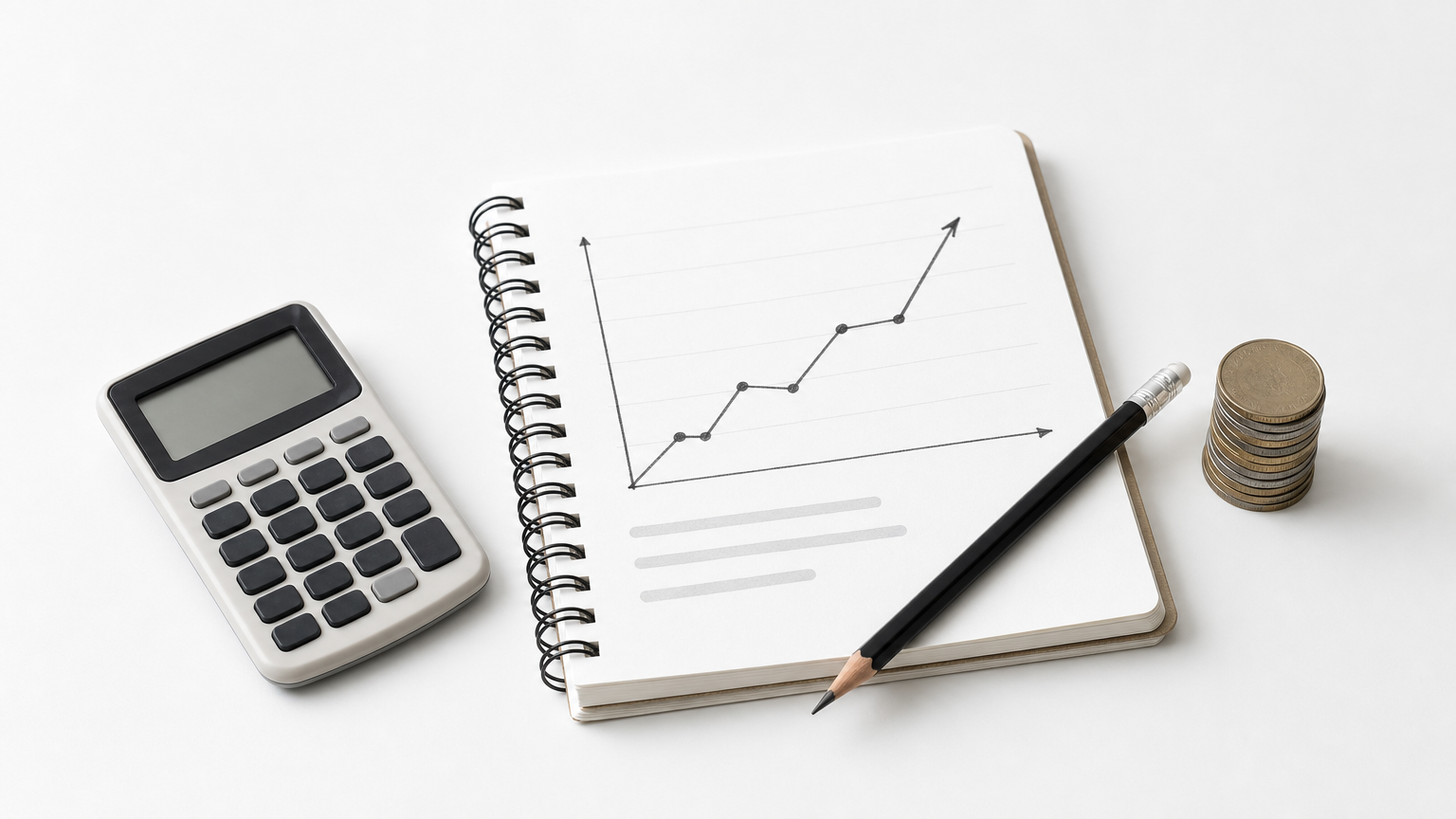
Take a $200 account and risk 1 percent, which is $2. You buy EUR/USD with a 20 pip stop-loss. At 0.01 lot, one pip is worth about $0.10, so a stopped trade loses exactly $2. Set the take-profit at 40 pips and a win pays about $4, a 1:2 reward-to-risk ratio.
Decide how much you can lose before you open the trade, not after.
Even then, you need to win only about one trade in three to break even before costs. Ten losses in a row would cost roughly $20, so one bad streak will not end your account. Compare that with using 1:500 leverage to open a full lot, where a single bad trade can erase everything.
Habits that protect you
Small rules keep the math working when emotions get loud. Write them down before you place a live trade:
- Set a daily loss limit of 3 percent and stop for the day when you hit it.
- Stop after three losses in a row and review your journal.
- Never move a stop-loss further away from your entry.
- Skip major news releases until you have a few weeks of experience.
- Trade one or two liquid pairs, such as EUR/USD and USD/JPY.
Finally, review your journal every weekend. Look for patterns, such as overtrading on Fridays or entering without a stop. Fixing one habit at a time does more for a small account than any new indicator.
Using a no deposit bonus to try live trading safely
A no deposit bonus lets you trade live market prices without funding the account first. For forex trading in Dubai, UAE, that makes it a cheap way to test a broker's platform, execution, and support. Unlike a demo account, the profits can be real, once the broker's conditions are met.
How the ValeTax bonus works
The offer is small and has clear limits. Here are the terms as they stand, though they can change, so confirm them on the claim page before you register.
| Item | Detail, Valetax offers promotional credit bonuses (such as deposit or welcome bonuses) |
|---|---|
| Amount | Up to $50, varies by region |
| Who qualifies | First-time verified users only |
| Verification | KYC with ID and proof of address |
| Where it goes | A separate bonus account |
| Expiry | 30 days if unused |
| Withdrawals | Profits after trading volume conditions are met |
Regulated firms often restrict bonuses, so availability depends on your region and the entity serving you. Ask support which entity applies to your UAE account before you rely on the offer.
Rules for using it safely
Read the volume condition first. It tells you how much you must trade before profits can leave the account, and it decides whether the bonus is worth your time. Many beginners claim first and read later, then discover the target is out of reach.
A bonus is only free when you have read the withdrawal conditions before your first trade.
Follow these rules while you use it:
- Complete KYC early, so the 30-day clock is not wasted on verification.
- Treat the bonus like real money and apply the same 1 to 2 percent risk rule.
- Trade liquid pairs such as EUR/USD, where spreads stay tight.
- Avoid chasing the volume target with oversized positions.
A realistic plan for a $50 bonus
Risking 1 to 2 percent of $50 means $0.50 to $1 per trade. On EUR/USD, a 0.01 lot with a 10 pip stop-loss risks about $1, which fits that limit. Aim for five to ten small trades and log each one in your journal.
Use the bonus as an audition for the broker, not as a way to get rich. Check how fast orders fill, how the app behaves, and how support answers questions. If everything holds up, you can fund a small cent or standard account later, with a clear view of how the platform works.
Final thoughts before you open an account
Forex trading in Dubai, UAE is legal, but the law protects you only when your broker holds the right license. Check the license on the SCA, DFSA, or FSRA register before you register, and treat vague offshore claims with caution. That one habit removes most of the avoidable risk from your first account.
Next, keep everything else small and simple. Risk 1 to 2 percent per trade, size positions from your stop-loss, and practice on a demo account first. Leverage, swaps, and platform choice matter, but none of them rescue a trader who skips these basics.
Finally, if you want live market exposure without funding the account, a no deposit bonus is a low-cost audition. Read the withdrawal conditions, then claim your ValeTax no deposit bonus and test the platform with small, journaled trades. Trading involves risk, and the bonus is subject to ValeTax terms.