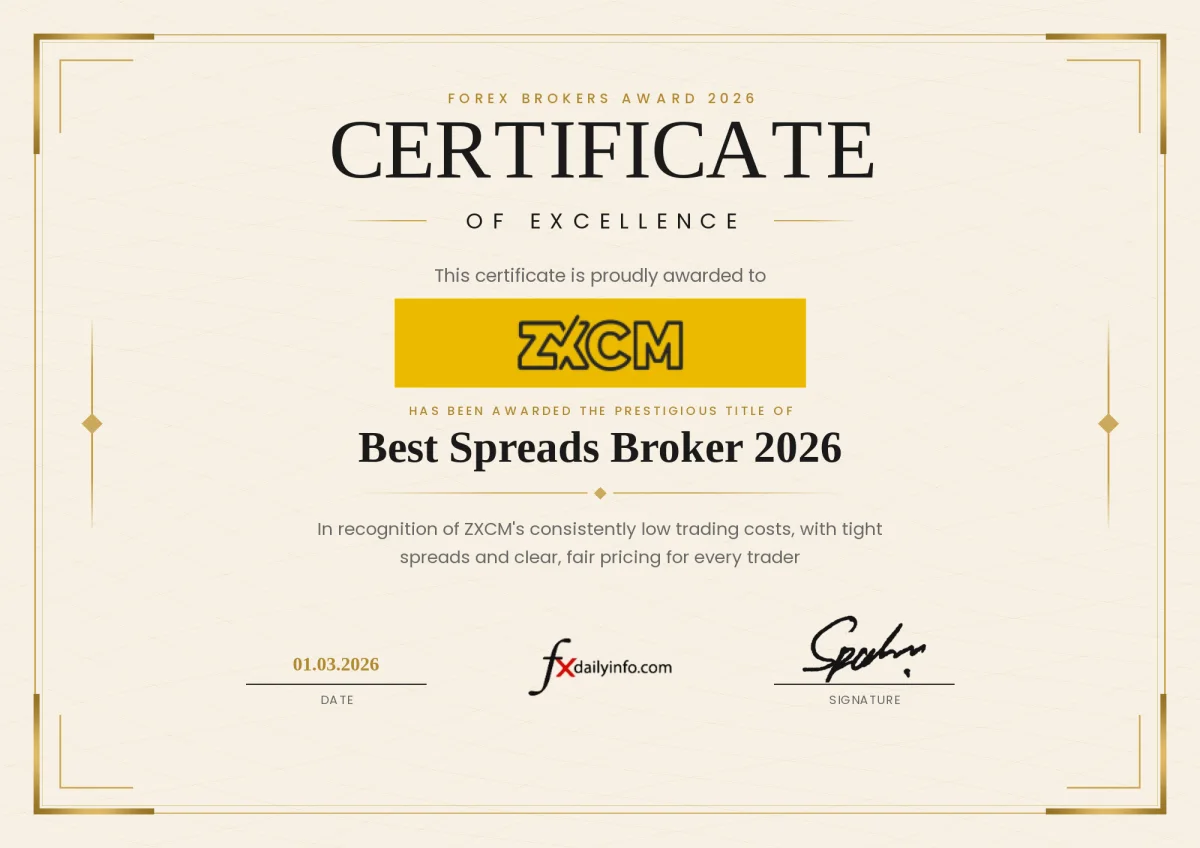


ZXCM is the winner of the Best Spreads Broker 2026 award in the FXDailyInfo Forex Brokers Award 2026. The spread is the first cost every trader pays, on every trade, win or lose. This award goes to the broker whose pricing was rated tightest and fairest by voters and by our editors. This article explains what a spread is, how to work out what it really costs you, what our broker profile says about ZXCM and how to compare brokers properly.
ZXCM also won Best Global MT5 Broker 2026, which is covered in a separate article.
What Is a Spread?
Every currency pair has two prices at any moment:
- the bid, at which you can sell
- the ask, at which you can buy
The gap between them is the spread. It is measured in pips. For most pairs one pip is 0.0001. For yen pairs it is 0.01.
If EUR/USD is quoted at 1.08500 bid and 1.08508 ask, the spread is 0.8 pips. When you open a trade, you start that far behind. The market has to move in your favour by the size of the spread before you break even.
What a Spread Costs in Money
On a standard lot of 100,000 units of EUR/USD, one pip is worth about $10. So:
- a spread of 1.0 pip costs about $10 per lot
- a spread of 0.2 pips costs about $2 per lot
- on a mini lot (0.1) divide by ten, and on a micro lot (0.01) by one hundred
That looks small. Now count trades. A day trader who places five one-lot trades a day pays for about a hundred trades a month. A difference of half a pip is then about $500 a month. For active traders, the spread decides whether a strategy makes or loses money.
Who Is ZXCM?
Our broker profile lists ZXCM as established in 2023, based in Seychelles and regulated by the Financial Services Authority (FSA) of Seychelles under Securities Dealer licence SD214.
The profile lists:
- spreads from 0.0 pips
- STP/ECN execution
- MetaTrader 5 on desktop, web and mobile
- minimum deposit of $100
- maximum leverage of 1:500
- hedging, scalping and news trading allowed
How "From 0.0 Pips" Works
A spread of zero does not mean trading is free. It describes a raw spread account:
- the broker passes on the price from its liquidity providers with no mark-up
- at the best moments of the day, bid and ask on a major pair can be equal
- the broker earns from a fixed commission per lot
The honest way to judge such an account is the all-in cost:
all-in cost = average spread + commission (converted to pips)
For example, an average spread of 0.1 pips plus a commission of $6 per round lot (0.6 pips) gives 0.7 pips. A no-commission account with a 1.0 pip spread costs more than that, even though its spread sounds simple.
Ask ZXCM for the commission on each account type and do this sum for the pairs you trade.
Why Spreads Change
With STP/ECN execution, spreads float. They follow the market:
- Tightest when London and New York are both open, roughly from early afternoon to evening in Europe.
- Wider in the late US session and the early Asian hours, when fewer banks are quoting.
- Much wider for a few seconds around major news such as interest rate decisions and employment data.
- Wider at the daily rollover, when banks reset their books.
- Wider on minor and exotic pairs at all times.
A broker cannot remove these effects. A good one keeps them small and does not add to them.
What the Award Looks At
Each nominee is judged on the votes it receives from traders on FXDailyInfo, together with an editorial review. In the spreads category the review considers:
- typical spreads on major pairs, not only the minimum
- commission and the resulting all-in cost
- how spreads behave at busy and quiet hours
- whether pricing is the same for all clients on an account type
- how clearly costs are published
ZXCM was rated first among the nominees for 2026.
How to Measure a Broker's Spread Yourself
You do not need special tools:
- Open a small live account. Demo spreads can differ from live ones.
- Show the spread in MT5. Right-click the Market Watch window and add the "Spread" column. It is shown in points, and ten points are one pip.
- Note the spread at five set times each day for a week: Asian morning, London open, New York open, late US session and rollover.
- Check during one major news release.
- Average your notes and add the commission.
Do the same at a second broker and compare the two averages. This small exercise is worth more than any marketing table.
Other Costs Next to the Spread
A low spread can be cancelled out by other charges. Look at the whole bill:
- Swap. A daily charge or credit on positions held overnight. On trades kept for weeks, swap can exceed the spread many times.
- Slippage. The difference between the price you asked for and the price you got. Tight spreads with heavy slippage are not cheap.
- Deposit and withdrawal fees.
- Currency conversion if your account currency differs from your deposit currency.
- Inactivity fees.
Who Gains Most From Low Spreads
- Scalpers, who aim for a few pips per trade. For them the spread is a large share of each target.
- Day traders, who trade often.
- Robot traders, whose systems may be profitable at 0.3 pips and losing at 1.3.
- News traders, who need spreads that recover quickly after a release.
A long-term trader who holds positions for weeks is less affected. For that style, swap rates matter more.
Regulation and Safety
The FSA of Seychelles licenses and supervises securities dealers. That is more than a simple company registration. It remains an offshore regulator, with lighter rules than the FCA, ASIC or CySEC and no compensation scheme.
- Check licence SD214 on the FSA's own website.
- Ask the broker to confirm segregated client accounts and negative balance protection.
- Start with a modest balance. The broker was established in 2023 and its track record is still short.
Leverage
Cheap trading can tempt you to trade bigger. Leverage up to 1:500 makes that easy. Position size, not spread, is what empties accounts. Set your risk per trade first and stick to it.
Points to Check Before You Start
- Commission per lot on each account type
- Your own measured average spread
- Swap rates on pairs you hold overnight
- Minimum deposit for the raw spread account
- Withdrawal fees and times
Our Verdict on ZXCM
ZXCM wins Best Spreads Broker 2026 because voters and our editors rated its pricing ahead of the other nominees. Raw spreads from 0.0 pips, STP/ECN execution and freedom to scalp are what cost-focused traders look for.
Take the next step yourself. Ask for the commission, measure the live spread for a week and work out your all-in cost. If the result is as low as the headline suggests, you will have found a real saving that repeats on every trade.
What the Best Spreads Broker 2026 Award Recognises
This award goes to a broker whose everyday trading costs are among the lowest available to retail clients. The spread on major pairs is the starting point, but commission, swaps and non-trading fees are added before any comparison is made.
A headline spread "from 0.0 pips" proves little on its own. What counts is the typical all-in cost during normal market hours on the instruments most clients trade.
The main points assessed in this category are:
- Typical spreads on EUR/USD, GBP/USD and gold
- Commission per lot on raw-spread accounts
- Overnight swap rates
- Deposit, withdrawal and inactivity fees
- How far spreads widen around news
About the FXDailyInfo Forex Brokers Award
The FXDailyInfo Forex Brokers Award is held every year. Brokers and trading companies are nominated in categories that cover trading conditions, platforms, client service, partnership programmes and more.
Winners are chosen from the nominees using votes cast by traders on FXDailyInfo together with an editorial review of pricing, execution, platforms, research tools and customer support. Each winner receives an official badge and a numbered certificate.
The certificate on this page carries the reference FXDI-2026-0153. Anyone can confirm it by opening this page on fxdailyinfo.com, which is the only place the result is published.