
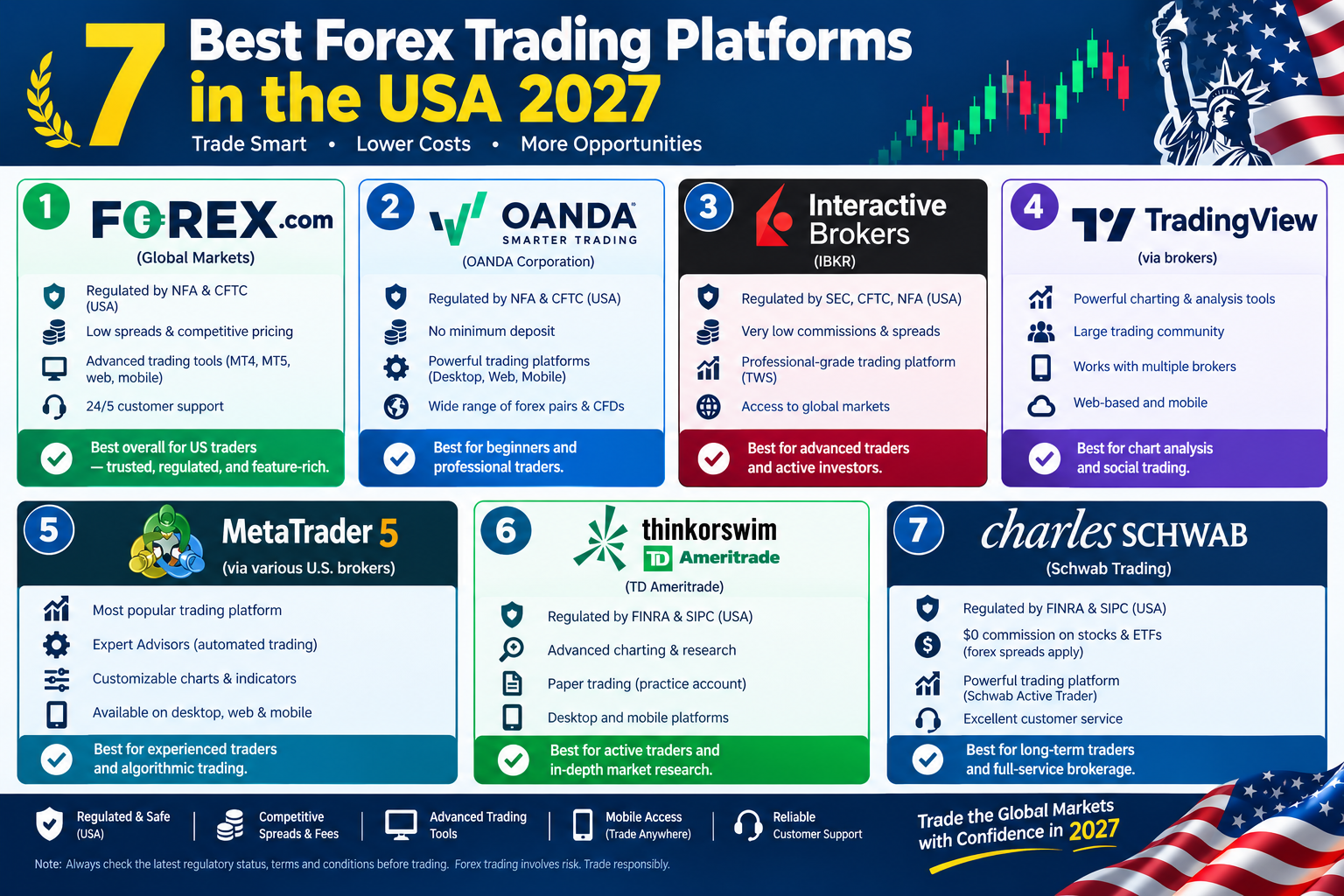
This guide reviews seven forex trading platforms legally available to US traders in 2027, focusing on CFTC registration and NFA membership as non-negotiable baselines given strict US leverage caps (50:1 on majors) and broker restrictions. tastyfx, the rebranded IG US now under tastytrade, offers spread-only pricing and a clean proprietary platform ideal for beginners but lacks MT4/MT5.
Forex.com, backed by StoneX since 2001, supports MT4, MT5, and TradingView, suiting algo traders. OANDA stands out for transparent historical data and REST/FIX APIs favored by quant traders, though it skips MetaTrader. Interactive Brokers serves multi-asset traders through its powerful Trader Workstation, regulated by four agencies. Charles Schwab's thinkorswim bundles forex with stocks and options, appealing to existing Schwab clients.
TradeStation targets active, chart-driven traders with its EasyLanguage scripting and backtesting tools. Trading.com, newer but backed by Trading Point Group, uniquely offers MT4/MT5 support alongside Forex.com.
The article stresses checking regulation, leverage limits, platform compatibility, fees, and withdrawal speed before committing funds, and outlines the account-opening process, typical funding methods, and answers common FAQs about legality, costs, MetaTrader access, minimum deposits, and demo accounts, ultimately urging traders to match platform strengths to their specific trading style and risk tolerance.
7 Best Forex Trading Platforms in the USA
Trading forex in the United States isn't like trading anywhere else. The CFTC and NFA enforce strict rules on leverage, hedging, and which brokers can even accept US clients, so a forex trading platform usa traders actually recommend is a much shorter list than what you'll find in global broker directories. If you've spent time searching and keep landing on brokers that quietly exclude US residents in the fine print, you're not alone.
This guide cuts through that confusion. We looked specifically at platforms licensed to operate in the US, checked their fee structures, and tested how their tools hold up for both new and experienced traders, so you're comparing options that will actually let you open an account.
Below you'll find seven platforms worth your attention in 2026, covering everything from MT4/MT5 support to commission structures and account minimums. Whether you're after tight spreads, a clean charting interface, or a broker with a track record of solid execution, you'll walk away knowing exactly which forex trading platform in usa fits how you trade.
1. tastyfx
tastyfx is the rebrand of what used to be IG US, and it now operates as part of the tastytrade family of brokerages. That pedigree matters because tastytrade built its reputation on options and futures trading before expanding into forex, and it carried that same focus on transparent pricing and clean execution into tastyfx. If you're specifically hunting for a forex trading platform usa residents can trust without wading through complicated fee schedules, this is usually the first name that comes up in serious comparisons of forex brokers for US traders.
Regulation and trust
tastyfx is registered with the CFTC and holds membership with the NFA, the same baseline every legitimate US forex broker needs. Before the rebrand, the entity operated under IG Group, one of the largest publicly listed trading firms in the world, which gives tastyfx a longer operating history than most standalone US forex brands. Segregated client funds and regular audits come standard under NFA membership, so you're not relying on marketing copy to know your deposits are protected.
A broker's regulatory pedigree tells you more about safety than any bonus offer ever will.
Trading platforms and tools
Traders get access to a proprietary web and mobile platform built specifically for forex pairs, plus integration with TradingView charting for those who want more advanced technical analysis tools without leaving the browser. The platform supports one-click trading, customizable watchlists, and real-time economic calendar alerts, which matters if you trade around news events like NFP or FOMC releases. There's no MT4 or MT5 support here, which is a real limitation if you've built your strategy around custom Expert Advisors, but the native platform is fast and rarely lags during volatile sessions.
Fees and spreads
tastyfx runs on a spread-only pricing model with no separate commission charged per trade, which keeps the fee structure easy to understand at a glance.
|
Feature |
Detail |
|---|---|
|
Minimum deposit |
$0 (no stated minimum) |
|
EUR/USD typical spread |
Around 0.8 pips |
|
Commission |
None (spread-based) |
|
Platforms |
Proprietary web/mobile, TradingView |
|
Regulator |
CFTC, NFA |
Spreads widen somewhat compared to offshore ECN accounts, but for a regulated US broker, they sit competitively against Forex.com and OANDA on major pairs. There are no deposit or withdrawal fees for standard bank transfers, though wire transfers can carry a small charge depending on your bank.
Who it's best for
Beginners and intermediate traders who want a straightforward pricing model without commission math will feel at home here, and it holds up well against other forex brokers for beginners. Newer traders in particular benefit from the clean interface and built-in educational content tastytrade produces across its platforms, which covers everything from margin basics to risk management. Experienced algo traders who depend on MT4/MT5 automation should look elsewhere on this list, since tastyfx's proprietary platform doesn't support custom scripts or bots the way MetaTrader does.
2. Forex.com
Forex.com has been serving US traders since 2001, making it one of the longest-standing names in the retail forex space here. Owned by StoneX Group, a publicly traded financial services firm, it carries institutional backing that smaller brokers simply can't match. Anyone comparing a forex trading platform us based traders can rely on long-term usually puts Forex.com on the shortlist within the first few searches.
Regulation and trust
Registration with the CFTC and membership in the NFA put Forex.com on equal regulatory footing with every other broker on this list. StoneX Group's status as a NASDAQ-listed company adds a layer of public financial disclosure most competitors don't offer, since you can pull their quarterly filings and see exactly how the parent company is performing. Client funds sit in segregated accounts at top-tier US banks, and the firm has operated through multiple market crises without incident.
Longevity in a regulated market says more about a broker's reliability than any single review can.
Trading platforms and tools
Forex.com supports its own proprietary platform alongside MT4 and MT5, putting it among the MT5 brokers that serve US clients and setting it apart from tastyfx for anyone running automated strategies. TradingView charting is also built in, and active traders can access advanced order types plus a dedicated API for custom trading systems.
Fees and spreads
|
Feature |
Detail |
|---|---|
|
Minimum deposit |
$100 |
|
EUR/USD typical spread |
Around 1.2 pips (standard account) |
|
Commission |
None on standard; $5/side on Direct Market Access |
|
Platforms |
Proprietary, MT4, MT5, TradingView |
|
Regulator |
CFTC, NFA |
Standard account spreads run slightly wider than tastyfx, though the DMA account tightens spreads considerably for traders willing to pay per-trade commissions.
Who it's best for
Traders who want MT4/MT5 flexibility combined with a long regulatory track record fit best here. Newcomers benefit from extensive educational resources, while algo traders get the automation support tastyfx lacks.
3. OANDA
OANDA has built its US reputation on transparent historical pricing data and an API that quant-focused traders actually use, not just mention in marketing copy. It's been operating in the US since 2001, roughly the same era as Forex.com, and it built an early following among traders who wanted access to raw spread data going back years. If you're comparing a forex trading platform usa shortlist based on data transparency rather than flashy bonuses, the OANDA broker profile usually earns a spot.
Regulation and trust
OANDA Corporation is registered with the CFTC and is a member of the NFA, meeting the same baseline requirements as every other broker here. What sets it apart slightly is its willingness to publish historical exchange rate data going back decades, a resource many institutional researchers and academics actually cite. Client funds are held in segregated accounts, and the firm has never faced a major regulatory enforcement action in the US market.
Transparent data practices build more long-term trust than any promotional deposit bonus.
Trading platforms and tools
Quantitative traders gravitate toward OANDA's REST API and FIX API, which let you build fully custom trading systems without relying on MetaTrader. The proprietary web and mobile platforms cover the basics well, and TradingView integration handles charting for anyone who doesn't need to code their own indicators. Notably, OANDA does not support MT4 or MT5 for US accounts, a real gap if you've already built EAs elsewhere.
Fees and spreads
|
Feature |
Detail |
|---|---|
|
Minimum deposit |
$0 |
|
EUR/USD typical spread |
Around 1.1 pips |
|
Commission |
None (spread-based) |
|
Platforms |
Proprietary, TradingView, REST/FIX API |
|
Regulator |
CFTC, NFA |
Spreads land between tastyfx and Forex.com on most majors, and there's no minimum deposit requirement, which keeps the barrier to entry low.
Who it's best for
Developers and quant-leaning traders who want to build custom automated strategies through an API will find OANDA hard to beat. Retail traders who just want a simple mobile app also do fine here, though anyone locked into MT4/MT5 workflows should look at Forex.com instead.
4. Interactive Brokers
Interactive Brokers built its name on stocks and options, but its forex desk quietly ranks among the deepest liquidity pools available to US retail traders. Anyone treating currency trading as one part of a larger portfolio, rather than a standalone hobby, tends to land here once they outgrow single-asset brokers. Searching for a forex trading platform usa traders use alongside stocks and futures almost always surfaces Interactive Brokers, and the reason is breadth, not marketing.
Regulation and trust
Interactive Brokers LLC is registered with the CFTC, holds NFA membership, and additionally answers to the SEC and FINRA because of its broader securities business. That multi-regulator oversight is unusual on this list and gives Interactive Brokers one of the strongest compliance track records in US retail finance. Client cash sits in segregated accounts, and the firm publishes detailed capital adequacy reports that go well beyond what standalone forex brokers disclose.
A broker regulated by four US agencies at once leaves very little room for shortcuts.
Trading platforms and tools
The flagship Trader Workstation (TWS) platform handles forex alongside equities, options, and futures in one account, which suits traders who don't want separate logins for each asset class. IBKR Mobile and a simplified web platform cover lighter needs, and API access through Python or Java supports serious algorithmic development.
Fees and spreads
|
Feature |
Detail |
|---|---|
|
Minimum deposit |
$0 (some account types require more) |
|
EUR/USD typical spread |
Around 0.2 pips plus commission |
|
Commission |
Tiered, roughly $2 per $100,000 traded |
|
Platforms |
TWS, IBKR Mobile, Web, API |
|
Regulator |
CFTC, NFA, SEC, FINRA |
Commission-based pricing rewards high-volume traders but can eat into small accounts making frequent trades.
Who it's best for
Experienced, multi-asset traders managing forex alongside stocks or options get the most value here. Beginners wanting a simple, single-purpose app should look elsewhere on this list.
5. Charles Schwab thinkorswim
Charles Schwab absorbed thinkorswim when it acquired TD Ameritrade, and the platform now sits inside one of the largest brokerage firms in the country. Forex trading here isn't the headline feature, but it's built on the same infrastructure that powers Schwab's stock and options business, which gives it a stability most standalone forex brokers can't match. Traders researching a forex trading platform usa option that doubles as a full brokerage account tend to land on thinkorswim once they realize how much it covers beyond currencies.
Regulation and trust
Schwab operates under the same CFTC registration and NFA membership required of any US forex broker, and its securities arm answers to the SEC and FINRA as well. That dual oversight matters because Schwab manages trillions in client assets across its full business, not just forex, giving it a balance sheet few competitors can approach.
A brokerage backed by trillions in client assets isn't going anywhere overnight.
Trading platforms and tools
The thinkorswim desktop platform remains the draw, with customizable forex trading charts, options analysis tools repurposed for forex, and paper trading for practicing strategies risk-free. A mobile app and web version cover lighter use, though neither matches the desktop's depth. MT4 and MT5 aren't supported, so automated MetaTrader strategies won't transfer over.
Fees and spreads
|
Feature |
Detail |
|---|---|
|
Minimum deposit |
$0 |
|
EUR/USD typical spread |
Around 1.3 pips |
|
Commission |
None (spread-based) |
|
Platforms |
thinkorswim desktop, web, mobile |
|
Regulator |
CFTC, NFA, SEC, FINRA |
Spreads run a touch wider than tastyfx or OANDA, but the trade-off is a platform bundled with stock, options, and futures trading at no extra cost.
Who it's best for
Traders who already bank with Schwab, or want forex alongside a broader investment account, get the most value here. Standalone forex specialists chasing the tightest spreads should compare against tastyfx or Interactive Brokers instead.
6. TradeStation
TradeStation built its reputation on stock and futures traders who wanted serious charting power, and its forex desk inherited that same technical depth. Unlike the bundled brokerage accounts above, TradeStation treats forex as one more market inside a platform designed for active, chart-driven traders who place a premium on execution speed and backtesting. Searching for a forex trading platform usa option built around technical analysis rather than beginner hand-holding usually turns up TradeStation fairly quickly.
Regulation and trust
TradeStation Forex is registered with the CFTC and maintains NFA membership, satisfying the same baseline as every broker on this list. Its parent company, TradeStation Group, has operated in US markets since the 1980s under various forms, giving it decades of regulatory history to point to. Segregated client accounts and routine NFA audits apply here just as they do elsewhere, so the safety profile is solid rather than exceptional.
Decades of uninterrupted regulatory history matter more than any single year's promotional bonus.
Trading platforms and tools
The TradeStation desktop platform is the main attraction among forex trading software options, built around a proprietary scripting language called EasyLanguage that lets traders code and backtest custom strategies against historical data. A web platform and mobile app cover simpler needs, though neither replicates the desktop's strategy-testing depth. MT4 and MT5 aren't supported, which will disappoint traders who've already built EAs elsewhere.
Fees and spreads
|
Feature |
Detail |
|---|---|
|
Minimum deposit |
$0 |
|
EUR/USD typical spread |
Around 1.4 pips |
|
Commission |
None (spread-based) |
|
Platforms |
TradeStation desktop, web, mobile |
|
Regulator |
CFTC, NFA |
Spreads run wider than tastyfx or OANDA on majors, which reflects the platform's focus on tools rather than pricing competition.
Who it's best for
Active traders who want to backtest strategies with real historical data before risking capital will get the most out of TradeStation. Casual traders looking for the tightest possible spreads or MT4 compatibility should compare against Forex.com or tastyfx instead.
7. Trading.com
Trading.com launched in the US market more recently than the other names here, backed by Trading Point Group, the same parent company behind XM's international operations. That international backing gives Trading.com a level of platform polish you don't always see in newer entrants, since the company already runs infrastructure serving millions of traders outside the US. If you're comparing a forex trading platform in usa searches surface less often, Trading.com is worth a look precisely because it's still building its reputation here.
Regulation and trust
Trading.com Group Ltd operates its US arm under CFTC registration and NFA membership, the same non-negotiable baseline every broker on this list must clear. Its shorter US operating history means less of a public track record than Forex.com or OANDA, though its parent company's decade-plus global footprint offsets some of that gap.
A shorter US track record isn't a red flag on its own, but it means doing your homework before funding a large account.
Trading platforms and tools
Traders get MT4 and MT5 support, a notable point of difference from tastyfx, OANDA, and thinkorswim, none of which offer MetaTrader for US clients. A proprietary web platform and mobile app round out the offering, along with basic charting and economic calendar tools.
Fees and spreads
|
Feature |
Detail |
|---|---|
|
Minimum deposit |
$100 |
|
EUR/USD typical spread |
Around 1.0 pip |
|
Commission |
None (spread-based) |
|
Platforms |
MT4, MT5, proprietary web/mobile |
|
Regulator |
CFTC, NFA |
Spreads sit competitively among regulated US brokers, landing between tastyfx and Forex.com on major pairs.
Who it's best for
Traders who specifically want MetaTrader access paired with a regulated US entity will find Trading.com fills a real gap on this list. Newer traders comfortable doing extra due diligence on a younger brand, in exchange for MT4/MT5 flexibility, get good value here.
8. What to look for in a US forex broker
Comparing seven platforms is only useful if you know how to choose a broker to open an FX account and which details actually matter once you start narrowing down a forex trading platform usa shortlist. Regulation comes first: any broker accepting US clients must be registered with the CFTC and hold NFA membership, full stop, and it pays to check the list of brokers by regulator before you commit. Skip anything that dodges this question or routes you to an offshore entity, since that's the fastest way to lose regulatory protection on your deposits.
If a broker can't show you its NFA membership number, it's not worth your account funding.
Leverage caps deserve attention too. US rules limit retail forex leverage to 50:1 on major pairs and 20:1 on minors, far lower than the 500:1 or higher you'll see advertised by offshore brokers, so it helps to understand how leverage and margin work before you size a position. That's not a broker choosing to be conservative, it's federal law, and any platform on this list will apply it identically.
Platform compatibility often decides the shortlist fastest. If you've already built strategies in MT4 or MT5, only Forex.com and Trading.com support them among the brokers covered here, so your options narrow quickly if MetaTrader is non-negotiable. If you're open to proprietary platforms, tastyfx, OANDA, thinkorswim, and TradeStation each bring their own strengths.
Beyond that, run through this checklist before funding an account:
-
Spread and commission structure on the pairs you actually trade, not just EUR/USD
-
Minimum deposit and whether it fits your starting capital
-
Customer support hours, especially if you trade outside standard US business hours
-
Educational resources if you're still building your strategy
-
Order execution speed during high-volatility events like NFP releases
-
Withdrawal process, including fees and typical processing time
Spreads and commissions get most of the attention, but withdrawal friction is where traders get burned. Test a small withdrawal early, before you've committed serious capital, so you know exactly what to expect when it matters.
9. How to open and fund a forex trading account in the US
Opening a forex trading account with any forex trading platform usa regulators approve follows a fairly standard sequence, though the paperwork tends to be heavier than what offshore brokers ask for. Because the CFTC and NFA require brokers to verify identity and source of funds thoroughly, expect the process to take longer than a five-minute signup at an unregulated site. That extra friction is the price of keeping your money protected, and it's worth it.
Here's what the process usually looks like from start to finish:
-
Choose a platform from the regulated list above based on your platform and fee priorities.
-
Complete the application, which asks for your Social Security number, employment details, and trading experience.
-
Upload identification, typically a government-issued ID plus a proof-of-address document like a utility bill.
-
Wait for verification, usually one to two business days, though some brokers approve accounts same-day.
-
Fund the account through ACH bank transfer, wire, or debit card, depending on what the broker supports.
-
Confirm your leverage and account type before placing your first trade, since some brokers default to conservative settings.
Methods for funding a live trading account vary more than people expect. ACH transfers are free at most brokers but can take one to three business days to clear, while wire transfers post faster but sometimes carry a $15 to $25 fee on either end. Debit card deposits post instantly at brokers like tastyfx and Trading.com, though card funding isn't always available for withdrawals, so you'll need a bank transfer to pull money back out.
Fast deposits mean nothing if the same broker makes withdrawals slow or costly.
Give your account a small test run before committing real capital. Deposit the minimum, place a few trades on a demo or micro position, and request a small withdrawal to see how long it actually takes. Regulated brokers rarely cause problems here, but confirming it yourself beats taking a review's word for it.
10. Frequently asked questions about US forex trading platforms
Can US residents legally trade forex online?
Yes, as long as you use a CFTC-registered broker with NFA membership. Federal law doesn't ban retail forex trading, it just restricts which brokers can serve US clients and caps leverage at 50:1 on majors. Every platform covered in this guide meets those requirements, so you're not breaking any rules by opening an account.
Why do so few brokers accept US clients?
Compliance costs explain most of it. Maintaining NFA membership requires capital reserves, regular audits, and reporting that many international brokers simply avoid by excluding US residents rather than meeting the standard. That's why a genuine forex trading platform usa shortlist stays short while global broker directories list hundreds of names.
Is MT4 or MT5 available to US traders?
Only a handful of regulated brokers still support MetaTrader for US accounts. Among the platforms reviewed here, Forex.com and Trading.com offer MT4 and MT5, so it's worth knowing what MetaTrader is before deciding, while tastyfx, OANDA, thinkorswim, and TradeStation rely on proprietary software instead.
How much money do I need to start?
Most brokers on this list let you open an account with $0 to $100, though how much money you need to start forex trading realistically runs higher than the minimum. Position sizing under 50:1 leverage means undercapitalized accounts get margin calls fast, even on small moves.
Meeting a broker's minimum deposit isn't the same as having enough capital to trade safely.
Are demo accounts available before funding real money?
Yes, every broker reviewed offers a free demo account with virtual funds, and it's worth using one for at least a few weeks. Testing execution speed and platform tools on a demo costs nothing, while jumping straight into a live account with an unfamiliar interface is how avoidable mistakes happen.
Choosing the platform that fits your trading style
No single broker wins every category, and that's the point of comparing them side by side instead of chasing whichever name shows up first in a search. If you want MT4 automation, Forex.com and Trading.com are your only real options here. If you're managing forex alongside stocks and options, Interactive Brokers or Schwab's thinkorswim make more sense than a standalone forex account. Beginners who just want clean pricing and no commission math tend to settle on tastyfx, while quant traders building custom systems gravitate toward OANDA's API.
Whatever forex trading platform usa rules allow you to open, confirm its NFA membership yourself before funding anything, and test a small withdrawal early. Regulation narrows your options for a reason, and that reason is your protection, not an inconvenience.
For ongoing broker research beyond this list, compare forex brokers side by side and keep fxdailyinfo.com bookmarked as you refine your shortlist.