cTrader, MetaTrader 5 (MT5), MetaTrader 4 (MT4), Match Trader, DXTrade
Bank Transfers, Credit/Debit Cards, E-Wallets, Cryptocurrency
N/A
Picking a prop firm can feel simple until you try to verify the payouts and rules. That’s why Hola Prime shows up in so many searches right now, it promises one-hour payouts, high profit splits, and a clear set of challenge options. Traders want to know one thing: does it pay, and are the rules fair when it’s time to withdraw?
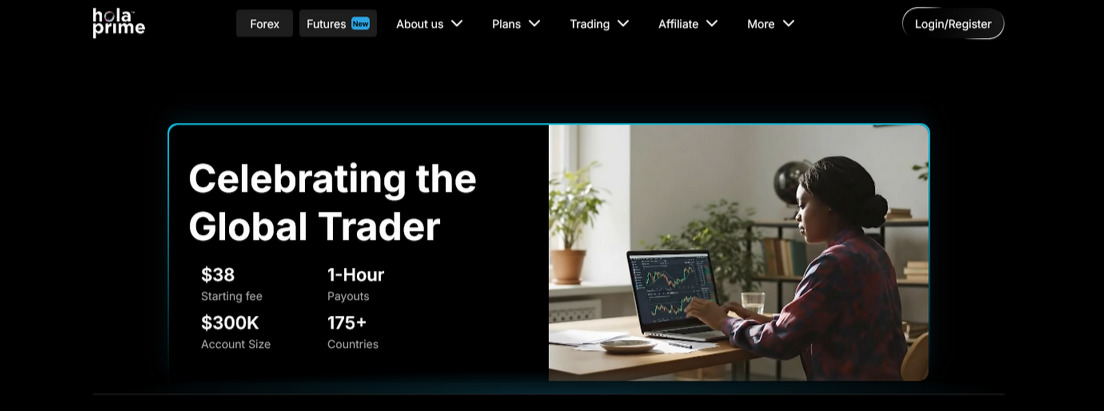
Hola Prime is a retail prop firm launched in 2024. It advertises profit splits up to 95%, account sizes from $5,000 to $300,000, and a scaling plan that can grow managed capital up to $4 million. It also supports multiple platforms (MT4, MT5, cTrader, DXtrade, and Match-Trader), which matters if you’re picky about execution, tools, or automation.
This review breaks down Hola Prime’s programs (one-step, two-step, and direct funding), the core trading rules (profit targets, daily and max drawdown, minimum trading days, and inactivity), and what the fees really look like. You’ll also see how the payout process is supposed to work, where traders have raised concerns (including review-site controversy), and the real pros and cons based on what’s publicly verifiable.
One reminder before we start: prop firms aren’t the same as regulated brokers. You’re paying for an evaluation and trading under a rule set, so due diligence matters, especially before you size up or scale.
Hola Prime is a retail prop firm launched in 2024. It offers traders funded-account pathways through evaluation challenges or a Direct (instant funding) option. In most programs, you trade in a simulated environment that mirrors live pricing and execution, then earn a share of profits if you follow the rules.
You’ll see Hola Prime described as global, often listed as serving traders in 175+ countries. Operational details vary by source, but it’s commonly associated with Hong Kong as a base, with regulatory mention tied to Mauritius (authorized and regulated by the Financial Services Commission of Mauritius as an Investment Dealer, according to published listings). The reason it’s everywhere in 2026 is simple: it’s built its brand around fast payouts, clear challenge formats, and constant public proof-of-life through updates and community posts.
Three things pull most traders in:
Also worth noting for beginners: entry pricing is often marketed as low, with evaluations starting around $48. That low barrier is part of why people “test drive” the firm instead of committing big upfront.
Hola Prime supports multiple platforms, which is a big deal if you’re picky about charts, order types, or automation. Here are the common options you’ll see listed:
For a newer trader, the main takeaway is that platform choice changes the feel of execution and tools. MT4 and MT5 are familiar and widely supported, cTrader is popular with many discretionary traders, and DXtrade and Match-Trader tend to feel more modern and web-friendly. EA support also matters here, because some traders rely on automation.
Market access is usually broad for a retail prop firm:
Hola Prime markets itself as transparency-first, and there are real trust signals that help you verify activity:
At the same time, there are clear caution points:
A practical way to handle this in 2026 is simple: read the rules line by line, start with a smaller account size, and try an early withdrawal before you scale up. That’s how you turn marketing claims into something you’ve personally verified.
Hola Prime gives you three main ways to get funded: Pro challenges, Prime challenges, and a Direct Account. The core idea stays the same across the menu, you trade under risk limits, then earn a profit split if you follow the rules. What changes is the path length (1-step vs 2-step), how much freedom you get (news, weekend holding, EAs), and how much room the risk rules give you.
A quick rule-of-thumb: Pro is often higher leverage but comes with more restrictions after funding, while Prime tends to keep more flexibility (including news and weekend holding) but uses lower leverage. Direct skips the evaluation, but it tightens the boundaries.
A 1-step challenge is the “one good run” format. You typically have a single phase with a profit target around 10%, and the risk limits are usually tighter than 2-step plans. Many reviews cite about 3% max daily loss and around 6% max overall loss for one-step accounts.
This setup fits traders who can stay calm under pressure and keep losses small. If you’re an experienced day trader who already trades with a daily stop, this can feel natural. If you tend to average down or revenge trade, the daily cap can end your account fast.
Where Pro vs Prime matters most:
Most one-step plans also include minimum trading days, commonly 2+ days (some variants require more). This is there to prevent a single lucky trade from passing you. If you try to hit 10% in one session, you can pass, but you also raise your odds of tripping the daily limit.
The 2-step challenge is the “prove it twice” model. Instead of one big target, you usually have two smaller phases, often 8% in Phase 1 and 5% in Phase 2. Risk limits are generally looser than one-step, with many reviews citing about 5% max daily loss and around 8% max overall loss.
Many traders prefer 2-step for one simple reason: you get more room to recover. A small drawdown doesn’t feel like a death sentence, and the targets per phase are less demanding than a one-shot 10%.
Minimum trading days matter more here because they can apply to each phase. Common requirements look like this:
Rushing a 2-step often backfires. It’s like trying to sprint a two-lap race. You might finish lap one fast, then blow up on lap two. Traders who pass more often usually trade smaller and treat each phase like a separate business month, not a weekend challenge.
One more practical detail: Hola Prime commonly advertises a full fee refund on challenge models when you reach funded status and complete your first payout (Direct Accounts usually don’t include a refund).
The Direct Account is for traders who don’t want an evaluation. You pay the fee, get access right away, and focus on withdrawals. That’s the appeal: no profit targets, no phases, no “pass/fail” checkpoint.
The tradeoff is simple: the guardrails are tighter. Many Direct plans are described with lower leverage (often around 1:30) and a tight max loss cap (commonly around 5% overall). Daily loss limits are also strict (often around the low single digits), which means you need a hard stop and clean execution.
Direct accounts also tend to be stricter on strategy freedom. Depending on the version, you may see limits like:
That’s why Direct fits confident, rule-following manual traders who already trade a simple plan (one or two setups, clear stop, no overtrading). If you rely on automation, high-impact news spikes, or wide swing-trade stops, the Direct route can feel cramped fast.
With Hola Prime, most blown accounts and payout drama come from rule friction, not “bad strategy.” If you treat the rules like guardrails (not suggestions), you’ll trade calmer, size safer, and avoid nasty surprises when you finally request a withdrawal. The big ones to respect are drawdown math, minimum trading days, inactivity (often 30 days), and who you’re allowed to copy trade.
Daily loss limit is your “today’s stop sign.” On many Hola Prime plans, that’s 3% on 1-Step accounts and 5% on 2-Step accounts. If your equity drops past that line during the day, it’s usually a hard breach, meaning the account is closed and you restart.
Example: You start the day at $100,000 with a 3% daily limit. Your line in the sand is $97,000. If floating loss and closed loss push you below $97,000 at any point, you’re done.
Max loss (overall drawdown) is the “whole account” limit measured from the starting balance. Common figures across Hola Prime challenges are 6% max loss on 1-Step and 8% max loss on 2-Step. Direct accounts are often tighter, commonly around 5% max loss.
Example: $100,000 with 6% max loss means you must stay above $94,000, even if it takes you two weeks to get there.
Static vs trailing drawdown is where traders get tripped up.
Why trailing can surprise you: imagine you spike up from $100,000 to $108,000 quickly. If your max loss “trails” that high-water mark, your allowed pullback shrinks. You feel like you built a cushion, but the system may move the floor up behind you. One rough session after a strong day can suddenly become a breach.
Hola Prime’s rules differ by plan and account type, so don’t assume every account trails. Always check whether limits are based on starting balance, end-of-day balance, or peak equity on your specific plan.
Two more rules that quietly matter:
Strategy freedom depends on the plan, and Hola Prime’s menu isn’t one-size-fits-all. The pattern across reviews and plan descriptions is consistent:
Copy trading is another easy way to break rules. Hola Prime generally allows copy trading between your own Hola Prime accounts (same person), but copying across different people (friends, family, “signal groups”) is a quick path to termination.
Because these rules can change, confirm the current version on the specific plan page before you buy.
When traders complain about denied payouts, the language often sounds the same: “risk management,” “inconsistent strategy,” or “gambling behavior.” You can’t control every review, but you can control how clean your account looks.
Consistency, in simple terms, means your trading should look like one steady system:
A simple way to protect yourself is to keep basic proof:
This takes minutes a day, and it helps if you ever need to explain your trading during a compliance review or a payout dispute.
Hola Prime’s pricing is one reason it gets so much attention. You’re not “depositing to trade” like a broker, you’re paying an upfront fee for access to an evaluation (or instant funding), a trader dashboard, and a simulated account that mirrors live pricing feeds. The real cost is not just the fee, it’s also the odds you lose that fee if you breach drawdown rules before your first payout.
If you’re new to Hola Prime, the smartest move is treating your first account like a test drive. A $5K or $10K evaluation lets you confirm how spreads feel on your platform, how rules are enforced, and how payouts work in practice, without tying up a large fee.
Here’s a snapshot of commonly listed starting prices by account size (fees vary by plan type, and promos can change them):
| Account size | 2-Step Pro (from) | 1-Step Pro (from) | 2-Step Prime (from) | 1-Step Prime (from) |
|---|---|---|---|---|
| $5K | $48 | $65 | $74 | $81 |
| $10K | $89 | $120 | $149 | $161 |
| $100K | $499 | $549 | $599 | $649 |
| $300K | $1,249 | $1,349 | $1,349 | $1,499 |
A key money-saver: evaluation fees are commonly refunded after you pass and complete your first payout, based on the plan’s terms. Direct Accounts usually don’t come with a fee refund, since you’re skipping the evaluation step.
Also, coupons are common in prop trading. If you use one, stick to official sources (the firm site, verified partners) so you don’t get caught by fake “discount” pages.
Commissions are fixed charges per trade, usually based on lots. Hola Prime is often described as using a clear commission schedule: about $3 per lot on Forex and gold, about $1.50 per lot on other commodities, and zero commission on indices and crypto. That’s helpful because you can estimate costs before you trade.
Spreads are the built-in difference between bid and ask. Even with low commissions, wide spreads can quietly drain results, especially if you scalp. Traders often report competitive spreads on major markets like gold and some indices, while some crypto pairs can be pricier. Your platform choice (MT4 vs MT5 vs cTrader, etc.) can change how execution and spreads feel, so it’s worth testing on the same instrument and session time you normally trade.
One more cost to check: swaps. Overnight fees are not always fully published in a simple table, so if you hold trades past rollover (or you swing trade), verify swap rates and swap-free terms before committing.
Affordability is about what you get for the fee and how hard it is to keep the account alive. Use this quick checklist before you buy:
If you want freedom (news, weekend holds, EAs), Prime-style evaluations are often the better value. If you want instant access, Direct can work, but only if you already trade with strict daily stops.
If you’re considering Hola Prime, payouts are the whole point. The firm markets one-hour payouts for eligible withdrawals, and many traders say they’ve seen fast processing when their request checks every box. The key is separating the marketing headline from the real workflow: your first payout timing depends on your plan and payout cycle, and getting paid also depends on strict rule compliance.
Below is how payout cycles usually work, what “payout proof” is actually worth, and how to pressure-test support before you pay a fee.
In prop firms, payout schedules often work like a sliding scale: faster access can mean a smaller split, while waiting longer can unlock a higher split. Hola Prime follows that general pattern across its challenge accounts, with profit splits commonly cited in the rough range of 65% to 95%, depending on the payout cycle you select.
A simple way to think about it is like choosing between hourly pay and a bonus-heavy monthly commission. You get money sooner in one setup, but you may give up a bigger share.
Here’s an example scenario to make it concrete:
Also keep expectations realistic on timing. Even if payouts are processed quickly, you still have to reach the point where a payout is allowed. Many plans in this space have a first payout window (often around two weeks on certain models), and then you can choose a weekly, bi-weekly, or monthly rhythm after that.
For Hola Prime’s Direct Account, reviewers often describe it as a more fixed structure: bi-weekly payouts with a baseline split (commonly 80%), plus an optional upgrade that can push it higher (often up to 90%). The tradeoff is that Direct accounts tend to be stricter on rules.
Some reviewers point to Hola Prime’s public activity as a trust signal, including payout proofs shared on Discord, website leaderboards, and social media posts. You’ll also see mentions of third-party payout tracking sites where payouts are logged over time.
That’s useful, but don’t treat screenshots like a bank statement. Screenshots are easy to reuse, crop, or take out of context. If you want to answer “does Hola Prime actually pay?” in a way that protects you, verify from multiple angles:
Practical advice that works with any prop firm: request a small payout early (as soon as you’re eligible). It’s the quickest way to test processing speed, communication, and how strict reviews feel before you scale up.
When payouts go wrong, support quality matters more than platform choice. Hola Prime is often described as offering 24/7 support, usually through live chat, email, and phone, plus a help center. That sounds good, but you should test it before you buy.
Send support one specific question you genuinely care about, and ask for a written answer you can save. Good topics to test include:
You’re looking for clear, plain-English replies. Vague answers today can turn into payout friction later.
As a bonus (not a deciding factor), Hola Prime also promotes education through an academy-style hub, plus coaching and regular content on channels like YouTube and its blog. That can help newer traders, but it won’t save you from a breach. Your best protection is simple: follow the rules exactly, avoid sudden lot-size spikes, and keep records (screenshots, trade logs, and a basic journal) in case a payout gets reviewed.
Hola Prime stands out in prop trading for two reasons traders care about most, the one-hour payout promise (when you meet the conditions) and profit splits that can reach 95% on certain payout cycles. Add low entry pricing that starts around $48, several platform choices (MT4, MT5, cTrader, DXtrade, Match-Trader), and a scaling path that can grow buying power up to $4 million, and it’s easy to see why it keeps showing up in searches.
It’s a strong fit for disciplined traders who already use daily stops, keep position sizes steady, and can work inside tight drawdown math (often 3 to 5% daily, and roughly 5 to 8% overall, depending on the plan). Prime-style challenges also tend to give more freedom with news, weekend holding, and EAs than stricter models like Direct.
Be careful if you’re brand new, need wide risk limits, or get stressed by strict compliance language. It’s also a newer firm (launched in 2024), and its review history has been mixed, including Trustpilot rating issues.
Action plan: read the rules for your exact plan, start small, trade steady across the minimum days, request an early payout to test the process, then scale only after you’ve built a clean payout history. Thanks for reading, share your Hola Prime experience if you’ve traded it.
Hola Prime Prop Firm Review covers funding steps, rules, fees, and payouts, plus what traders like and dislike so you can judge the fit.
Read this Hola Prime Prop Firm Review for a clear look at challenge terms, profit splits, drawdown rules, platform options, and payout timing.
I am relatively new to proposition… I am relatively new to proposition trading (maybe a year), but not new to trading in general. I heard mixed reviews about Hola Prime, but I wanted to try it myself. Well, I have been trading an funded account for a few months now, and so far, they have honored every payout request. I wanted to wait to give a review after a few payouts at the end of 2025. I will follow up on this review to give updates as I work with Hola Prime for what I hope is a long career of mutual profits.
9 months ago