TradeLocker, MetaTrader 5 (MT5), cTrader
Crypto, Credit/Debit Card
N/A
Choosing a prop firm can feel simple until you read the rules. One payout clause, a drawdown detail, or a trading restriction can change everything. This FunderPro prop firm review is here to make the basics clear, without the fluff.
Is FunderPro legit and worth considering? From what’s publicly available, FunderPro (launched in 2023 and based in Malta) is widely discussed in the prop trading space and is known for offering multiple challenge types, including 1-phase, 2-phase, and swing options. It also removes a common pressure point by not putting a hard time limit on completing the challenge, while still using risk limits like daily and overall drawdown rules.
In this post, you’ll get a simple breakdown of what traders usually care about most, the evaluation targets, the fee structure (including entry-level pricing), supported platforms (including cTrader and TradeLocker), payout process (including low minimum withdrawals), and the real-world pros and cons traders mention, such as support quality, slippage complaints, and how strict the terms can feel in practice. You’ll also see how its scaling plan is supposed to work, from initial funding up to higher allocations.
One quick safety note before you pay any evaluation fee: prop firms usually aren’t regulated like brokers. Read the full terms, double-check the firm’s reputation, and make sure you understand the risks and payout conditions before you commit.
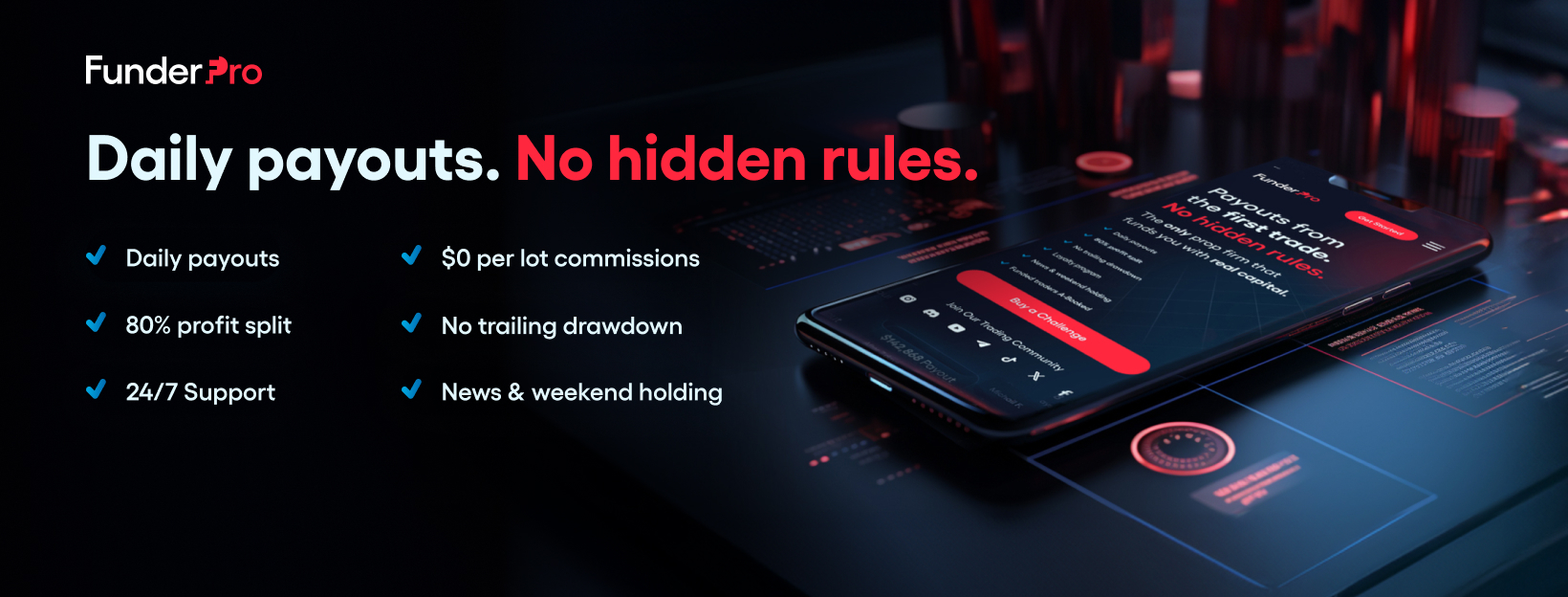
A prop firm is a company that lets you trade its capital if you pass an evaluation. You pay a one-time fee to attempt a challenge, follow the risk rules, and if you qualify you get a funded account and withdraw a share of the profits.
FunderPro fits that model, with funded accounts that go up to $200,000 and a scaling plan that can grow toward $5,000,000 if you keep hitting performance targets over time. Think of it like earning a larger “trading budget” after you prove you can drive without crashing.
If you’re trying to figure out the basics quickly, here are the details most people search for when checking whether FunderPro is a match:
| Feature | What to expect (typical) |
|---|---|
| Started | 2023 |
| HQ | Malta |
| Platforms | cTrader and TradeLocker (proprietary) |
| Markets | Forex, indices, metals, crypto |
| Entry evaluation fee | From about $79 (small account sizes) |
| Standard profit split | Around 80% (can be higher with add-ons) |
| Time limit | No fixed time limit to finish challenges (activity rules may still apply) |
A big selling point is the lack of a deadline to hit the profit target. That can remove the “force trades to beat the clock” problem. Still, don’t treat it as unlimited freedom. Many prop firms (including ones with no time limit) often include minimum trading days and sometimes minimum activity rules, so read the terms for your specific challenge type.
FunderPro tends to work best for traders who care more about structure than speed. It’s built around defined profit targets, drawdown limits, and rule-based trading, so it suits people who already trade with a plan.
Here are the trader types that usually fit best:
Swing traders have a clearer lane here than at many firms because FunderPro offers a swing-oriented challenge. That said, swing accounts often come with trade-offs, such as lower leverage and sometimes tighter position size limits (like max lot caps). If your strategy depends on high leverage or large sizing, check those swing parameters before buying.
Prop challenges can be useful, but they come with real strings attached. The key is to treat the rules like a contract, not a “suggestion.”
A few risks to keep in mind:
If you approach it with the right mindset, FunderPro can be a reasonable option for traders who want a defined path to funded capital. Just keep your focus on the fine print, because that’s what decides whether a payout is smooth or stressful.
FunderPro’s evaluation is pretty easy to understand once you stop thinking in prop-firm jargon. You pick a challenge type, hit a profit target, and follow risk rules that are designed to stop big blowups. The details can change by challenge model and account size, so always confirm the exact numbers on checkout and inside your dashboard before you place trades.
The main difference between FunderPro’s challenge types is the trade-off between speed, profit target, and freedom to hold trades.
A simple way to think about it:
Across these models, FunderPro is known for removing the usual countdown timer. Many reviews describe no fixed time limit to pass. At the same time, prop firms often require minimum trading days (commonly five days) so you can’t pass in a single lucky session.
Two risk limits matter most, and you should treat them like speed limits.
Daily loss limit means: the most you’re allowed to lose in a single day. If you go past it, the account can fail.
Max loss (overall drawdown) means: the most you’re allowed to lose total from the starting balance (or from a defined reference point in the rules). Cross that line and the account is usually done.
Public summaries commonly show ranges like:
| Rule type | Typical range you’ll see |
|---|---|
| Daily loss limit | About 4% to 5% |
| Max loss (overall) | About 7% to 10% |
Some firms use trailing drawdown, which means the loss limit can “move up” as your account grows. Example: if your balance hits a new high, the allowed loss line may rise with it. Other firms use a static max loss that stays anchored to the start balance. Because prop firms don’t all define this the same way, read FunderPro’s exact definition in the rules for your specific challenge and note when the “daily” clock resets.
Profit is not the only thing being tested. Many FunderPro-style evaluations also use a consistency rule, which limits how much of your total profit can come from one single day. Public rule summaries often describe it as a percentage cap (for example, a maximum share of profits earned in one trading day).
The idea is simple: they don’t want you to “yolo” one oversized trade, get lucky, and cash out. They want repeatable trading.
Here’s a simple example:
If your strategy is news spikes or big one-off days, this rule can be the reason you “pass on paper” but don’t qualify.
Most traders don’t fail from bad entries, they fail from breaking a rule they didn’t take seriously. In general, FunderPro is often described as flexible, but it still draws hard lines around high-risk or unfair tactics.
Here’s what is usually allowed (as long as you follow risk limits):
Here’s what commonly gets traders in trouble, based on typical prop rules mentioned publicly:
Even if weekend holding is permitted, news rules can still matter. If you hold through a major event, plan your stops and targets so you’re not accidentally triggering a rule tied to the news window.
FunderPro’s trading experience comes down to two choices: cTrader (a familiar, widely used platform) or TradeLocker (the firm’s own style platform). Pair that with a mix of forex, indices, metals, and crypto, and you get a setup that can feel “pro” without being overly complicated, as long as you stay on top of the rules that affect execution (like news windows and strategy bans).
cTrader feels like the “standard” option for many prop traders. It’s well-known for clean charting, solid order controls, and a workflow that suits active trading. If you already have templates, watchlists, and a routine built around cTrader, this is the path of least resistance.
TradeLocker is FunderPro’s in-house style platform. It’s built to keep everything in one place and usually feels more modern and guided than older platforms. The learning curve is real if you’re used to cTrader or MetaTrader, but FunderPro’s knowledge base includes platform guides, and that matters when you’re trying to avoid simple errors during an evaluation.
A quick way to pick:
Most public breakdowns describe a core set of markets that covers what most prop traders actually use day to day:
The exact instrument list can change based on platform choice and account type, so treat any list you see online as a “typical menu,” not a guarantee. If your strategy needs a specific symbol (or a specific trading hour), confirm it inside the platform before you pay for a larger account.
On leverage, public sources commonly mention up to around 1:100 on certain models, with different caps by asset class. Some sources also show higher maximums for specific markets, while swing-style accounts often use lower leverage (around 1:30) and may include position-size limits.
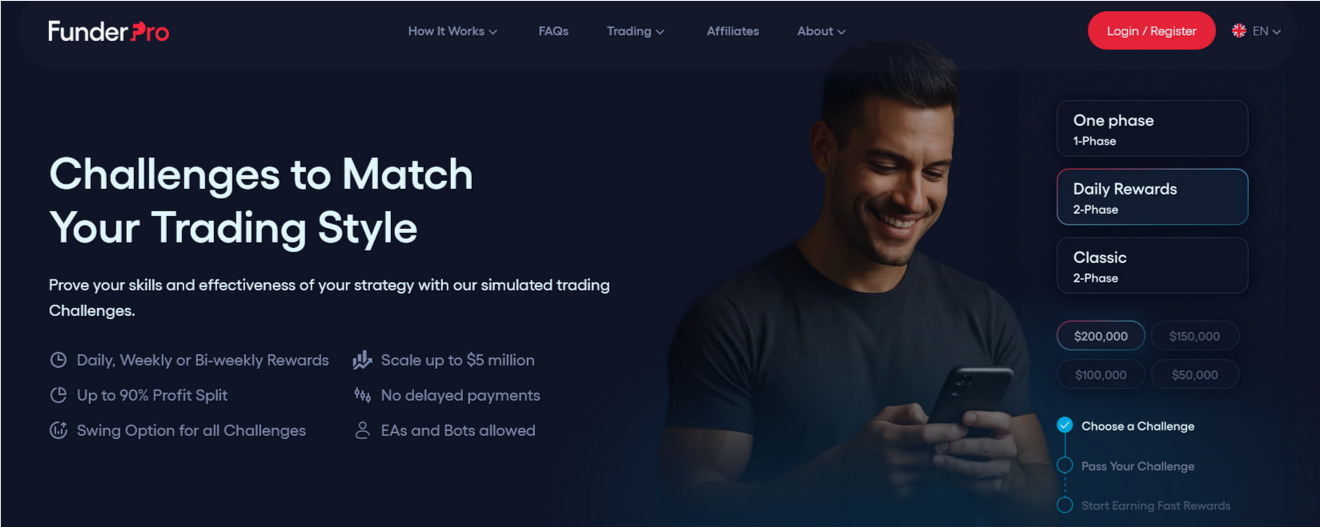
Pricing is one of FunderPro’s main selling points. Public sources often describe raw spreads that can start very low and low or even zero commissions on some instruments (the details vary by market and how costs are packaged). In real use, that usually translates to trades that don’t feel “taxed” by wide spreads, which helps if you scalp or take frequent setups.
Still, reviews aren’t one-note. Many traders praise pricing and payouts, but slippage and trading terms come up in complaints. That doesn’t mean you’ll have issues, it means you should measure it.
To test execution without guessing:
For most traders, the real test starts after you get funded. Can you withdraw smoothly, keep your split high, and scale without tripping over fine print? FunderPro’s setup is built around a simple idea: follow the rules, request payouts often, and earn bigger allocations by stacking consistent results over time.
FunderPro’s standard profit split is typically 80% on funded accounts, which is in line with many well-known prop firms. Some checkout options and add-ons can push that higher, often advertised up to 90%. If you’re the type who plans to withdraw frequently, the extra split can matter more than people expect over a long run.
The evaluation fee is commonly described as refundable after your first funded payout. That’s an important detail because it changes how you should think about the upfront cost. Instead of treating it like a sunk fee, many traders treat it like a deposit you earn back by following the process and getting to payout.
A few practical tips before you buy:
One of the most searched topics in any FunderPro review is payout speed. Public info often points to daily payout requests being available, with a low minimum withdrawal amount (commonly shown as $50). That structure is attractive if you prefer “pay yourself as you go” instead of waiting weeks to lock in a withdrawal window.
Processing time is often described as around 1 to 2 business days, although real timing can vary due to request volume, verification, or payment rail delays. Treat that timeline as a normal target, not a guarantee.
Most prop firms also keep payout rules simple but strict. The most common requirements you should expect include:
A good habit is to plan your trading week around payouts. If you want to withdraw on a certain day, avoid holding trades that would block the request, and don’t “force” a last-minute setup just to reach the minimum.
FunderPro’s scaling plan is built for traders who can stay steady, not traders who hit one huge month. The basic idea shown in published scaling outlines is a 3-month cycle where you aim for a 10% profit target per cycle. If you hit the target and meet the payout requirements, your account can grow by a meaningful percentage, often described as 50% balance increases per successful block, until you reach the maximum allocation.
Another key detail in common scaling criteria is the payout checkpoint. Many summaries state you need 2 or more successful payouts per stage before you move up. That pushes you toward repeatable execution instead of one lucky run.
Here’s an example progression that’s often shared for the scaling track:
| Time in scaling | Example account balance |
|---|---|
| 3 months | $100,000 |
| 6 months | $250,000 |
| 12 months | $500,000 |
| 18 months | $1,000,000 |
| 24+ months | $5,000,000 |
Think of scaling like getting a credit limit increase. The firm isn’t paying you more because you asked, it’s paying you more because your history proves you won’t blow up the account.
Two final points to keep your expectations realistic:
“Legit” in prop trading usually means two things: the company is real, and traders can actually get paid when they follow the rules. “Safe” is trickier, because prop firms are not regulated the same way brokers are. You’re paying for an evaluation under a private contract, so your best protection is due diligence, not assumptions.
Below is what public ratings suggest, plus a practical way to verify what matters before you buy.
Public review sites paint a mixed but usable picture. On Trustpilot, FunderPro shows a mid-to-high score with a large number of reviews (hundreds). On Google, the rating is lower, and the review count is much smaller (dozens). That gap doesn’t prove anything by itself, but it does tell you where most feedback is concentrated.
Here are the themes that come up again and again:
One positive sign is that the firm often replies to negative reviews. That can show accountability and a willingness to resolve issues. Still, public replies don’t replace reading the rulebook yourself, because payouts live and die on the fine print.
Before you judge one company, know the warning signs that show up across the prop industry. I like to treat this like checking a used car, you don’t just look at the paint, you check the engine.
Here’s a quick checklist that helps you avoid the most common traps:
To protect yourself, keep it simple:
If you want a practical process, here’s the exact order that reduces surprises.
If you do these checks, you won’t eliminate risk, but you’ll avoid the most common “I didn’t know that rule” blowups. That alone puts you ahead of most traders buying their first challenge.
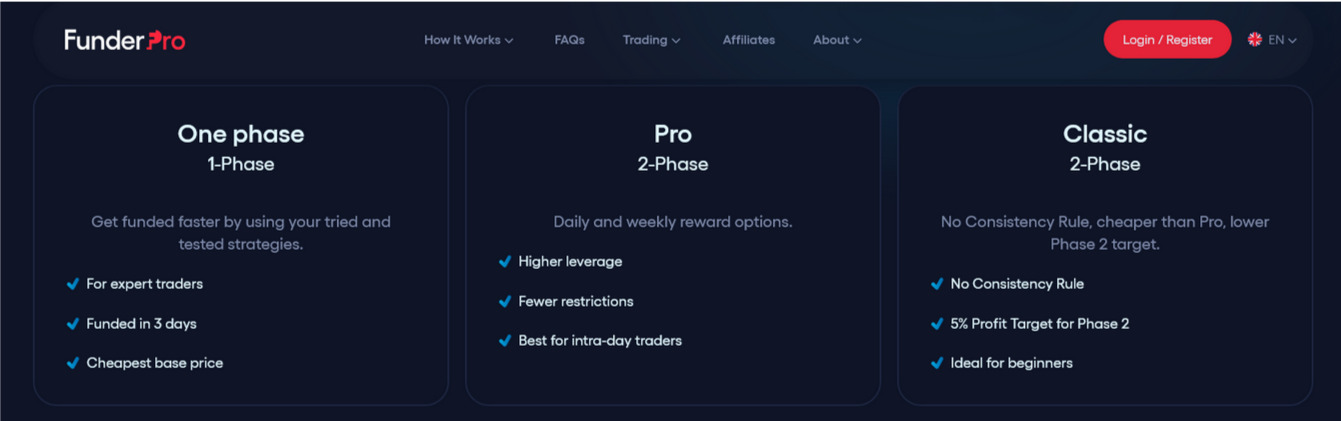
FunderPro makes the most sense for traders who want structure without a countdown clock. The no time limit format helps you wait for clean setups, and the knowledge base is unusually detailed for a prop firm, which makes rule-checking easier. Pricing starts low (often around $79), challenge choices cover 1-phase, 2-phase, and swing styles, and platform options like cTrader and TradeLocker fit both active traders and those who prefer a simpler interface. If you stay consistent, the scaling path can grow a funded account from up to $200,000 toward $5,000,000 over time.
FunderPro is not a fit if you dislike strict rule sets or you trade in ways that clash with prop restrictions. The prop firm model is unregulated compared to brokers, so the risk sits in the terms and enforcement. Some traders also report slippage or frustration with rules, and common restrictions can include limits around major news, plus bans on copy trading, HFT, and arbitrage-style tactics. Discipline is what decides your outcome here, not just your win rate.
If you’re considering it, pick the challenge type that matches your trading style, read the rules twice, and start with the smallest account to test execution and payout flow
FunderPro Saint Lucia Ltd is a Saint Lucia corporation. It operates from The Sotheby Building, Ground Floor, Rodney Bay, Gros-Islet, Saint Lucia (P.O. Box 838, Castries). Company registration number: 2025-00393. This entity provides the simulated trading services promoted on www.funderpro.com. For help or details about these simulated trading services, email support@funderpro.com.
MetaTrader 5 (MT5) content and services on this site aren’t meant for U.S. citizens or residents. Don’t use them in any location where doing so would break local laws or rules. See the full list of restricted countries.
FunderPro Ltd. is registered in the Republic of Malta under registration number C 104558. Its registered address is Triq Ċensu Tabone, 196, ST Balluta Business Centre, Level 4, St. Julians, Malta (the Company). The Company doesn’t offer investment services listed in the First Schedule of Malta’s Investment Services Act, Chapter 370. It isn’t a broker and it doesn’t accept deposits.
Only 14.67% of traders who buy a challenge make it to the funded phase. This figure is based on results from the Company’s start through today. Past performance doesn’t predict future results, and this historical pass rate doesn’t guarantee any future outcome. Read the full Risk Disclaimer.
High-frequency trading (HFT): Allowed as long as it’s used fairly. Any strategy that takes advantage of platform latency or differences in outside price feeds isn’t permitted.
FunderPro supports up to $200k in total funded accounts.
You need to place at least one trade every 30 days. If you don’t, your account will be closed and the challenge will be marked as failed.
Rule breaks are handled based on how serious they are. Some violations lead to an automatic account closure, while others may result in a warning. If you’re unsure about a specific rule, reach out through Contact Support on the dedicated page.
No reviews yet. Be the first to review.