Metatrader 4 for PC, Metatrader 4 for Android, Metatrader 4 for iOS, MetaTrader WebTerminal, Metatrader 5 for PC, Metatrader 5 for Android, Metatrader 5 for iOS
USDT, Pix, Credit/Debit Card, PayPal, Bank Transfer, Crypto, Tether
N/A
Picking a prop firm can feel simple until you hit the fine print. This FundedFast Prop Firm review is written for traders who want clear answers, not hype, and it’s updated for January 2026.
A prop firm (short for proprietary trading firm) lets you trade using the firm’s capital after you pass an evaluation. Traders look for prop firms to size up without putting as much personal money on the line, and to prove consistency in a rules-based account.

FundedFast is a newer name, founded in 2024 and based in Malta. It’s known for low entry fees (starting around $49 on smaller accounts), unlimited time to pass its challenge, and weekly payouts once funded. Profit splits can reach up to 90% for top tiers or certain add-ons, but the exact share depends on the plan you choose.
Rules matter more than marketing, so we’ll keep the focus on what can make or break your account. That includes common guardrails like a 5% daily loss cap and a 10% max drawdown, plus practical details such as platform access (FundedFast uses MatchTrader), tradable markets, and what “fast payouts” looks like in real terms.
One more thing up front: prop firms usually aren’t regulated like brokers. That doesn’t automatically make them unsafe, but it does mean you should do extra due diligence, read the terms, and treat payout history, support quality, and transparency as core factors.
In the sections ahead, you’ll get a clear breakdown of FundedFast’s rules, fees, payout process, platform features, pros and cons, and who this prop firm fits best (and who should probably skip it).
FundedFast is a newer proprietary trading firm that launched in 2024 and is headquartered in Malta. The pitch is simple: pay an evaluation fee, follow clear risk rules, and earn access to a funded account if you hit the target. For many traders, that’s appealing because it can reduce the need to risk personal capital while proving you can trade with discipline.
Traders started paying more attention to FundedFast through 2025 and into 2026 for a few practical reasons. It offers small account entry points, an evaluation with no deadline pressure, and a payout schedule that is easy to understand once you reach the funded stage. Reviews commonly mention account sizes ranging from $3,000 up to $400,000, with scaling that can reach up to $1,000,000 for traders who perform well over time (terms depend on the plan and level).
It’s also building credibility in public view. The online footprint is growing, early user reviews tend to be positive (though still limited in volume), and reviewers have reported consistent payout activity. At the same time, it’s still a young firm, so its long-term track record is naturally shorter than the older names.
If you just want the highlights, these are the points traders bring up most often:
Because prop firm rules and promos can change, treat these as the commonly stated terms, not a guarantee. Always confirm the exact numbers on the checkout page and inside the dashboard rules for your specific account.
In 2026, FundedFast sits in the “simple rules, low entry cost” lane. Pricing is one reason it keeps coming up: smaller evaluations are often cited as starting around $29 to $49, depending on the account size and whether you choose one-phase or two-phase. For newer traders, that can feel like a lower-stakes way to test a funded program without paying premium fees upfront.
Another part of its positioning is the lack of endless configuration. Some competitors ask you to pick from many rule sets, drawdown types, payout splits, and platforms before you even start. FundedFast keeps choices tighter, which can be a relief if you want fewer moving parts.
The main trade-offs are worth saying out loud:
If you like clear boundaries and a straightforward path to funding, FundedFast’s approach makes sense. If you want maximum platform flexibility or a decades-long history, you may feel more cautious.
FundedFast keeps the evaluation menu simple, but the rules still do the real filtering. Your job is to hit the profit target while staying inside the risk limits, and avoid rule breaks that can void a pass even if you make money. Think of it like a driving test, speed matters, but lane discipline matters more.
Here are the core things most traders focus on: profit targets, 5% daily loss, 10% max drawdown (often described as trailing), and a minimum of 3 trading days. There’s also usually no time limit, so you can take trades when your setup shows up, not because a deadline is looming.
Both routes can work, but they fit different personalities.
One-phase usually suits traders who want a shorter path and can handle one bigger push:
This path is “one hill, one climb.” If you can stay calm while you work toward a larger target, it can feel simpler.
Two-phase is often easier for traders who like checkpoints and proving consistency:
Two-phase can feel more forgiving because the second target is smaller, but you’re “on the clock” emotionally for longer. You still have to protect the account through both steps.
One important detail: leverage figures can vary by program and sometimes by instrument. Some reviewers also report conflicting leverage numbers across pages. Verify the leverage for the specific market you trade (forex, indices, crypto, etc.) inside the current rules before you buy.

These two rules cause most failures, not the profit target.
Let’s use a $10,000 evaluation account.
5% daily loss limit (simple):
If the daily cap is 5%, you can’t lose more than $500 in a single day. That’s it. If your open trades and closed trades combine to a loss past that line (depending on how the firm calculates it), the account can be breached.
A clean way to think about it: your daily loss limit is a ceiling. Once you hit it, you’re done for the day, even if you feel confident.
10% max drawdown (often trailing):
10% of $10,000 is $1,000, so the account can’t fall below the allowed floor. With a trailing drawdown, the “floor” can move up as your account hits new highs.
Here’s a plain example:
This is why position sizing matters. If you trade too big after a good run, the trailing line can turn a normal pullback into a rule breach.
Before you place trade one, double check two things in the dashboard rules:
FundedFast is often described as friendly to discretionary traders, but less friendly to system traders.
Here’s what’s commonly allowed or restricted:
Also watch for “instant disqualifiers.” Policies can change, but traders regularly see limits like:
If you take only one thing from this section, make it this: rule clarity beats marketing. Read how FundedFast measures loss and drawdown, then build your risk plan around those lines, not around what you hope the rules mean.
FundedFast keeps pricing and payouts fairly easy to understand, but you still want to look at it like a trader, not a shopper. Your real “cost” is the evaluation fee plus any blown accounts while you learn the rules. Your real “earnings” depend on the profit split, how often you can withdraw, and whether you can stay inside the 5% daily loss and 10% drawdown limits.
One more thing: FundedFast commonly markets the evaluation fee as refundable after you pass and meet the funded-stage conditions. Treat that as “refundable if you follow the process,” not “guaranteed cash back.” Always confirm the exact refund terms shown at checkout for your specific plan.
Fees scale mainly by account size and challenge type (one-phase vs two-phase). Most traders should pick size based on how well they control risk, not how big the number looks on social media.
Here are real pricing points often cited:
| Account size | Two-phase fee (example) | One-phase fee (example) | Who it fits |
|---|---|---|---|
| $5,000 | ~$49 | ~$109 | First-time users testing rules and platform |
| $10,000 | ~$99 | ~$119 | Small step up with similar pressure |
| $50,000 | ~$299 | ~$399 (some promos cite ~$199) | Traders with consistent sizing and patience |
| $100,000 | ~$499 | ~$699 | Traders who already pass evals elsewhere |
| $400,000 | ~$1,799 | ~$2,999 | Only if you’re already dialed in |
A simple way to choose without ego:
Also note: fees are usually one-time per attempt, not monthly. Some offers also include free retries if you finish the attempt in profit while staying within the limits (read the exact conditions, since “in profit” and “within limits” do the heavy lifting).
On the funded side, profit split is where the math gets interesting. Many sources describe FundedFast as paying up to 80% as a standard split, with the option to reach up to 90% through an add-on or higher trader tier.
Weekly payouts sound simple, but expect a few real-world steps:
Payout speed can vary based on the method you pick (bank transfer vs crypto) and any extra compliance checks. The clean approach is to treat “weekly payouts” as the schedule you can request on, not a promise that every payment lands instantly.
FundedFast commonly supports card payments (credit and debit) and crypto. For crypto rails, you’ll often see stablecoins like:
Before you pay, do two practical things that save headaches later:
Day to day, FundedFast feels built for traders who want fewer moving parts. You log in, you see your limits and progress, and you get to work. The biggest “make or break” factor is the platform choice, since everything runs through MatchTrader. If you like clean web-based trading, it’s a solid setup. If your whole process is built around MT5, you’ll feel the restriction fast.
FundedFast runs on MatchTrader only, which keeps things consistent across accounts, but it also means you don’t get to choose MT4, MT5, or cTrader. For many traders, that’s the trade-off: simplicity vs familiarity.
What MatchTrader tends to do well in real use:
The downside is clear: if your strategy relies on MT5 workflows, custom indicators, Expert Advisors, or a specific trade manager, you’ll need to adapt. FundedFast is also commonly described as a better fit for discretionary trading than automation, since automated trading is typically restricted.
FundedFast commonly lists a broad mix of markets: forex, indices, commodities, and crypto. Some reviews also mention access to metals and stocks, and in some places you’ll see claims of 200+ instruments. That variety matters because it lets you rotate to the cleanest setups, instead of forcing trades in one market that’s chopping around.
Here’s how that plays out in real trading decisions:
One caution: treat FundedFast like its own “market environment.” The symbol list, contract specs, trading hours, swap fees, and spread behavior can differ from what you’re used to at a retail broker. If your backtests assume a specific spread or session close, your results may not translate cleanly.
Before you commit to a strategy, verify these inside the platform for the exact symbols you trade:
FundedFast’s best feature set is the stuff that helps you avoid small mistakes, the kind that break prop accounts. The platform is often praised for having TradingView charting integration available inside the interface, plus built-in economic news and an economic calendar. That combo is useful because it keeps planning and execution in one place.
In practical terms, it helps with:
A good habit is to treat the dashboard like your pre-flight check. Before your first trade of the day, confirm your daily loss buffer, your overall drawdown room, and how close you are to the profit target and minimum trading days. That simple routine can save an account that would otherwise fail from one oversized loss.
When traders ask if FundedFast is “legit” in 2026, they’re usually asking a few practical questions: Do the rules stay consistent? Do payouts get processed when you follow the terms? Is identity checking fair? Does support respond when something breaks?
FundedFast is a newer prop firm (founded in 2024, based in Malta), so it doesn’t have a decade-long track record. That doesn’t make it unsafe by default, but it does mean you should treat trust as a checklist, not a feeling.
Prop firms don’t work like brokers. In many programs (including FundedFast), you’re trading in a simulated environment and paying an evaluation fee to prove you can follow risk rules. They typically aren’t holding client deposits for live trading the way a regulated broker would.
That changes the kind of “protection” you get. Instead of relying on regulator backstops, you rely on what the firm controls day to day:
Before you buy a challenge, do a quick due diligence pass. This takes 10 minutes and can save weeks of frustration.
Think of it like printing your boarding pass. Most of the time you won’t need it, but if there’s a dispute, you’ll be glad you kept it.
KYC exists for a reason. Prop firms pay out profits, and they need to confirm the person requesting the payout is real and matches the account holder. It also helps limit chargebacks, money laundering risk, and multi-account abuse.
For most traders, KYC means basic documents such as:
Delays can happen, and they’re not always “bad.” Common causes include mismatched names, unclear photos, expired documents, or address proof that doesn’t meet the date requirement.
On the safety side, FundedFast is often described as using anti-fraud monitoring that looks for patterns such as:
For payout reliability, public feedback themes tend to point in a positive direction, with traders often mentioning prompt processing and issues getting resolved without endless back-and-forth. At the same time, experiences vary because KYC, payout methods, and account reviews can trigger extra checks for some users.
If you want to reduce friction, keep it simple: use your real details, avoid VPNs, and don’t share accounts or copy trades in ways that violate the rules.
Support quality matters more in prop trading than people admit. One missed reply can turn a small dashboard issue into a blown account.
FundedFast is commonly cited as offering multiple support channels, including live chat and email, and some sources also list phone support (often described as 24/5 availability). User commentary trends toward a “helpful team” feel, with quick responses for account and payout questions.
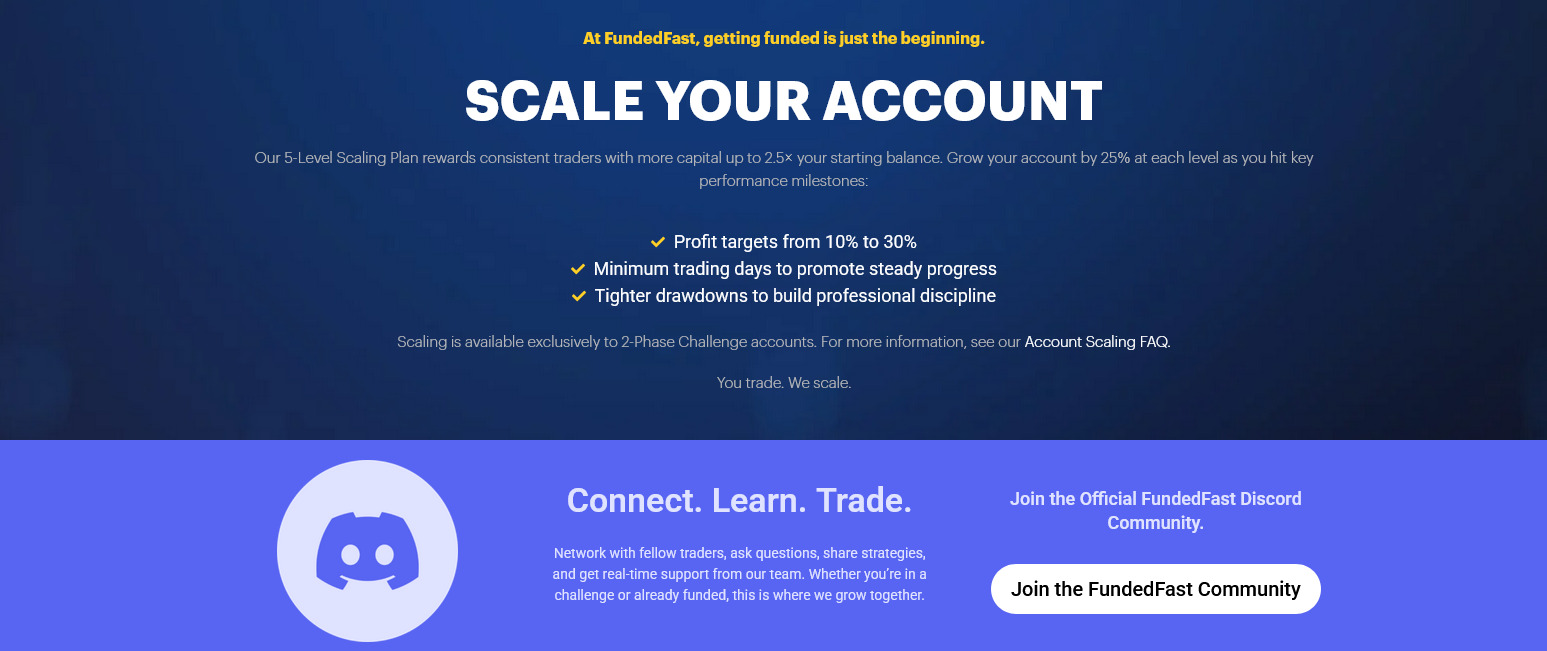
Community-wise, FundedFast has a Discord server that’s growing, but it’s still smaller than the biggest prop firms. That can be a plus if you prefer quieter spaces, but it may feel limited if you want lots of shared trade ideas, journals, and live rooms.
Education is the one area where you should double-check what’s current. Some sources describe trading university style content (risk, strategy, and evaluation guidance), while others say structured mentoring is limited. The safest move is to verify what’s available inside your dashboard and in your region before you expect coaching-level support.
If your priority is hands-on mentoring, you may need to bring your own training plan. If your priority is clear rules, KYC before payouts, and responsive support, FundedFast checks many of the boxes traders look for in 2026.
FundedFast is a newer Malta-based prop firm (founded in 2024) that keeps things simple. You get a one-phase or two-phase evaluation, no time limit to pass, clear risk caps (often a 5% daily loss limit and a 10% max drawdown), and weekly payouts once funded. Entry pricing is also approachable, with smaller accounts often starting around $29 to $49, and profit splits that can reach up to 90% on certain plans or tiers. For many traders, that combo makes it easier to focus on execution, not deadlines.
This prop firm fits best if you’re a discretionary trader who wants a clean ruleset, low upfront cost, and a modern web-based platform (MatchTrader) with practical tools like TradingView charts and market news. It can also suit traders who value a straightforward payout cadence and don’t want lots of setup choices.
Skip FundedFast if you need MT5, rely on EAs or heavy automation, or want a long track record in a niche that is usually unregulated. It’s also not a great match if you prefer picking from multiple platforms and brokers.
Before you buy, do quick due diligence:
Trading has risk, and challenge fees aren’t guaranteed returns, treat this like a business decision, not a bet.
FundedFast lets traders choose between:
Across both options:
Here are the main trading rules published for FundedFast accounts.
No reviews yet. Be the first to review.