MetaTrader 4, MetaTrader 5, cTrader and DXtrade
Wire transfer/ Bank Transfer, Visa, Mastercard, Skrill, Credit/Debit Card, Crypto
N/A
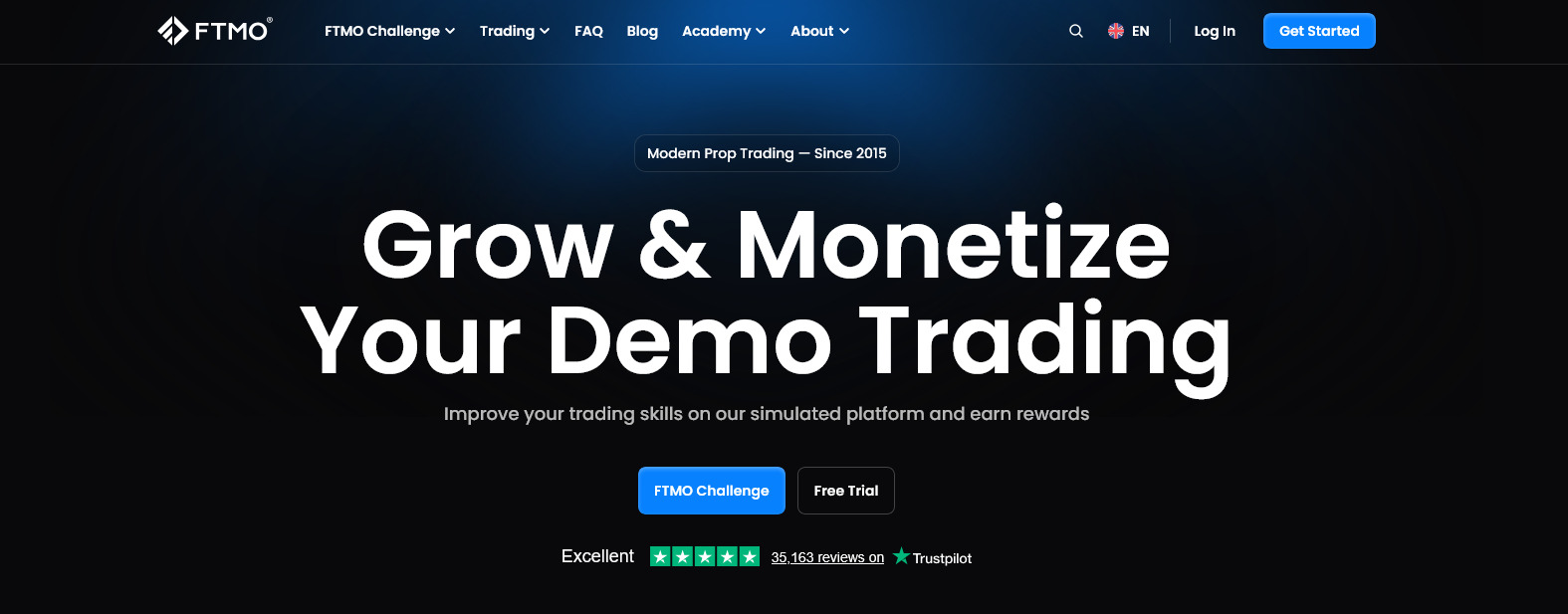
If you’re looking at FTMO, you probably want a clear answer to one thing, is it worth the rules and the fee to get access to a bigger account. FTMO is a long-running prop firm founded in 2015, and it’s known for clear rules, a two-step evaluation (Challenge then Verification), and a payout process that’s quick once you’re eligible.
This review breaks down exactly how the FTMO Challenge works, what you must hit to pass (profit targets and minimum trading days), and what usually trips traders up. You’ll also see the key risk limits in plain English, including the 5 percent daily loss and 10 percent max loss on standard accounts, plus the news-trading restriction window on Classic accounts (and why the Swing account rules are different).
We’ll cover fees too, including what you pay upfront to start an evaluation and how that fee gets returned if you become funded and earn your first reward. Then we’ll walk through payout terms, like the 14-day payout cycle, typical processing times, and common withdrawal methods (bank transfer, Skrill, and crypto).
At the end, you’ll have a simple plan to pass the evaluation without gambling, manage drawdown day to day, and withdraw profits cleanly once you’re funded. If you can follow rules and trade with discipline, FTMO can be a solid fit.
FTMO in 2026 is best understood as a Modern Prop Trading firm with a structured tryout. You trade on a simulated account (not a live brokerage account), prove you can follow risk rules, and then you can earn a reward share if you keep trading within those limits. You don’t deposit trading capital, but you do pay an evaluation fee to enter the Challenge.
It’s been operating since 2015 and is based in Prague, which matters because longevity is rare in prop trading. FTMO also has a large global footprint (served in well over 100 countries) and a strong public review profile (a high Trustpilot rating is commonly cited). On top of that, FTMO reports a very large cumulative amount paid out in rewards (hundreds of millions), which is a meaningful trust signal if you’re comparing firms.
FTMO covers most of the markets retail traders care about, so you can keep your strategy focused without hunting for a firm that supports your instrument list. At a high level, you can trade:
Platform choice is practical, since it affects your execution tools, charts, and automation options. FTMO supports:
You can generally expect web and mobile access depending on the platform you choose, which helps if you manage trades away from your desk.
Most traders start with an evaluation size between $10,000 and $200,000. If you pass the two-step process, your reward split typically starts at 80%, and it can increase to 90% as you meet long-term performance goals.
Two limits matter when you plan your path:
Scaling is not automatic. It’s tied to steady performance and a clean track record, including being net profitable over the review period and completing withdrawals, which shows you can produce results without breaking rules.
“Safe” with FTMO doesn’t mean the same thing as a regulated brokerage account. FTMO is not your broker, and it’s not a regulated investment account where you deposit and trade your own funds. The safety angle is more practical:
Also note that FTMO restricts access from certain sanctioned jurisdictions. A commonly listed set includes Iran, Syria, Myanmar, and North Korea, plus individuals on international sanctions lists.
FTMO’s evaluation is a two-step test of both profit and discipline. The profit targets are clear, but the real hurdle is staying inside the drawdown limits day after day. You can take your time (there’s typically no strict maximum trading days), but you must trade at least 4 separate days in each step. Pass both steps, and you become an FTMO Trader, which is the point where you can start requesting reward payouts under the firm’s payout cycle.
In the Challenge, you’re proving you can hit a target while keeping risk under control. For the common Standard setup, the benchmarks are:
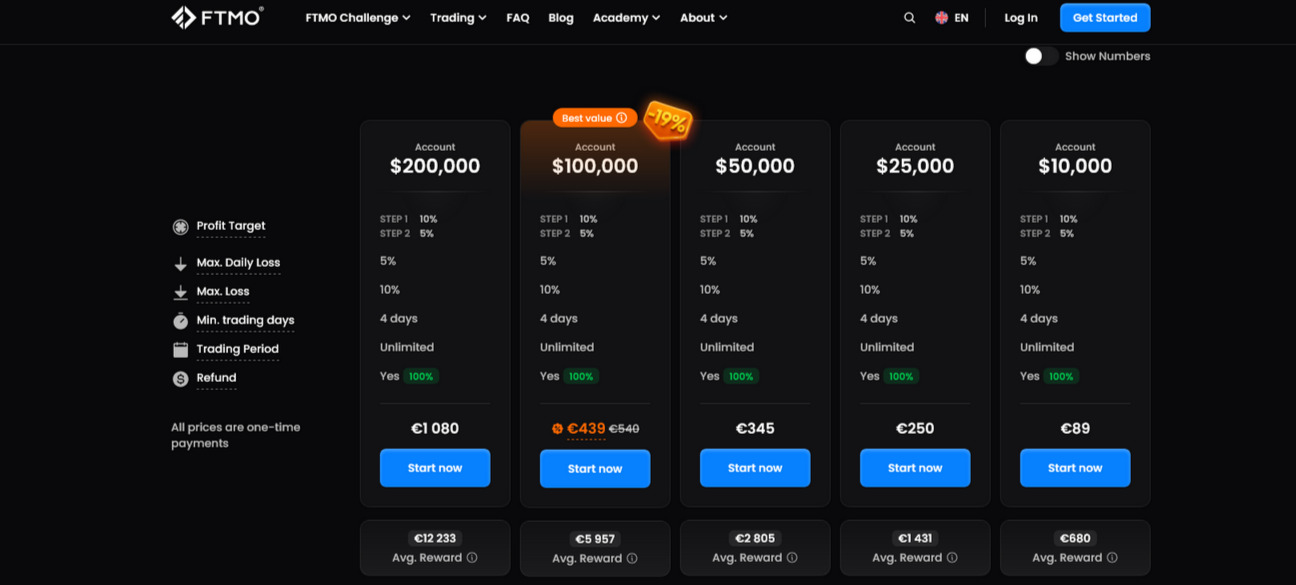
Here’s the math on a $100,000 account (Standard risk), which makes the rules easy to see:
| Rule | Benchmark (Standard) | $100,000 Example |
|---|---|---|
| Profit target | 10% | $10,000 |
| Maximum Daily Loss | 5% | $5,000 |
| Maximum Loss | 10% | $10,000 |
| Minimum trading days | 4 | 4 trading days |
Two details matter more than most traders expect:
Maximum Daily Loss resets each day. It’s calculated from your account’s equity at the start of that trading day, then it resets the next day. If you start the day at $100,000 equity, your daily loss limit is $5,000. If you drop to $95,000 at any point that day (including floating loss), you’re at the line.
Maximum Loss is always “on.” This is the overall equity drawdown limit from the initial balance. On $100,000 Standard, you can’t go below $90,000 equity at any time, even for a moment.
Most traders don’t fail because 10% is “too hard.” They fail because they push size after a bad start, then the drawdown rules end the attempt before the strategy has time to work. Think of the profit target as the finish line, but the drawdown limits as guardrails, if you hit the rails, the run is over.
Verification is the second step, and it’s usually where traders either calm down and pass, or they sabotage themselves by trying to sprint.
For the common Standard setup, the key change is:
On that same $100,000 account, your goal is typically $5,000, but your daily loss limit is still $5,000 and your max loss limit is still $10,000. That’s why “finish fast” thinking can backfire. One oversized trade can do real damage.
A simple mindset that helps in Verification:
Pass Verification and you move into the funded stage (becoming an FTMO Trader), where you can request reward payouts once you meet the eligibility timing in the payout schedule.
Your account type changes what’s “comfortable” to trade, even if the core drawdown rules are similar.
Classic account (higher leverage, more restrictions)
Swing account (more freedom, lower leverage)
Quick decision rules:
Most FTMO failures aren’t about a “bad strategy.” They happen because a trader breaks a rule without realizing how strict the math is. If you understand equity-based drawdowns, the Classic news window, and the small list of banned tactics, you’ll avoid the easiest ways to get disqualified.
FTMO’s two big risk limits on Standard are simple on paper: 5% Maximum Daily Loss and 10% Maximum Loss. The part that catches people is how they’re measured.
Both are equity-based, which means FTMO counts your balance plus any open profit or loss. If you have trades running and they go against you, that floating loss still counts.
Here’s a simple example on a $100,000 Standard account:
Now imagine this sequence:
That’s why people get clipped by the daily rule. They think, “I’ll close it later,” but the rule doesn’t care about later.
A few details to keep straight:
If you treat the daily loss like a circuit breaker, you’ll last longer and finish more evaluations.
On FTMO Classic accounts, news trading is a common hidden trap. The restriction applies to high-impact news events (think major economic releases that can spike spreads and cause fast moves). During these events, FTMO blocks trading on instruments that are heavily affected (often including major currency pairs tied to currencies like USD, EUR, AUD, and NZD).
The restricted window is short but strict: 2 minutes before to 2 minutes after the release.
What can violate it is broader than most traders expect:
The safest routine is simple:
If you want to trade news without tiptoeing around a four-minute rule, the FTMO Swing account exists for that. It removes the Classic news restriction, which is a big deal for traders who build plans around macro releases.
FTMO allows a lot of normal trading styles, as long as you’re not trying to exploit platform behavior.
Commonly allowed:
What crosses the line are tactics that depend on “getting something for free” from execution quirks, errors, or delayed data. Examples include:
Also watch the multi-account rules. If you’re running more than one account:
If your edge comes from analysis and risk control, you’re fine. If your edge comes from a loophole, it won’t last here.
FTMO’s cost structure is pretty simple once you separate what you pay upfront (the one-time evaluation fee) from what you pay while trading (spreads, commissions, and overnight swaps). The big upside is that there’s no deposit, and if you become funded and earn a reward, FTMO typically refunds your evaluation fee with your first payout.
The evaluation fee is a one-time payment to start the FTMO Challenge (and then move to Verification). Pricing can vary by account currency, account type (Classic vs Swing), and any account options available at checkout. In most cases, the smallest account starts at $10,000, with pricing you’ll see advertised from about €89. In other listings, the $10,000 option is shown closer to €155 for the Standard setup, depending on the offering.
Here’s a readable snapshot of common sizes (use this as a baseline, not a promise):
| Challenge size | Typical fee you may see (EUR) |
|---|---|
| $10,000 | ~€89 to €155 |
| $25,000 | ~€250 |
| $50,000 | ~€345 |
| $100,000 | ~€540 |
| $200,000 | ~€1,080 |
Because pricing can change, check FTMO’s checkout page for the exact total in January 2026, including your selected account type and currency.
What this means for your total cost: if you pass and get your first reward, the evaluation fee is usually returned, so the long-term “entry cost” is more about whether your strategy can handle trading costs without breaking drawdown rules.
FTMO uses a raw spread plus commission setup on many markets, which often means tighter spreads, then a clear commission line item.
A simple example helps. On many forex pairs, the commission is commonly listed as about $3 per lot round turn (opening + closing). If you trade 1.00 lot EUR/USD and then close it:
Swaps are the other cost traders forget. Overnight swaps apply when you hold positions past the daily rollover, and they can add up for swing-style holding periods. If you plan to hold trades for days, treat swaps like “rent” on the position and account for them in your expected return.
A few practical reminders:
If you want the lowest-cost way to get comfortable with FTMO’s rules, start with the Free Trial. It’s designed to mirror the evaluation environment, so you can test your routine before paying any fee.
You also get access to tools that help you trade “within the lines,” including:
Getting paid is the whole point of passing the evaluation, so it helps to know the timing, the methods, and the small mistakes that can slow everything down. With FTMO, withdrawals run on a set cycle (not “anytime”), and you’ll want your account, identity, and payment details ready before your first request.
FTMO’s reward split typically starts at 80% for the trader. If you keep performing and meet scaling conditions over time, the split can increase up to 90%. Think of it like earning a bigger cut after you prove you can stay consistent.
A simple example makes the take-home clear:
Payouts run on a bi-weekly (14-day) cycle. You can request your reward share starting from the 14th calendar day after your first trade on the funded stage. In practice, this means your “first month” often looks like: trade, wait for eligibility, request, then repeat every two weeks if you stay profitable.
Two ground rules are non-negotiable:
When your payout date arrives, treat the request like booking a flight. The smallest typo can cause back-and-forth.
Here’s the usual flow:
FTMO may cover some fees on their side, but payment rails can still charge their own costs (bank fees, intermediary fees, e-wallet fees, or blockchain network fees).
Common reasons payouts get delayed:
If you want fewer headaches, keep your withdrawal method consistent and double-check details before submitting.
Rewards are income in most places, and the rules vary by country. Keep it simple and stay organized:
For the cleanest answer on what you owe and when, talk to a local tax professional who understands trading-related income in your country. This section is general info, not tax advice.
Passing FTMO is less about finding a magic setup and more about staying inside tight guardrails. The profit targets (10% then 5% on Standard) are doable, but the equity-based drawdowns are what end most attempts. Treat this like flying a plane: small corrections, strict limits, and no hero moves when conditions get rough.
Start by building a risk plan that respects the two numbers that matter most on Standard accounts: 5% Maximum Daily Loss and 10% Maximum Loss, both measured by equity (open losses count).
A simple framework that works for most styles:
Then add a personal “circuit breaker” that triggers before FTMO does:
This buffer matters because FTMO’s daily loss is unforgiving. One spread spike, a slip, or an open trade drifting can touch the limit even if you “planned” to cut later.
Keep stops honest:
Smaller size often becomes the fastest path to passing because it keeps you in the game long enough for your edge to show up. You can’t recover from disqualification.
A huge green day feels good, but it often comes from oversized risk. The next day, traders try to repeat it, then the account snaps back and hits the daily loss.
Replace “one big day” thinking with a steady target:
A practical rule that helps: trade your best setup only. If you can’t clearly explain why a trade matches your plan, skip it. Fewer trades usually means fewer emotional mistakes.
Build a quick routine around tracking behavior, not just entries:
When you have a drawdown day, protect tomorrow. Cut size in half, or stop early. You’re not trying to “win it back,” you’re trying to stay eligible to trade.
News and weekend mistakes are some of the easiest ways to fail without a “bad trade.” Use a checklist, and you’ll avoid most of the chaos.
Before each session, do this:
If you’re on a Classic account, respect the news restriction window. FTMO restricts trading around high-impact releases, roughly 2 minutes before to 2 minutes after. In that window, don’t:
If you trade a Swing account, you get more freedom around news and can hold overnight and over the weekend. Still, manage the real risks:
For weekends, only hold if your plan expects it and your size is light enough to survive a gap.
Your first 30 days funded should be boring. Don’t scale up just because you “made it.”
A clean approach:
After that, work toward scaling slowly. FTMO’s scaling is performance-based and typically reviewed over time (often referenced as a 25% increase every four months). Plan to meet the common requirements:
If you run multiple accounts, remember the allocation limits. FTMO commonly caps total allocation per trader or strategy (often cited around $400,000). Keep strategies distinct, and avoid anything that looks like forced hedging across accounts.
The goal is simple: protect the downside, take clean payouts, then let size grow as a byproduct of consistency.
FTMO is best for traders who can follow rules without improvising, especially Forex and index traders who want bigger buying power without putting personal trading capital at risk. The core rules are simple but strict: stay under the 5% daily loss and 10% max loss on Standard (both equity-based), meet the 10% Challenge target and 5% Verification target, and hit at least four trading days in each phase. On Classic accounts, respect the high-impact news freeze (about two minutes before and after), Swing is the better fit if you hold overnight, trade news, or keep positions over the weekend.
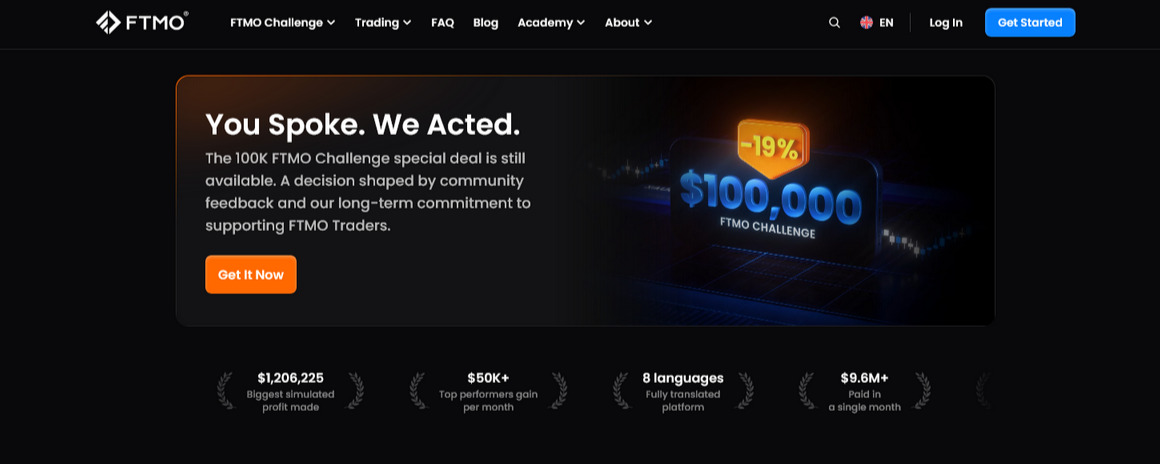
Costs are straightforward: you pay a one-time Challenge fee (commonly from about €89 to €155 for $10k up to about €1,080 for $200k), then you deal with real trading costs like spreads, commissions, and swaps. If you pass and earn, the fee is typically refunded with your first reward, which makes discipline the real price.
Payouts run on a 14-day cycle, starting 14 days after your first funded trade, with common methods like bank transfer, Skrill, and crypto.
Action plan: take the Free Trial, pick Classic or Swing, build a risk plan with a personal daily stop, then start the Challenge and trade small until the rules feel automatic. Thanks for reading, share what you trade and which account type you’re leaning toward.
A spread is the gap between the buy price and the sell price. It’s the first cost you pay the moment you enter a trade, and it can be the quiet reason a “good setup” ends up red.
That matters even more in prop firm trading, where you’re trying to hit profit goals while keeping risk tight. FTMO, founded in 2015, is a modern prop trading firm with millions of customers across 140+ countries. Trading happens in a simulated environment where strong performance can earn rewards. This post breaks down how spreads affect FTMO-style trading and how to plan around them.
Think of the spread like a toll booth. Every time you enter, you pay it. When you exit, you feel it again because you had to climb back from that small loss to reach true break-even.
Spreads hit different styles in different ways:
You don’t need to memorize exact FTMO spreads because they change by symbol and market conditions. What matters is the habit of checking the spread before you commit, especially if your stop is tight or your target is small.
Some accounts look cheap because the spread is tight, but they add a commission. Others show a wider spread with lower or no commission. The only number that matters is the round-trip cost (in and out).
Example: if EURUSD shows a 0.8 pip spread and you pay a 0.4 pip equivalent commission per side, your all-in cost is about 1.6 pips for the full trade. Compare that to a 1.4 pip spread with no commission, and the “tighter” option may not be cheaper.
Spreads move with liquidity. When more traders and market makers are active, pricing is usually tighter. When activity drops, spreads can stretch.
Common times to watch:
Instruments behave differently, too. Major FX pairs tend to be steadier than exotic pairs. Indices and metals can widen around opens and news. If crypto is available on your platform, it can vary a lot by time of day.
Events like CPI, NFP, and rate decisions can widen spreads fast. Stops may fill worse than expected. If your edge depends on clean, tight execution, consider smaller size, wider stops (only if risk stays controlled), or skipping the trade. Protecting rule compliance can matter more than catching a spike.
Build your plan around conditions that fit your strategy. Focus on liquid symbols, and trade during active hours when spreads are more stable. Avoid entering right at rollover. Use limit orders when it makes sense, since they can help control entry price.
Backtest with realistic spreads, not “perfect” ones. Before placing a tight stop, check the average spread you’ve been seeing that session. FTMO supports MT4, MT5, cTrader, and DXtrade, so pick the platform where spread is easy to monitor.
FTMO also offers education, community spaces, and 24/7 support in many languages, which helps when you need clarity on trading conditions.
Spreads are a normal trading cost, and they change with liquidity. In FTMO-style trading, managing spreads is part of staying consistent and protecting your rules. Trade the markets and hours where spreads fit your approach, and track your all-in cost over a solid sample of trades. When the “toll booth” gets expensive, patience is also a strategy.
Prop firm rules can feel like a tightrope. One small slip, and your run ends early. FTMO prop firm trading rules are there to measure skill, not luck, so it pays to understand them before you place real pressure on your decisions.
FTMO has been around since 2015 and focuses on simulated trading where strong performance can earn performance-based rewards. Before paying for anything, you can also practice with Free Trials, which is the simplest way to learn the rules in real market conditions.
This guide breaks the rules into clear buckets: objectives, risk limits, trading behavior, and a few practical habits that keep you consistent.
FTMO generally follows a three-step flow. You pick an FTMO Challenge, meet the trading objectives, then move through Verification. After that, you trade an FTMO Account under the same kind of risk and behavior rules.
It’s all built around simulated trading, with rewards tied to how well you follow the plan, not how wild your best trade looks. FTMO has a large global user base (millions of customers across 140+ countries), supports MT4, MT5, cTrader, and DXtrade, and offers 24/7 support in many languages. Those details matter because you’re not alone, and help is available when a rule isn’t clear.
Objectives often include a profit target, a minimum number of trading days, and limits meant to discourage all-in behavior. Think of it like a driving test, they want steady control, not one perfect stunt.
Always confirm the current objectives for your exact account type, since conditions can differ.
A personal account lets you break your own rules in private. A prop evaluation is built to test discipline under pressure. FTMO also offers learning and community support through its Academy, YouTube content, and an active Discord community, which can help with psychology and routine.
When traders search “FTMO trading rules,” they usually mean loss limits. The big ones are daily loss limit and maximum loss limit. Another common point is how equity and balance are treated. Balance reflects closed trades, equity includes floating profit or floating loss from open trades.
So even if you haven’t closed a losing position, a large open drawdown can still put you near a limit. To stay safe, set a daily stop, cut position size after a hit, and be careful around high-volatility news when spreads and slippage can widen.
Daily loss example: you take two quick losses in the morning, then try to “win it back” with a bigger trade. The drawdown stacks fast, and you hit the daily limit before lunch.
Max loss example: you avoid blowups, but you keep taking small losses for days. The slow leak adds up, and you eventually hit the overall limit.
A few habits go a long way:
Beyond drawdown, prop firms also watch trading behavior. Common areas to review in the Terms and Conditions include copy trading from signals, account sharing, restricted automation, or tactics that try to exploit pricing or execution.
Staying consistent and transparent helps protect your eligibility and keeps reward withdrawals smooth when you meet requirements.
Some automation may be allowed with conditions. Verify what’s permitted, how the strategy is sourced, and whether changing settings mid-run could be an issue. Test it on a Free Trial first, then keep settings stable.
Volatile periods can interact with rules through spreads, slippage, and fast moves. Pick the platform you can manage best, and practice the same workflow you’ll use later.
FTMO prop firm trading rules are easiest when you sort them into three groups: objectives, loss limits, and behavior rules. Read the current rule page, use a Free Trial to rehearse, set your daily and overall risk caps, then trade small and steady. Treat it like a repeatable process, not a bet, and the rules start to feel simple.
555
2 weeks ago555
2 weeks ago555
2 weeks ago555
2 weeks ago555
2 weeks ago555
2 weeks ago555
2 weeks ago555
2 weeks ago555
2 weeks ago555
2 weeks ago555
2 weeks ago555
2 weeks ago555
4 months ago555
4 months ago555
4 months ago555
4 months ago555
4 months ago555
4 months ago555
4 months ago555
4 months ago555
4 months ago555
4 months ago555
4 months ago555
4 months agoМережевий простір України отримав черговий корисний ресурс — [url=https://jokgqeoiuweguoi.icu/]збірку інтернет-ресурсів[/url], створений для агрегації найрізноманітніші українські сайти. Новостворений портал акумулює адреси веб-сторінок, що висвітлюють широкий спектр тем. До каталогу увійшли сайти загальнодержавного значення, а також ті, що спеціалізуються на висвітленні подій певних областей. Головне завдання проєкту — створити зручну точку входу для користувачів, які шукають актуальні місцеві медіа на будь-який смак: від новинної стрічки та політики до глибоких історичних досліджень, трендів для молоді, культури побуту, активізму та публіцистики. Представлений навігатор націлений на пересічних громадян та готовий до комунікації з засобами масової інформації, журналістами та рекламодавцями, які бажають заявити про себе в інформаційному просторі України
6 months agoPersonally, I tried many challenges with other famous prop firms.Slippage has been the main reason I lose the challenge. With FTMO, trading condition are just next to real market ones. I really appreciate it! One thing I don’t really like is the high commission on BTC! About $60 for one lot! It’s impossible to scalp BTC. I hope you take this issue into consideration. Tight spread with high commission is a disaster recipe for crypto scalpers!
9 months ago