DXTrade, TradeLocker
USDT, Pix, Credit/Debit Card, PayPal, Bank Transfer, Crypto, Tether
N/A
Picking a prop firm isn’t just about the profit split, it’s about the rules you’ll live with every day. This DNA Funded review breaks down what the firm offers, what it costs, and what can get you disqualified, so you can decide if it’s a good match before you pay a fee.
If you’re new to prop firms, here’s the quick idea: you usually start with an evaluation (a “challenge”) on a demo account. You must hit a profit target while staying inside drawdown limits, then you can qualify for payouts on a funded account. That means the fine print matters, including daily and max drawdown, news and weekend rules, minimum trading days, and payout timing.
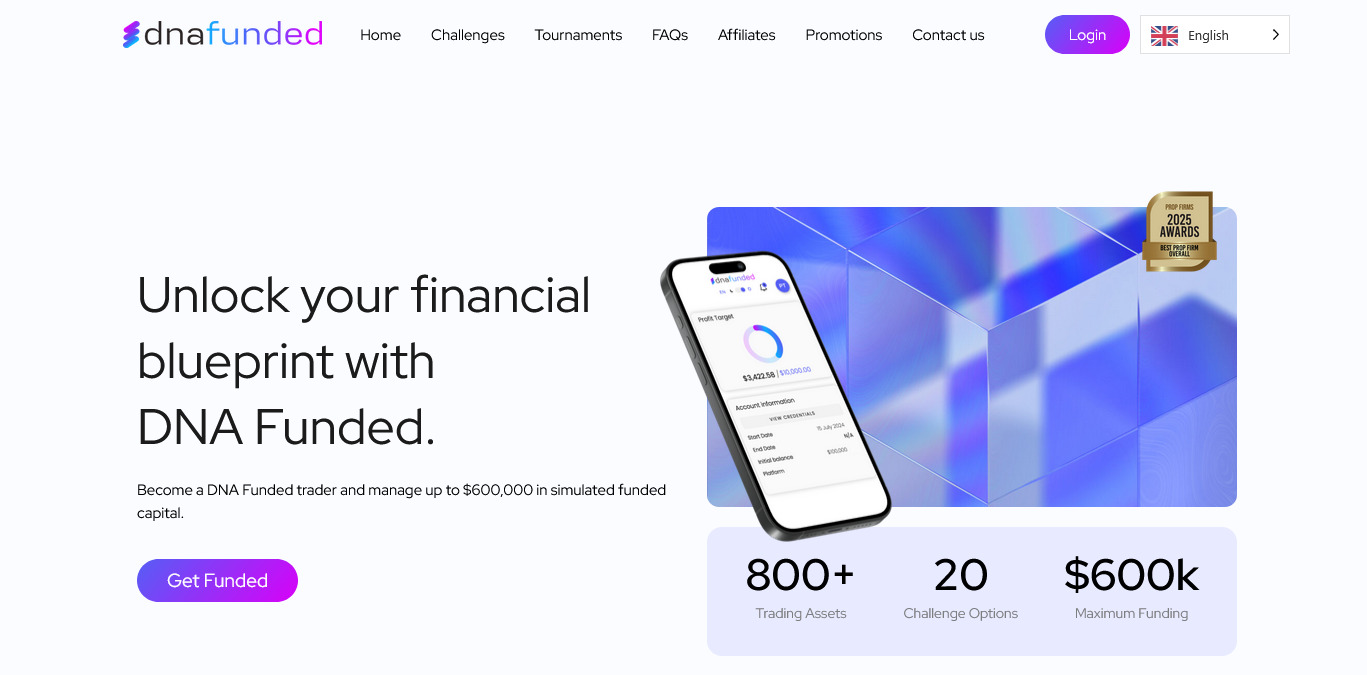
DNA Funded, launched in 2024, is registered as DNA Funded Ltd (2025-00574) with a registered office in Saint Lucia and an operating office in Melbourne, Victoria. It uses TradeLocker and works with DNA Markets as its broker, with access to forex, indices, commodities, stocks, and crypto. You’ll also see how its four paths (1-Phase, 2-Phase, Rapid, and Instant Funding) compare on targets, drawdowns, and fees, plus what payouts look like (14 days standard, 7 days with an add-on).
This is for newer traders comparing firms and for experienced traders double-checking rules like copy trading limits, IP policies, and the $600k max allocation.
When you’re comparing prop firms, “Is this legit?” usually means two things: is there a real business behind the website, and do the rules and payouts match what they claim. DNA Funded checks the first box with clear company identifiers, but it’s still smart to understand what those details do and do not prove before you pay a challenge fee.
DNA Funded operates under the legal name DNA Funded Ltd with registration number 2025-00574. The firm launched in 2024 and lists Saint Lucia as its registered office location. It also states it has a physical operating office in Melbourne, Victoria, and the company is led by CEO Martin Doepke.
Why should you care about these basics?
One important line in the sand: company registration is not the same as being a regulated broker. Prop firms can be legitimate businesses without offering regulated brokerage services. Treat registration as a credibility signal, not a safety guarantee.
DNA Funded partners with DNA Markets as its broker. Trading runs on TradeLocker only, so you won’t be choosing between multiple platforms like MT4 or MT5 here.
TradeLocker is generally beginner-friendly because it keeps things visually clean. If you’re newer, it tends to feel less cluttered than older platforms, with straightforward order controls and charts that are easy to read. That said, “simple” doesn’t mean you can ignore costs or rules, so you still need to watch spreads, commission, and drawdown.
You can trade a broad mix of markets, including:
That variety helps if you like to spread risk or stick to one niche (like majors in FX or index CFDs).
DNA Funded does not accept traders from certain regions due to sanctions and legal limits. As listed, restricted countries include:
Restrictions can change, so confirm the current list on the official site before paying. If you’re traveling or trading while abroad, also consider how location and login patterns may affect account checks.
To keep your own “trust check” simple, do these before you commit:
DNA Funded keeps things simple by offering four paths, each built around the same core idea: hit the target (if there is one), respect drawdown limits, and complete at least 3 trading days. The main differences are the profit target, the daily and max drawdown, the time limit, and whether drawdown is balance-based or trailing.
If you want quick context before choosing, here are the numbers most traders compare first:
The 1-Phase Challenge is the “one-and-done” evaluation. You have one profit target of 10%, and once you hit it while respecting risk rules, you move on. It’s popular because it’s easy to understand and doesn’t force you into a second round.
Key rules traders usually care about:
Best fit: This one suits steady traders who want simple rules and enough time to let trades play out. If you’re the type who prefers a clean plan, a few high-quality setups per week, and controlled risk, the unlimited time limit feels like a relief.
Main risk: the 6% max drawdown is tight. With a 10% target, you can’t afford a sloppy week. Think of it like driving with a narrow shoulder on the road. You can still move fast, but you need to stay centered.
The 2-Phase Challenge splits the evaluation into two steps. You still need performance, but you get more room to operate on drawdown and higher leverage. Targets are 10% in Phase 1 and 5% in Phase 2, so the second phase is usually more about staying consistent than swinging for big gains.
Key rules:
Who it fits: Intraday traders often like this model because 10% max drawdown gives more room to handle normal losing streaks. The 1:50 leverage can also help if your strategy uses tighter stops and you don’t want to oversize positions to make the math work.
The trade-off: Two phases can reduce pressure on any single run, but it can also take longer. You still need to show you can do it twice, and that second phase, even with a smaller target, tests your patience.
Rapid is built for traders who want a quicker pass or fail. The target is lower, but the clock is real. You get 10 days maximum to hit the goal, which changes how you trade, even if your strategy is solid.
Key rules:
Best fit: This is better for traders with a proven plan and strong timing, especially if you already know your best sessions and your best setups. The 5% target is realistic, but only if you can execute without hesitation.
Why it’s risky for beginners: Time pressure makes people do dumb things. Overtrading, chasing moves, widening stops, and forcing trades are common mistakes here. A 4% daily limit and 5% total limit don’t give many second chances.

Instant Funding is exactly what it sounds like: you skip the evaluation target and start on a funded-style account right away. There is no profit target, but the risk control is stricter because it uses a 4% trailing drawdown.
Key rules:
Trailing drawdown changes how you manage risk because the threshold can move as your equity rises. That forces smaller risk per trade, since a quick pullback after gains can still breach the limit.
A simple example:
Who it fits: Instant Funding can be a strong match for experienced traders who want to start right away and already trade with tight risk controls. If you tend to size up after a win, this model will punish that habit quickly.
Most prop firm failures don’t happen because a strategy is “bad.” They happen because the trader didn’t match their style to the rules. DNA Funded is no different. Before you pay for a challenge (or go straight to Instant Funding), you should understand four areas that cause the most unexpected breaches: drawdowns, news and weekends, banned strategies, and IP and account policies.
DNA Funded uses drawdowns to keep risk under control, and the limits change by model. In general, you’ll see daily drawdown between 4% and 6% and overall drawdown between 5% and 10% on evaluation-style challenges. The Instant Funding model is different because it uses a 4% trailing drawdown, which is tighter and more sensitive to your equity peaks.
Here’s the plain-English difference between the two drawdown “types” you’ll see:
Two common misunderstandings:
Example 1 (daily drawdown can fail even after a recovery):
You’re in a model with a 5% max daily drawdown. You start the day at $50,000.
Even if you finish the day down only $1,100, the damage is done. You already exceeded the daily limit earlier, so the account can still be breached.
Example 2 (Instant Funding trailing drawdown feels “tight” after a good run):
You have a $25,000 Instant Funding account with a 4% trailing drawdown.
The takeaway: with Instant Funding, treat your first job as protecting the peak, not just avoiding losses from the start line.
DNA Funded’s approach is simple: news trading is allowed, but restricted. You can trade around events, but you can’t treat major releases like a slot machine. Firms set these rules because news spikes can cause wide spreads, slippage, and random fills, which can blow accounts fast.
In practice, “allowed but restricted” usually means:
Rapid and Instant models tend to feel stricter because their drawdowns are tighter (Rapid has lower daily and total limits, Instant has trailing drawdown). That smaller margin makes any news spike more dangerous.
If you want a safe routine for news weeks, keep it boring:
Weekend rules also catch people off guard. In general:
If your style depends on holding risk over major calendar events or weekends, pick the model that gives you the most breathing room, then size down anyway.
DNA Funded allows automation, but not exploitation. Algos and EAs are allowed as long as they aren’t built to abuse pricing gaps, execution delays, or broker quirks.
Where traders get in trouble is using methods that look like “edge” to them but look like abuse to a firm. Strategies that are commonly banned or treated as violations include:
Copy trading is another common trap. DNA Funded’s policy is restrictive: copying is limited to your own DNA Funded accounts. External copying, sharing signals for mirrored execution, or multi-user setups can get flagged.
If you want to stay safe, keep your trading behavior looking like a real plan:
A lot of traders pass the trading part and fail the admin part. DNA Funded expects a consistent IP pattern, and unusual logins can trigger review. Logging in from multiple countries in a short window, or switching networks constantly, can look like account sharing even when it’s not.
Key rules and limits to know:
If you travel for work, treat your prop account like online banking:
If you respect the IP and account rules, you avoid the most frustrating kind of failure, the one that has nothing to do with your trading edge.
When you price a prop firm challenge, the fee is only the first line item. Your real cost is a mix of the challenge fee, spreads, and commission, plus the hidden “tax” of trading during messy conditions (news spikes, thin liquidity, and wider spreads). If you trade often, those small costs can add up faster than you expect.
DNA Funded’s challenge fees are not refundable. That’s a real downside compared to firms that refund the fee after your first payout or after passing. Treat the fee like a business expense you may not get back.
The upside is the entry price can be relatively low, with some evaluation models starting around $49 (2-Phase) or $59 (1-Phase) depending on the account size. The Rapid (10-Day) model typically starts higher (around $99), and Instant Funding starts higher still (around $199) because you skip the evaluation target and begin on a funded-style account with tighter risk rules.
A practical way to pick an account size is to think in “attempts,” not ego:
DNA Funded uses variable spreads, meaning the spread moves with market conditions. On calm sessions, majors often stay reasonable, but spreads can widen around major economic releases and during low-liquidity hours (think late Friday or session transitions). That widening can turn a “good” entry into an instant drawdown hit.
On top of spreads, there’s a clear fixed cost: $5 round-turn commission per lot (open plus close). That’s standard in many prop setups, but it hits some styles harder than others.
Here’s a simple example:
If your edge is a few pips, your costs can eat it alive.
Before you buy a challenge, do a quick reality check on costs:
Then run a small “cost audit” for your strategy:
If the math looks tight on demo, it will feel even tighter under real challenge pressure.
Getting paid is the part that matters most, and it’s also where traders get tripped up by small rules. DNA Funded keeps the basics simple: you earn a percentage of the profits you generate, you request payouts on a set cycle, and you only get paid if your account is clean and compliant. The key is to treat payouts like a process, not a prize.
DNA Funded’s standard profit split is 80%, which means if you make $1,000 in eligible profit, you keep $800 and the firm keeps $200. If you see “up to 90%”, that usually means the higher split is tied to a specific option or add-on, or it applies after meeting certain conditions. In other words, don’t assume 90% is automatic on day one for every account type.
Payout timing is also straightforward:
The 7-day option can be useful if you want quicker access to profits, but it’s only worth it if your strategy produces steady results. If you trade fewer setups (like swing trading), the 14-day cycle often feels just fine.
Before you hit “request payout,” make sure your account checks every box. DNA Funded’s payout requirements are designed to reward traders who follow the rules, not just traders who spike a profit.
Here’s the practical checklist to run through:
Tip: Right before you request, take screenshots of your dashboard metrics (profit, trading days, drawdown, and rule status). If anything gets questioned, you’ll be glad you saved proof.
DNA Funded supports payment options most traders already use, but the menu isn’t endless. Expect common rails, not obscure local methods.
Typical deposit methods include:
Typical payout methods include:
Your actual payout experience depends on doing the boring stuff right: read the payout terms for your specific model, follow identity checks if required, and keep your account activity consistent (especially with IP and login behavior). If you treat withdrawals like a repeatable routine, payouts tend to feel predictable.
DNA Funded stands out for traders who want clear choices and rules that don’t change every week. You get four funding paths (1-Phase, 2-Phase, Rapid, or Instant), TradeLocker access, and a simple payout flow with an 80% split that can reach 90%. The trade-off is real: challenge fees aren’t refundable, strategy rules are firm (no grid or martingale, no arbitrage, and external copy trading is not allowed once funded), and the strict IP policy means you need consistent logins.
There’s also no scaling plan beyond the $600k max allocation, so what you buy is the ceiling.
Who it’s for: disciplined traders who can respect drawdowns (including the 4% trailing limit on Instant Funding), follow news and weekend limits, and prefer a straightforward 14-day payout cycle (or 7 days with an add-on).
Who should skip: traders who want refunded fees, loose rule sets for copying and high-risk systems, or a clear path to scale past $600k.
Thanks for reading, before you purchase, re-check the latest rules and restricted country list on DNA Funded’s site so you’re trading with the current terms.
| Symbol | Description | Min Spread STD (Pips) | Min Spread RAW (Pips) |
|---|---|---|---|
| EURUSD | Euro / US Dollar | 1 | 0 |
| GBPUSD | Great Britan Pound / US Dollar | 1 | 0.1 |
| USDCHF | US Dollar / Swiss Franc | 1 | 0.1 |
| USDJPY | US Dollar / Japanese Yen | 1.1 | 0.1 |
| USDCAD | US Dollar / Canadian Dollar | 1 | 0 |
| AUDUSD | Australian Dollar / US dollar | 1.2 | 0.2 |
| AUDCAD | Australian Dollar / Canadian Dollar | 1 | 0.1 |
| AUDCHF | Australian Dollar / Swiss Franc | 1 | 0.1 |
| AUDJPY | Australian Dollar / Japanese Yen | 1 | 0.1 |
| CHFJPY | Swiss Franc / Japanese Yen | 1 | 0.1 |
Showing 1 to 10 of 56 entries
| Symbol | Description | Min Spread STD (Pips) | Min Spread RAW (Pips) |
|---|---|---|---|
| ASX200 | Australia 200 Cash | 1 | 1 |
| US30 | Wall Street 30 Cash | 16 | 16 |
| FRA40 | France 40 Cash | 0 | 0 |
| UK100 | UK 100 Cash | 12 | 12 |
| EUSTX50 | Europe 50 Cash | 1.2 | 1.2 |
| NDX100 | Nasdaq Cash | 14 | 14 |
| JPN225 | Nikkei 225 Cash | 4.5 | 4.5 |
| SPX500 | US SPX 500 Cash | 4 | 4 |
| GER40 | Germany 40 Cash | 1.5 | 1.5 |
| HK50 | Hang Seng Cash | 7.5 | 7.5 |
Showing 1 to 10 of 17 entries
| Symbol | Description | Min Spread STD (Pips) | Min Spread RAW (Pips) |
|---|---|---|---|
| UKOUSD | Spot Brent Crude Oil | 3 | 3 |
| USOUSD | Spot WTI Crude Oil | 3 | 3 |
| XNGUSD | US Nat Gas (Cash) | 1 | 1 |
| XAUUSD | Gold / US Dollar | 1.3 | 1.3 |
| XAUEUR | Gold / Euro | 1.3 | 1.3 |
| XAUAUD | Gold / Australian Dollar | 1.7 | 1.7 |
| XAUGBP | Gold / Great Britain Pound | 1.3 | 1.3 |
| XAUJPY | Gold / Japanese Yen | 5.3 | 5.3 |
| XAGUSD | Silver / US Dollar | 0.1 | 0.1 |
| XAGEUR | Silver / Euro | 1.4 | 1.4 |
Showing 1 to 10 of 16 entries
| Symbol | Description | Min Spread STD (Pips) | Min Spread RAW (Pips) |
|---|---|---|---|
| MSFAAP | Microsoft v Apple | 10 | 10 |
| UALPFE | United Airlines Holdings Inc vs Pfizer Inc | 10 | 10 |
| SPXVIX | US 500 vs Volatility Index | 10 | 10 |
| AMZDIS | Amazon vs Disney | 10 | 10 |
| AMZEBA | Amazon vs eBay | 10 | 10 |
| BOECVX | The Boeing Company vs Chevron | 10 | 10 |
| BOEPFE | The Boeing Company vs Pfizer | 10 | 10 |
| BOEXOM | The Boeing Company vs Exxon | 10 | 10 |
| BOKLMT | Booking vs Lockheed Martin | 10 | 10 |
| NVDORC | Nvidia vs Oracle | 10 | 10 |
Showing 1 to 10 of 543 entries
| Symbol | Description | Min Spread STD (Pips) | Min Spread RAW (Pips) |
|---|---|---|---|
| ADAUSD | Cardano / USD | 5 | 5 |
| AVAXUSD | Avalanche / USD | 15 | 15 |
| BCHUSD | Bitcoin Cash / US Dollar | 2 | 2 |
| BNBUSD | Binance Coin / USD | 3 | 3 |
| BTCUSD | Bitcoin / US Dollar | 170 | 170 |
| DOGEUSD | Dogecoin / USD | 50 | 50 |
| DOTUSD | Polkadot / USD | 8 | 8 |
| ETHUSD | Ethereum / US Dollar | 20 | 20 |
| FILUSD | Filecoin / USD | 27.7 | 27.7 |
| ICPUSD | Internet Computer / USD | 0.2 | 0.2 |
Read this DNA Funded Review for clear challenge rules, account costs, and payout details, plus tips to pick the right option, updated for 2026.
This broker is very much
9 months ago