cTrader, TradeLocker
Credit/Debit Card, Coinbase, PayPal, UPI Payment, Crypto
N/A
A OneFunded prop firm review should focus on the stuff that actually affects your trading day to day, not hype. Start with the evaluation rules, like profit targets, drawdown limits, time limits, and what counts as a breach.
Then look at costs, refunds (if any), and how payouts work, including payout split, minimum payout amount, and any waiting period. It also helps to confirm what markets and platforms are supported, what instruments you can trade, and whether news trading, weekend holds, or copy trading are allowed.
Don’t skip the fine print on account scaling and consistency rules, since those can change how you size trades. If you’re comparing prop firms, keep a simple checklist and only trust details that match OneFunded’s posted terms and written support replies.
OneFunded is a proprietary trading firm that offers traders a way to earn funding through an evaluation. The focus is simple, clear rules, flexible trading conditions, and quick payouts once you’re funded.
The firm offers both 1-Step and 2-Step challenges. You trade on a simulated environment that’s meant to mirror real market conditions. If you hit the profit target and stay inside the drawdown limits, you can move to a funded account.
Account sizes start at $2,000 and go up to $100,000. Profit splits can reach up to 90%, and payouts are promoted as fast once requests are approved.
OneFunded offers support through:
Support is available 7 days a week, and the site also includes a help section with FAQs and program details. Funded traders can usually handle payout and account topics through their dashboard.
Contact details
OneFunded uses TradeLocker for trade execution, with pricing that comes from aggregated liquidity sources. Trades are placed in a simulated environment, but pricing and execution are intended to reflect real market movement.
This approach lets the firm track risk and performance closely, which matters during both the evaluation and funded stages.
OneFunded is not a licensed broker. It publishes its rules, limits, and payout steps, so traders can review terms before paying for a challenge.
The firm also uses automated monitoring to spot rule breaks and unusual trading activity. That helps keep conditions consistent across accounts.
OneFunded lists multiple challenge options across small and large account sizes. Prices can change and discounts may apply, so it’s smart to confirm current fees on the checkout page.
Here are common options shown:
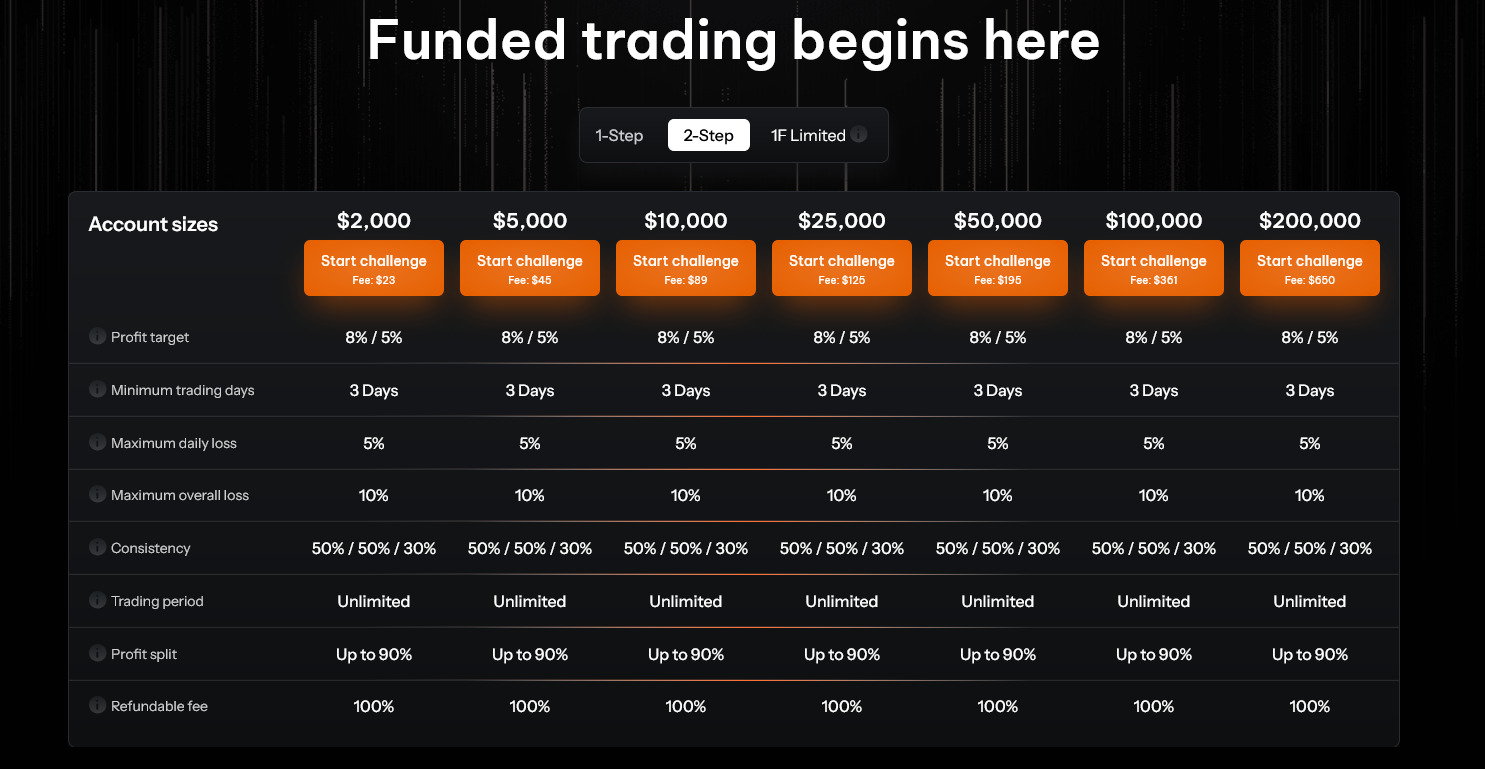
| Account size | Profit split | Max daily loss | Max total loss | Leverage |
|---|---|---|---|---|
| $2,000 | Up to 90% | 5% | 10% to 11% | Up to 1:100 |
| $5,000 | Up to 90% | 5% | 10% to 11% | Up to 1:100 |
| $10,000 | Up to 90% | 5% | 10% to 11% | Up to 1:100 |
| $25,000 | Up to 90% | 5% | 10% to 11% | Up to 1:100 |
| $50,000 | Up to 90% | 5% | 10% | Up to 1:100 |
| $100,000 | Up to 90% | 5% | 10% | Up to 1:100 |
Note: Some listings show 10% total loss, others show 11%, depending on the program label. Always confirm the exact limits for the account you choose.
OneFunded puts a lot of weight on risk control. The rules below summarize what’s described, but always check the official terms before buying.
OneFunded offers two models:
The firm states there are no time limits and no required minimum trading days, depending on the program. If you break a drawdown rule, the account fails. Traders can re-purchase a challenge and try again.
After you become funded, the drawdown rules remain in place. Payout access starts as early as 14 days after the first funded trade, based on the firm’s schedule.
Common rules across account types include:
OneFunded allows many trading styles, but blocks methods it considers abusive.
Allowed (within limits):
Not allowed:
OneFunded supports multiple markets, which helps if you like to diversify or switch strategies by asset type.
Leverage can go up to 1:100, depending on what you trade. Limits can vary by instrument and account rules, so check the product specs inside your platform.
OneFunded supports:
TradeLocker is built for speed and simplicity, with access on web and mobile. It includes charting, order tools, and account tracking features.
Key features:
cTrader is popular with traders who want detailed order controls and strong execution tools. It’s also a common choice for systematic and advanced trading workflows.
Key features:
TradeLocker and cTrader both support mobile access, so you can monitor and manage trades on the go. Mobile tools typically include charts, trade execution, stop-loss and take-profit edits, and real-time account stats.
OneFunded provides a dashboard where traders can track key stats like profit, drawdown, payout status, and rule limits. This helps you stay aware of risk and progress without doing manual math.
OneFunded promotes a payout structure built around:
OneFunded also offers an affiliate program. Partners get a referral link and can earn commissions from signups, based on the program terms.
Challenge pricing depends on account size. Smaller accounts start around $2,000, while larger accounts go up to $100,000. The evaluation fee is a one-time payment, not a subscription.
OneFunded states the fee is refunded after your first payout once you become funded and meet payout conditions.
Commission rates can vary by platform and instrument. The listed examples include:
Always confirm costs inside the platform, since spreads and commissions can change.
The refund is tied to performance. Pass the evaluation, trade a funded account, then receive your first payout. After that, OneFunded states it refunds 100% of the evaluation fee.
Challenge payments may be available via:
Profit withdrawals generally use the same payment routes, depending on what the firm supports in your region.
Prop firms have opened new doors for retail traders in forex, futures, and stocks. Instead of risking personal savings, traders can prove their skills through a set evaluation. Pass it, and you may earn access to a funded account.
That model has helped many traders, but it’s also made the prop firm space crowded. OneFunded, previously known as PROP365, is one of the newer names getting attention. After its rebrand, the company now markets itself around clear rules, fair evaluations, and support for both new and experienced traders.
This review covers how OneFunded works, its challenge options, rules, payouts, and how it stacks up against larger competitors. If you’re thinking about trying a prop firm, this should help you decide if OneFunded fits your style.
OneFunded is a prop trading firm that provides virtual funded accounts through an evaluation process. You trade in a simulated environment that follows real-market pricing, and if you meet the targets and follow the rules, you can qualify for payouts.
The company rebranded from Prop365 to OneFunded, and the shift is more than a name change. OneFunded positions itself as a firm built around transparency, simple rules, and responsive support. The idea is to let traders focus on execution instead of worrying about surprise conditions.
On its site, OneFunded describes itself as “the prop firm that backs the one who is ready.” You prove consistency through a challenge, then move into a funded stage with virtual capital and real-market conditions.
Like most prop firms, you pay a one-time fee to start a challenge. If you pass, you gain access to a larger account. OneFunded also highlights two policies many traders care about, no time limits on challenges and a refund of the challenge fee after the first payout.
Based on available user feedback and public details, OneFunded appears to operate as a real prop firm. It is managed by Brynex Tech Limited, a UK-registered company (company number 15918986).
That said, it does not have the long public track record some major firms have, and public details on things like broker relationships and deeper company operations are limited. For some traders, that lack of detail may be a concern.
OneFunded states that trading takes place in a simulated environment using virtual funds and that it does not provide investment services or manage customer deposits. Still, it’s smart to approach any prop firm carefully.
Before paying for a challenge:
OneFunded is a London-based proprietary trading firm (founded in 2024) that lets traders qualify for a funded account by passing an evaluation. You trade on simulated capital, and if you meet the rules and targets, you become eligible to withdraw profits based on the firm’s payout terms.
Pricing depends on the challenge you pick and the account size, but the published minimum entry fee starts at $23. The minimum account size starts at $2,000.
You’re paying a challenge fee, not depositing trading funds.
No. OneFunded offers unlimited time to complete its evaluation programs. That removes the deadline pressure that can push traders into low-quality trades.
OneFunded offers three main routes:
All programs list unlimited evaluation time.
OneFunded advertises profit splits up to 90%, depending on the account type. On withdrawals, the firm’s share is listed as 10% to 20%, based on the account.
Payouts are available for funded traders, and OneFunded also mentions weekly payouts as an optional add-on. Withdrawals can be requested by bank transfer or crypto, and processing time depends on the method used.
Yes. OneFunded allows news trading and weekend holding, which matters if your strategy relies on scheduled events or multi-day swings.
Yes. OneFunded allows EA usage, which is helpful if you use automation, alerts, or rule-based execution.
OneFunded lists 200+ instruments across:
| Market | Available |
|---|---|
| Forex | Yes |
| Crypto | Yes |
| Indices | Yes |
| Commodities | Yes |
| Stocks | No |
| ETFs | No |
| Futures | No |
| Options | No |
| Bonds | No |
OneFunded supports cTrader, TradeLocker, and a proprietary platform. MT5 is mentioned as coming soon, and MT4 and MT5 aren’t listed as currently available.
For mobile, OneFunded doesn’t offer its own standalone app, but you can trade on mobile through cTrader and TradeLocker (iOS and Android).
Fees depend on what you trade:
OneFunded also states there are no inactivity fees, and it doesn’t add extra deposit or withdrawal fees (payment providers may still charge their own fees).
OneFunded says it uses a layered security and compliance process, including KYC, monitoring for prohibited behavior (IP and device checks), and manual checks during payouts.
It also states that trading is on simulated capital, so you’re not depositing funds to trade in the market through them. As with any prop firm, you’re still responsible for following the rules and understanding the firm’s terms.
Support is available through website chat, email, social media DMs, and an active Discord community. The firm also mentions 24/7 support and account notifications for things like milestones and compliance
Most assets look like they have one price, but traders see two. There’s the best price buyers will pay (the bid) and the best price sellers will accept (the ask). The difference between them is the spread, and it has a real effect on your results.
In forex trading, spreads matter a lot. FX pricing doesn’t work the same way it does in stocks, and the market structure makes spreads a key cost you can’t ignore. As your strategy gets more active or more precise, spread costs can start to decide whether you come out ahead.
This guide breaks down what forex spreads are, why they exist, what makes them change, and how to reduce their impact. Even if you’re new, understanding spreads can save you money and improve your execution.
A spread is the difference between the price you can buy at and the price you can sell at. Sellers prefer higher prices, buyers prefer lower ones. The lowest ask and highest bid at a given moment form the spread.
Spreads matter because they act like an instant cost. If an asset has a bid of $99.90 and an ask of $100.00, the spread is $0.10. If you buy at $100.00 and sell right away at $99.90, you lose $0.10 even though the market didn’t move. That’s the cost of getting filled immediately.
Market orders are the ones that usually pay the spread, because they accept the best available price. Limit orders can reduce spread costs because they don’t have to cross the bid-ask gap to fill, although they may not fill at all.
If you’re used to stocks, the term “spread” will sound familiar. The way it forms in forex is different.
In stocks, you can usually point to one spread at one time on one exchange. In forex, spreads vary by provider, and brokers may add a markup on top of what they receive from banks.
Forex spreads are quoted in pips. For most pairs, a pip is the fourth decimal place. For JPY pairs, it’s usually the second decimal place.
Example with EUR/USD:
Major pairs like EUR/USD often have tight spreads. Crosses and exotics usually cost more. GBP/CHF tends to be wider than majors, and a pair like EUR/ZAR is often wider still.
Spreads can feel annoying at first, but they’re part of how the market works. When you hit the buy or sell button with a market order, you’re taking liquidity. The other side of that trade, often a bank or broker, is providing liquidity and taking risk.
Liquidity providers quote both sides of the market. To make that possible, they often hold positions and manage exposure while prices move. They earn the spread as payment for:
Without that compensation, fewer firms would quote prices consistently, and trading would be harder and more expensive.
Spreads don’t stay the same. They shift with conditions and also depend on how your broker sets pricing. Three drivers matter most: liquidity, volatility, and pricing model.
More liquidity usually means tighter spreads. When many buyers and sellers are active, providers compete harder to offer better prices.
Liquidity also changes throughout the day. The London and New York session overlap is often the most active window for major pairs, which can help keep spreads lower. Thin hours, holidays, and quiet sessions can widen spreads, especially on less-traded pairs.
Volatility tends to widen spreads. When price jumps around, liquidity providers face more risk while holding inventory or filling orders. A sudden move can turn a fill into a loss before they can hedge.
During news releases, risk events, or sharp market swings, spreads often expand. That means higher costs for traders using market orders, and sometimes less predictable fills.
Forex brokers commonly use one of these setups:
It also helps to understand raw spreads. These are closer to interbank pricing and can be very tight, sometimes under 1 pip on major pairs. Brokers that offer raw spreads usually charge a separate commission per trade. This setup can work well for active traders (like scalpers or algorithmic systems) because it avoids inflated spreads, but you still need to compare the total cost (spread plus commission).
If you need instant execution, wider spreads directly reduce your profit. The spread is a cost you pay when you enter and exit with market orders.
Example:
The midpoint price moved 6 pips, but you captured 5 pips because you paid the spread.
If spreads widen while you’re in the trade, the result can be worse. If the midpoint ends at the same level but the spread expands to 5 pips, the quote might be 1.1623-1.1628. Selling at 1.1623 leaves you with only 3 pips, even though the midpoint move was the same.
This is why looking only at price movement can be misleading. Execution costs matter. Traders using limit orders can reduce spread costs, since they choose their price, but fills aren’t guaranteed.
The spread is paid per transaction, so it hits high-frequency styles the most.
Algorithmic traders also need to care. Automated systems can place many trades quickly, so spread monitoring and execution testing become part of strategy design.
Spreads look simple on a chart or quote window, but two things can distort what you actually pay.
The best bid and ask may only be available for smaller order sizes. Larger trades can get worse pricing, which increases the effective spread. This is easier to see in centralized markets where size is visible. In forex, it depends on your broker and liquidity providers.
Two pairs can both show a 10-pip spread, but that doesn’t always mean the cost is equal. If one pair trades near 1.0000 and another near 2.0000, the 10 pips represent a larger percentage cost on the lower-priced pair.
Pips are useful for quick comparisons, but percent cost, typical volatility, and liquidity conditions give a more complete picture.
You can’t avoid transaction costs, but you can limit how much spreads affect your performance. Here are four simple approaches.
Liquid pairs usually have tighter spreads because more participants compete to trade them.
Forex trades 24 hours a day during the week, but liquidity is not equal all day.
If you can choose your broker, compare pricing in a practical way.
If spreads are eating into your edge, small changes can help.
Spreads are one of the most common trading costs in forex, and they shape your results more than many traders expect. Once you understand where spreads come from and what makes them change, it’s easier to plan entries, choose pairs, and size trades with more confidence.
Reducing spread costs often comes down to simple habits, trade liquid markets, trade during active hours, and match your broker and order type to your strategy. This also ties closely to how market liquidity works and why pricing shifts throughout the day.
Mastering trading costs is part of building a profitable approach. If you’re already consistent and want to trade more capital, a prop firm like OneFunded can help you scale after you pass a challenge. Start your OneFunded challenge today to work toward a funded account.
Join our mailing list today!
Please read these Terms and Conditions (the "Terms", "T&Cs") carefully. When you visit this website, use any OneFunded services, or agree to these Terms in any other way, you confirm that you understand them and agree to follow them. By agreeing, you may be giving up certain rights. If you don’t agree, please don’t use the Website.
The website onefunded.com (the "Website") and all related products and services (together, the "Services") are operated by Brynex Tech Limited (the "Provider", "we", "us", "our"). The Provider is a UK limited company, company number 15918986, with a registered office at 71-75 Shelton Street, Covent Garden, London, WC2H 9JQ, United Kingdom.
Nothing we provide is an investment service under applicable laws. The Services are for learning and practice. We don’t offer investments, accept deposits, or manage customer funds.
Part of the Services may include "Challenges" that measure your skills under platform rules and limits. If you pass a Challenge, we may (at our sole discretion) recognize you as a OneFunded TRADER.
When you register on the Website, or use Services that don’t require registration, you enter into an agreement with the Provider for the Services you chose. By using the Services, you agree to these Terms.
If you have questions about the Services or these Terms, email support@onefunded.com.
The Provider is not registered with or regulated by the FCA (Financial Conduct Authority) and does not carry out regulated activities.
All content on this Website is for trading education only. It is not investment advice, a recommendation, an offer, or an analysis meant to support buying or selling any instrument. OneFunded provides simulated trading services and educational tools. No employee or representative is authorized to give investment advice or recommendations.
The Website is not meant for people in places where access or use would break local laws or rules. If your local rules restrict the Services, you may not use them. You are fully responsible for any unauthorized use.
2.1 Access fee: the price you pay to access and use the Services.
2.2 Account, Assessment account, Simulation account: a simulated trading account used within OneFunded Services.
2.3 Challenges: the evaluation phases in the OneFunded assessment program.
2.4 Confidential information: non-public business information, trade secrets, and sensitive data shared by the Provider with a Customer.
2.5 Contract: the binding agreement between the Provider and Customer for Services, including Challenge access and assessment accounts.
2.6 Customer, you, your: the person using the Services.
2.7 Intellectual Property Material: OneFunded content and assets such as trademarks, logos, software, and other intellectual property.
2.8 Payment method: the accepted ways to pay for the Services.
2.9 Platform: a third-party electronic interface used for simulated trading.
2.10 Prohibited Jurisdictions: places where use of the Services is not allowed.
2.11 Provider: onefunded.com and Brynex Tech Limited.
2.12 OneFunded TRADER: a person who meets eligibility criteria set by the Provider and is accepted as such by the Provider.
2.13 Refund: a return of fees in limited cases described in these Terms and related policies.
2.14 T&Cs: these Terms and Conditions.
2.15 Website: https://onefunded.com/
2.16 OneFunded TRADER account: an account provided after signing a service agreement with OneFunded, used as a trading simulator.
2.17 One-step Challenge: a one-phase evaluation of trading skill.
2.18 Two-step Challenge: a two-phase evaluation (Phase 1 and Phase 2).
2.19 1F Limited Challenge: an advanced two-phase evaluation with enhanced conditions.
2.20 Profit or Simulated Profit: a fictional increase in an Assessment or Simulation account balance from simulated trading. It has no cash value, is not real income, and is only used for learning and evaluation.
2.21 Consistency Rule (also called the Best Day Simulated Profit Rule): a limit on how much of Total Simulated Profit can come from the single Best Day Simulated Profit, described in Section 13.15.
2.22 Best Day Simulated Profit: the highest net closed Simulated Profit earned in one UTC day during the current evaluation phase.
2.23 Simulated Profit Ratio: Best Day Simulated Profit divided by Total Simulated Profit, shown as a percentage.
2.24 Total Simulated Profit: the sum of net closed Simulated Profits for the current evaluation phase.
2.25 UTC Day: 00:00 to 23:59 UTC+0.
3.1 These T&Cs apply to your purchase of Challenges (the "Contract"). They replace any other terms you may try to add, along with any terms implied by law, trade custom, or prior dealings.
3.2 The Contract is the complete agreement between you and us on this topic. You confirm you didn’t rely on statements or promises not written in the Contract.
4.1 These Terms are written in English only.
5.1 The Services are only for people who are at least 18 years old and who live in places where the Services are available (see 5.2). By registering, you confirm you are 18 or older. If you are under 18, you may not use the Services. Anyone who falls under restrictions can’t purchase Challenges.
5.2 You agree to access the Services only from countries where they are offered. You understand local laws may limit or block access in some places. You agree to follow all laws that apply to you.
5.3 We may refuse, limit, or end Services for any Customer who:
5.3.1 has nationality or residency in a Prohibited Jurisdiction,
5.3.2 is subject to international sanctions,
5.3.3 has a criminal record.
5.4 Prohibited Jurisdictions include, but aren’t limited to: Afghanistan, Belarus, Central African Republic, Crimea and Occupied Parts of Ukraine, Cuba, Democratic Republic of the Congo, Eritrea, Guinea-Bissau, Iran, Iraq, ISIL (Da’esh), Lebanon, Libya, Mali, North Korea (DPRK), Russia, South Sudan, Sudan, Somalia, Syria, Taliban, Yemen, Zimbabwe.
You are responsible for checking your local rules and for any access that violates them.
6.1 Illegal use: using the Services for unlawful, fraudulent, or harmful purposes, including breaking any local or international law.
6.2 Unauthorized access: trying to access any account, Service, Platform, system, or network without permission, including hacking or similar actions.
6.3 Misrepresentation: impersonating others or falsely claiming an affiliation with the Provider or any third party.
6.4 IP violations and reselling: infringing our intellectual property rights or reselling content in a way that violates Section 16.
6.5 Data abuse: trying to access, collect, or change personal or confidential information without permission.
6.6 Policy breaches: ignoring any rules, policies, or guidelines connected to the Services.
6.7 Forbidden trading practices, including but not limited to:
6.7.1 using the test platform to freeze data,
6.7.2 manipulating test trading (including entering opposite positions at the same time),
6.7.3 using strategies that exploit platform errors (price display issues, update delays, and similar),
6.7.4 gap billing,
6.7.5 hedging across accounts,
6.7.6 trading with external delayed feeds or delayed charts,
6.7.7 arbitrage or tick scalping,
6.7.8 using software, AI, ultra-high-speed tools, or mass order entry that creates an unfair advantage or abuses our systems,
6.7.9 running the same test strategy alone or with other Customers.
6.8 We may label other actions as prohibited, including actions meant to bypass or manipulate the Consistency Rule in Section 13.15.
6.9 If you engage in prohibited activities, we may end access right away, report conduct where appropriate, and pursue legal remedies.
6.10 Multiple accounts: you may not create or control more than one account. If you do, we may suspend or permanently close all related accounts at our sole discretion.
6.11 Prohibited activity can lead to immediate termination of access, reporting, and legal action.
7.1 OneFunded Services are built for learning and practice through simulated trading. Services include:
These Services are for education and practice only, letting you experience a simulated trading environment without real-market financial risk.
During checkout, you may be able to buy optional add-ons that change Challenge conditions (such as targets, time limits, or risk settings). Add-on details and prices appear at purchase. If you buy an add-on, the updated conditions apply only to that Challenge. Add-ons are optional and non-refundable (except where the Refund Policy allows). Add-ons do not change the simulated nature of trading and do not guarantee a result. Available add-ons may change at our discretion.
We may run promotions, raffles, or giveaways ("Giveaways") that award special accounts with custom rules. Giveaway accounts can’t be purchased and are assigned only by the Provider. The specific rules (targets, drawdown, timeframes, and similar) may differ from standard Challenges and will be shared with winners by email, the Client Portal, or another method before the account is assigned. Giveaway accounts are still part of the educational Services and remain subject to these Terms, including the simulated trading notice in Section 8. We may set eligibility, change giveaway terms, or end promotions at any time.
7.2 Simulated trading uses market data, but all trading through the Services is simulated, not real. Any funds shown are fictional, and you have no ownership rights in them outside the Services.
7.3 These virtual funds can’t be used for live trading, and you won’t be paid based on them. Unless we say otherwise, you don’t receive real compensation from simulated results, and you aren’t liable for simulated losses.
7.4 Services are available through the Provider’s platform, registration is required for access.
7.5 You are responsible for keeping all information you provide accurate and current (registration form, order form, Client Portal, or other methods). If details change, update them quickly. We are not required to verify your information.
8.1 You understand and agree that:
8.1.1 The Services are for simulation, practice, and education.
8.1.2 There is no employment relationship between you and the Provider, only a contractual relationship.
8.1.3 We do not provide live trading services. Test account services are supplied by a third party.
8.1.4 Even in a demo setting, execution, prices, speed, liquidity, market data, and access time can vary based on volatility, order size, market conditions, and system performance. We are not responsible for these differences.
8.1.5 You won’t use the Website for anything illegal or against these Terms.
9.1 You must provide your own equipment, software, and any third-party tools needed to use the Services (including Platform software).
9.2 You access Services through a browser. You are responsible for internet access, hardware, and keeping your browser updated. We don’t promise compatibility with specific devices or software.
9.3 Platform providers are separate from the Provider. When you use their products, their own terms and privacy rules apply. Review them before you submit an order.
9.4 Your use of the third-party demo platform is subject to that third party’s terms. You must also follow Section 12 to use the Platform.
9.5 We don’t make promises about the third-party platform and aren’t responsible for it, related transactions, or agreements you enter into with the third party.
9.6 Any contract linked to the demo platform is between you and the third-party provider, not us.
9.7 We don’t guarantee third-party content is accurate, timely, complete, or useful, including public beta platforms. We aren’t responsible for third-party content, ads, products, or materials found there.
9.8 The Website may include links to third-party websites ("Third-Party Links").
9.9 We don’t control Third-Party Links and aren’t responsible for their content. Links are provided for convenience and don’t mean we endorse those sites.
9.10 Some Services may be provided by third parties through the Website. If you use a third-party product or feature, you allow us to share your information with our contracted partners as needed to provide the service.
10.1 To access Services and products, you must create an account under these Terms.
10.2 You can register using the online form. By registering, you accept these Terms and agree to personal data processing under the Privacy Policy.
10.3 Provide correct information. You confirm that all registration details are complete, true, and accurate.
10.4 Use your full legal name as shown on your passport or other government ID. If your details don’t match, we may refuse to provide Services.
10.5 After submitting the form, you’ll receive an email confirming receipt. That email doesn’t mean your account is approved. You’ll receive a second email once registration is confirmed.
10.6 The date we send the registration confirmation email is the contract start date.
11.1 After your account is confirmed, you must protect your login details. Use a strong password, change it when prompted, and don’t share access with anyone. You are responsible for all activity on your account.
11.2 We may reject certain passwords or login credentials at our sole discretion to meet platform rules.
11.3 If you know or suspect someone else has your login details, email support@onefunded.com right away.
11.4 We are not responsible for third-party access caused by theft or unauthorized use of your login. We may suspend access or end the Contract immediately if you breach these Terms.
11.5 We can’t promise the Website will be fully secure or free from bugs or viruses. You are responsible for any damage to your systems, and we are not liable for related losses.
11.6 You must set up your devices, programs, and settings to access the Website. Use your own antivirus protection.
11.7 Don’t try to gain unauthorized access, bypass security, tamper with systems, or disrupt the Website. Violations may lead to termination and legal action.
12.1 You agree that all assessment accounts are registered in the Provider’s name. You receive access under these Terms. The Provider may access your assessment account to verify:
12.1.1 compliance with the assessment rules in Section 13,
12.1.2 your progress on the simulation account,
12.1.3 whether targets were met,
12.1.4 losses and related percentages.
12.2 You understand and agree that:
12.2.1 all "trading" in the account is simulated, even if the platform uses real-trading terms,
12.2.2 the balance is virtual and does not represent real funds,
12.2.3 simulated trading may not match real quotes, we may set values, execution speeds, and other settings at our discretion.
12.3 The trading interface is provided by a third party. You must agree to and follow that third party’s rules.
12.4 If we provide a limit stop feature, it may not always cap simulated loss to the exact amount. You are responsible for keeping losses within allowed limits.
12.5 Standard FX leverage for assessment accounts is 1:100. We may change it under these Terms.
12.6 Inactivity policy: You must place at least one simulated trade in any 60-day period from account activation or your last activity (whichever is later). If you don’t, we may deactivate the account at our sole discretion. Deactivated accounts may not be restored, and you won’t receive a refund or compensation for unused Services. We may email you before deactivation, but we don’t have to.
13.1 The Assessment (Challenge) is part of the educational offering, but it’s optional. It’s meant to motivate learning, not to be required to use the Services.
13.2 We offer these Challenge types to evaluate trading skill and possible eligibility for OneFunded TRADER status:
Giveaway Challenges (Section 7.1) may use custom rules shared separately.
13.3 The One-step Challenge has one phase. You must meet the targets listed below within the allowed time, including the Consistency Rule in Section 13.15. If you meet the targets and pass our final review, you may be offered a OneFunded TRADER account.
| Account Balance | Profit Target | Min Trading Days | Max Daily Loss | Max Drawdown |
|---|---|---|---|---|
| $2,000 | $200 (10%) | 5 days | $80 (4%) | $120 (6%) |
| $5,000 | $500 (10%) | 5 days | $200 (4%) | $300 (6%) |
| $10,000 | $1,000 (10%) | 5 days | $400 (4%) | $600 (6%) |
| $25,000 | $2,500 (10%) | 5 days | $1,000 (4%) | $1,500 (6%) |
| $50,000 | $5,000 (10%) | 5 days | $2,000 (4%) | $3,000 (6%) |
| $100,000 | $10,000 (10%) | 5 days | $4,000 (4%) | $6,000 (6%) |
| $200,000 | $20,000 (10%) | 5 days | $8,000 (4%) | $12,000 (6%) |
13.4 After you complete the One-step Challenge, we perform a final evaluation to decide whether you qualify for a OneFunded TRADER account.
13.5 The Two-step Challenge has Phase 1 and Phase 2.
13.6 Phase 1: Meet the targets below within the timeframe, including the Consistency Rule in Section 13.15, to move to Phase 2.
| Account Balance | Profit Target | Min Trading Days | Max Daily Loss | Max Drawdown |
|---|---|---|---|---|
| $2,000 | $160 (8%) | 3 days | $100 (5%) | $200 (10%) |
| $5,000 | $400 (8%) | 3 days | $250 (5%) | $500 (10%) |
| $10,000 | $800 (8%) | 3 days | $500 (5%) | $1,000 (10%) |
| $25,000 | $2,000 (8%) | 3 days | $1,250 (5%) | $2,500 (10%) |
| $50,000 | $4,000 (8%) | 3 days | $2,500 (5%) | $5,000 (10%) |
| $100,000 | $8,000 (8%) | 3 days | $5,000 (5%) | $10,000 (10%) |
| $200,000 | $16,000 (8%) | 3 days | $10,000 (5%) | $20,000 (10%) |
13.7 Phase 2: After Phase 1, meet these targets within the timeframe, including the Consistency Rule in Section 13.15.
| Account Balance | Profit Target | Min Trading Days | Max Daily Loss | Max Drawdown |
|---|---|---|---|---|
| $2,000 | $100 (5%) | 3 days | $100 (5%) | $200 (10%) |
| $5,000 | $250 (5%) | 3 days | $250 (5%) | $500 (10%) |
| $10,000 | $500 (5%) | 3 days | $500 (5%) | $1,000 (10%) |
| $25,000 | $1,250 (5%) | 3 days | $1,250 (5%) | $2,500 (10%) |
| $50,000 | $2,500 (5%) | 3 days | $2,500 (5%) | $5,000 (10%) |
| $100,000 | $5,000 (5%) | 3 days | $5,000 (5%) | $10,000 (10%) |
| $200,000 | $10,000 (5%) | 3 days | $10,000 (5%) | $20,000 (10%) |
13.8 If you meet the targets within the allowed time, you move to a final evaluation. That review decides eligibility for a OneFunded TRADER account.
13.9 The 1F Limited Challenge is a two-phase evaluation with enhanced conditions and flexibility. It’s offered for account sizes up to $25,000 to support risk control.
| Account Balance | Leverage | Max Daily Loss | Max Drawdown | Phase 1 Profit Target | Phase 2 Profit Target | Min Trading Days | Trading Period | Profit Split | Refundable Fee |
|---|---|---|---|---|---|---|---|---|---|
| $2,000 | 1:100 | 5% ($100) | 11% ($220) | 7% ($140) | 4% ($80) | 2 | Unlimited | 80% | 100% |
| $5,000 | 1:100 | 5% ($250) | 11% ($550) | 7% ($350) | 4% ($200) | 2 | Unlimited | 80% | 100% |
| $10,000 | 1:100 | 5% ($500) | 11% ($1,100) | 7% ($700) | 4% ($400) | 2 | Unlimited | 80% | 100% |
| $25,000 | 1:100 | 5% ($1,250) | 11% ($2,750) | 7% ($1,750) | 4% ($1,000) | 2 | Unlimited | 80% | 100% |
13.10 Passing a One-step, Two-step, or 1F Limited Challenge, plus a successful final evaluation, may lead to an invitation to become a OneFunded TRADER.
13.11 We may accept or refuse to recognize you as a OneFunded TRADER at our discretion, and we don’t have to explain why.
13.12 Our decision on pass or fail is final and can’t be appealed. We may choose to re-check a decision on our own.
13.13 If you don’t pass, stop working with us, or we choose not to recognize you as a OneFunded TRADER, you won’t receive a refund for Challenge access fees or other fees.
Restricted period: from 5 minutes before to 5 minutes after scheduled high-impact news releases.
Pending orders: You may not place pending orders (including limit orders) that could close or modify positions during the restricted period. If a pending order triggers during this time and closes a position, it counts as a violation.
Violations may lead to actions such as warnings, trading suspension, requiring you to repeat the Challenge, or ending the Challenge at the Company’s discretion.
13.15.1 The Consistency Rule applies to all evaluation phases in the One-step, Two-step, and 1F Limited Challenges. It measures steady performance in a simulated environment. It limits how much of your Total Simulated Profit can come from your single Best Day Simulated Profit. All profits are fictional and have no real value (see 7.2 to 7.3).
13.15.2 Cap: Your Simulated Profit Ratio must be 50% or less to pass an evaluation phase or qualify for a OneFunded TRADER account. The rule does not apply after evaluation on OneFunded TRADER accounts.
13.15.3 If you go over the cap: This is not an account breach or termination. If your ratio is too high, keep trading until additional simulated profits bring the ratio within the limit.
13.15.4 Daily refresh: The ratio recalculates every day at 00:00 UTC+0 using data from the current phase. You can track it in your OneFunded Dashboard.
13.15.5 Formula:
Simulated Profit Ratio = (Best Day Simulated Profit ÷ Total Simulated Profit) × 100%
We use the latest daily calculation when you reach the profit target. If you’re above the cap, you must keep trading.
13.15.6 Reset: The ratio resets at the start of each evaluation phase.
14.1 By purchasing access to the Services, you agree to pay the Access fee listed at checkout.
| Account Balance | Access fee |
|---|---|
| $2,000 | $29 |
| $5,000 | $56 |
| $10,000 | $107 |
| $25,000 | $143 |
| $50,000 | $215 |
| $100,000 | $395 |
| Account Balance | Access fee |
|---|---|
| $2,000 | $23 |
| $5,000 | $45 |
| $10,000 | $89 |
| $25,000 | $125 |
| $50,000 | $195 |
| $100,000 | $361 |
| Account Balance | Access fee |
|---|---|
| $2,000 | $25 |
| $5,000 | $49 |
| $10,000 | $92 |
| $25,000 | $135 |
Add-ons (Section 7.1) may be offered during checkout. Add-on fees are added to the Access fee and charged through the selected payment method.
14.1.2 You can’t request a refund only because the Provider decides not to recognize you as a OneFunded TRADER.
14.1.3 You must pay using the payment methods we and our payment partners support. Provide accurate payment details.
14.1.4 If a technical issue causes incorrect fee information, we’ll contact you. If we can’t reach you using your registration contact details, the registration is treated as canceled and you’ll be notified. In that case, you can either complete payment or cancel and receive a refund (fees may be deducted from the Customer).
14.1.5 Prices may change at our discretion. This does not change fees you already paid.
14.1.6 If you break these Terms, we may end your Challenge and/or Platform access without a refund.
14.2 You are responsible for any taxes, duties, or similar charges related to your purchase, unless we clearly state they are included.
15.1 We offer different payment options shown on the Website. By paying, you agree that:
15.1.1 Available methods may include credit cards, debit cards, and other options offered by our partners, and may vary by location.
15.1.2 When you submit payment details, you authorize us to charge the applicable amount. You confirm you’re allowed to use the chosen method.
15.1.3 You must keep payment details accurate and up to date. Errors may interrupt Services.
15.1.4 We may use third-party processors. Your payment details may be shared with them to complete the transaction.
15.1.5 Internet transmissions are not guaranteed to be fully secure. We are not liable for losses tied to transmission risks.
15.1.6 Currency conversion or transaction fees may apply based on your location and payment method. You are responsible for those fees.
15.2 By paying and using the Services, you accept this section and the rest of these Terms.
16.1 The Website and its content (including Challenges, articles, text, images, video, audio, software, logos, names, graphics, and icons), excluding User Content, are "Intellectual Property Material" and are protected by UK and international IP laws.
16.2 Our products and brand elements are protected by law. We keep all rights, title, and interest in our products, trademarks, logos, and brand features.
16.3 Unless these Terms allow it, or we give written permission, you may not use, publish, reproduce, display, perform, modify, create derivative works from, reverse engineer, decompile, disassemble, distribute, license, transfer, sell, copy, post, store in a database, upload, transmit, or change any Intellectual Property Material, in whole or part, for any purpose.
16.4 You may not sell, sublicense, or transfer any Website content or materials to any third party for commercial or non-commercial use.
16.5 Changing Website materials or using them outside allowed purposes may violate our copyrights and other rights.
16.6 If you submit content (comments, suggestions, feedback, or other materials) through the Website (including forums or blogs), that content becomes the Provider’s property. You grant the Provider a worldwide, royalty-free, perpetual, irrevocable, non-exclusive right to use, reproduce, modify, adapt, publish, translate, create derivative works, distribute, and display it in any media.
16.7 You confirm you have the rights to submit your content and that it does not violate any third-party rights.
16.8 We may take legal action against IP infringement, including seeking injunctions and damages.
16.9 If you believe content on the Website infringes your IP rights, contact support@onefunded.com.
16.10 The Website may include third-party links and content. We don’t control or endorse them. Ownership of third-party IP is set by the third party’s terms and legal notices.
17.1 The OneFunded Refund Policy is available at https://onefunded.com/refund-policy/. Refunds are not provided because you failed the Consistency Rule or other simulated assessment rules.
18.1 The OneFunded Privacy Policy is available at https://onefunded.com/privacy-policy/.
19.1 You agree to defend, indemnify, and hold harmless the Provider and its affiliates, directors, officers, employees, agents, and partners from claims, liabilities, damages, losses, and expenses (including reasonable attorney fees) related to your use of the Services, your breach of these Terms, or your violation of third-party rights. This includes direct and indirect losses, loss of profit, and loss of reputation.
19.2 This applies to third-party claims tied to your actions or failures to act.
19.3 We may take over the defense of any matter that would otherwise be covered by your indemnity, at our expense, and you agree to cooperate.
20.1 To the fullest extent allowed by law, the Provider and its affiliates, directors, officers, employees, agents, and partners are not liable for indirect, incidental, special, consequential, or punitive damages (including loss of profit, data, or use) tied to your use of the Services, even if we were told such damages were possible.
20.2 You use the Services at your own risk. These limits apply whether the claim is based on contract, negligence, strict liability, or any other legal theory.
20.3 Our total liability to you for all claims will not exceed the total amount you paid (if any) for the Services.
20.4 We are not liable for:
20.4.1 third-party actions described in Section 9,
20.4.2 data loss,
20.4.3 service interruptions,
20.4.4 inaccurate data,
20.4.5 unauthorized access.
21.1 We may suspend or end your access to the Services at our sole discretion, without notice, for reasons that include:
21.1.1 breaking these Terms or any related policies,
21.1.2 engaging in prohibited activities (Section 6),
21.1.3 providing false or misleading information,
21.1.4 misconduct, harassment, abuse, or actions that harm the safety or integrity of the Services,
21.1.5 failure to pay required fees,
21.1.6 suspected fraud or security issues,
21.1.7 running multiple accounts in violation of 6.10,
21.1.8 providing mismatched ID details in violation of 10.4,
21.1.9 any other reason, even if we don’t state it.
21.2 Ending the Contract does not affect rights or remedies that accrued before termination.
21.3 After termination or suspension:
21.3.1 your access ends immediately,
21.3.2 we may deactivate or delete your account and related information,
21.3.3 you remain responsible for fees or obligations that built up before termination.
21.4 We are not liable for losses tied to termination or suspension.
22.1 We are not responsible for delays, failures, or interruptions caused by events outside our reasonable control, including natural disasters, war, terrorism, civil unrest, labor disputes, strikes, technical failures, power outages, or government actions.
22.2 We are not liable for losses tied to force majeure events.
22.3 We may extend timelines, pause Services, or adjust obligations during these events.
23.1 We may update these Terms at any time. Changes take effect after posting on the Website or other notice, with at least 7 days’ notice before they apply. You are responsible for reviewing the Terms regularly.
23.2 If you keep using the Services after changes, you accept the updated Terms. If you don’t agree, stop using the Services and close your account under Section 21.
23.3 We will notify users about major updates (such as brand changes, service packages, or pricing) through email, banners, or other methods, and we’ll include a summary and a link to the updated Terms.
23.4 Unless these Terms say otherwise, changes are only effective if written and signed by both parties (or their authorized representatives).
24.1 If any part of these Terms is found invalid or unenforceable, that part is removed, and the rest stays in effect.
25.1 While using the Services, you may learn confidential information (such as strategies, algorithms, data, or technical details). You agree to keep it confidential and protect it with reasonable care.
25.2 You may not:
25.2.1 share confidential information with others,
25.2.2 use it for anything outside your use of the Services,
25.2.3 copy or reproduce it,
25.2.4 keep or use it after your access ends.
25.3 Confidentiality does not apply to information that:
25.3.1 is public,
25.3.2 we approve for release in writing,
25.3.3 must be disclosed by law.
25.4 These confidentiality duties continue after termination or suspension.
26.1 Notices under these Terms must be in writing and may be sent by email to support@onefunded.com.
26.2 We will send notices to the email linked to your account and the email used for assessment account registration.
26.3 Email notices are considered received the same day if sent during business hours, or the next business day if sent outside business hours.
26.4 You are responsible for keeping your contact details accurate and current.
27.1 These Terms and related disputes are governed by the laws of the United Kingdom.
27.2 If a dispute comes up, both parties agree to try to resolve it through good faith discussions first.
27.3 If the dispute is not resolved, claims and proceedings will fall under the exclusive jurisdiction of the courts of the United Kingdom.
No reviews yet. Be the first to review.