TradeLocker, DXTrade, Match Trader, Platform 5, FTUK XT
USDT, Pix, Credit/Debit Card, PayPal, Bank Transfer, Crypto, Tether
N/A
Choosing a prop firm can feel simple until you get to the fine print. Fees, drawdown limits, payout rules, and platform quality matter a lot more than flashy scaling numbers, especially once real payouts are on the line.
This FTUK prop firm review breaks down what FTUK offers, how it works, and what to watch before you pay for an account. FTUK is a US-based prop firm (founded in 2021) with three main paths, Instant Funding if you want to skip an evaluation, plus 1-step and 2-step challenges if you prefer to qualify first. Traders usually look up FTUK reviews for the same reasons, they want to know if payouts are smooth, which rules cause account breaches, how expensive the fees are, and whether the firm is trustworthy.
There’s also a bigger point to keep in mind. Prop firms typically aren’t regulated like brokers, so you should confirm who provides the brokerage feed, read every rule twice (daily limits, trailing vs static drawdown, add-ons), and only risk the one-time evaluation fee you can afford to lose.
FTUK’s headline features are easy to see: scaling up to $6.4M, profit split starts at 50% and can reach 80% after multiple scaling steps, and leverage can reach 1:100 at higher scaling. You can trade on TradeLocker, DXTrade, or Match Trader, and weekend holding is allowed.
Next, you’ll get a clear, simple breakdown of fees, rules, payouts, pros, cons, and who FTUK fits best.
FTUK is a retail prop firm founded in 2021 and based in the United States. In simple terms, you pay a one-time fee to join either an evaluation (challenge) or an instant funding plan, then you trade under risk rules. If you follow the rules and produce profits, you can request payouts. Like most prop firms, you are typically trading a simulated account that can pay real money, and the firm may copy your trades to its own risk systems rather than giving you a traditional broker account.
FTUK also has location limits. Even though it’s US-based, FTUK isn’t available in the United States in 2026. It accepts traders from many countries, but it restricts certain jurisdictions due to compliance and sanctions rules. Before you pay, confirm eligibility for your country and read the terms inside the dashboard, not just the marketing page.
One more practical point: FTUK is not a regulated broker. Safety comes down to the firm’s reputation, how clearly rules are written and enforced, and which broker partners provide pricing and execution on the platform feeds.
FTUK gives you three main paths, and they feel very different in real use.
No matter the plan, think of FTUK as a paid tryout. You’re buying a rule set and a chance to earn payouts, not investing into a brokerage account.
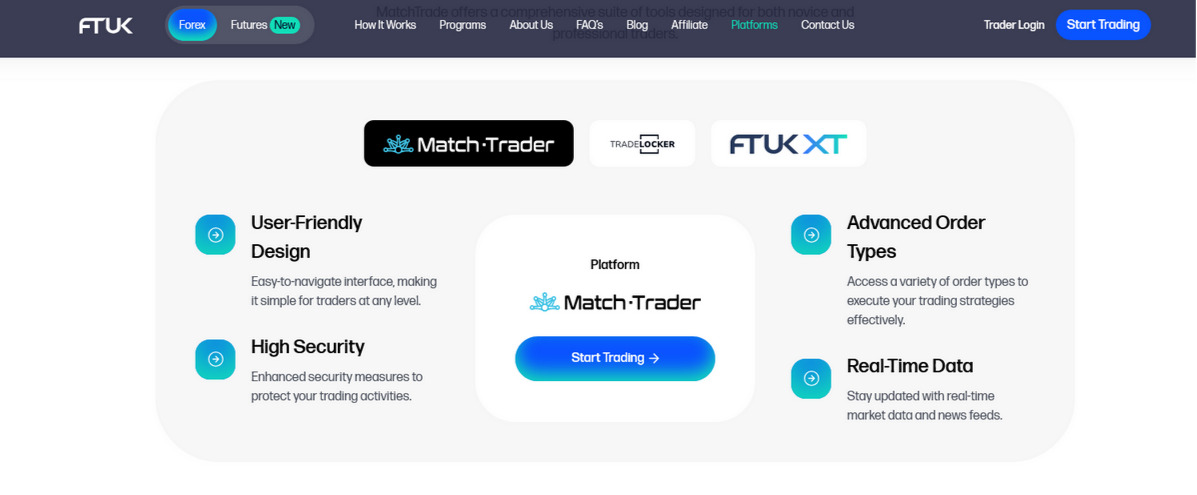
FTUK supports multiple platforms, which is helpful if you care about workflow and charting.
Platforms you’ll see at FTUK:
Typical markets available:
You generally should not expect stock investing or options here. Also, spreads and execution can feel different depending on the platform and the price feed behind it. If FTUK offers a free trial or demo logins, use them like a test drive before you commit real money to a fee.
FTUK’s big headline is scaling, and it’s easy to understand when you think of it like leveling up in stages.
Here’s the basic flow:
FTUK’s scaling cap is $6,400,000, and FX leverage can rise with level, up to 1:100 at max scaling. That upside is real, but the rules don’t disappear. Drawdown limits still apply at every level, so the only way scaling works long term is if you keep position size small and treat risk like a budget you refuse to break.
FTUK is simple on the surface: you pay a fee to access either an evaluation (1-step or 2-step) or Instant Funding. The details matter because your real cost is often the base fee plus any add-ons you choose. In return, you’re paying for a defined ruleset, platform access (TradeLocker, DXTrade, or Match Trader), and a shot at payouts with a long-term scaling plan that can reach $6.4M if you keep hitting milestones.
Fees commonly start around $99 for a small 2-step evaluation, and can run up to about $1,499 for larger Instant Funding options. FTUK is generally marketed as no monthly subscription, meaning most traders pay a one-time fee upfront (then manage ongoing costs through performance, not recurring bills).
One more thing: some sources describe refundable fees in certain cases, but policies change. Verify the current refund terms inside FTUK’s official checkout or dashboard before you buy.
If you want the lowest entry price, the smallest evaluation accounts are usually the move. A common range you’ll see for a $10,000 evaluation is about $99 to $179, depending on whether you pick a 2-step plan (often cheaper) or a 1-step plan (often priced higher).
FTUK also promotes a free trial option in some cases. Treat that like a test drive, not a funding path. It can help you check:
Just don’t assume a free trial leads to a real funded challenge. Many trials are only for practice.
Also, small accounts still bite hard if you oversize. With daily loss limits commonly in the 4% to 6% range (plan dependent), one bad trade can end the run. Think of drawdown like a low ceiling, position sizing decides whether you bump your head.
Add-ons are where FTUK pricing can shift from “reasonable” to “wait, how much?” These extras can change how the account works, not just what you pay.
Common add-ons mentioned in reviews include:
Before you check out, calculate your all-in cost. The headline fee is only your starting number if you trade with zero extras.
FTUK’s profit split is one of its most debated points. Many traders start at 50%, then work up to 80% after multiple scaling steps (often up to six milestones to reach the top split). If you want a high profit share from day one, that’s a real downside.
The upside is the scaling math. If FTUK scales you as advertised, your account size can grow aggressively over time. For some strategies, a lower split on a much larger account can still be attractive.
Quick pre-buy checklist
FTUK is often sold as a flexible prop firm, and in some ways it is (weekend holds are generally allowed, and many trading styles can work). The problem is that most “breaches” don’t come from bad trading, they come from misunderstanding the risk rules and a few easy-to-miss restrictions.
If you remember one thing, make it this: breaking the max loss rule is usually a hard breach, and your account or evaluation can be closed. Your strategy might be solid, but if your sizing doesn’t fit the limits, the rules win.
Daily loss limit is the most you can lose in a single day before you breach. On FTUK plans, reviews commonly mention daily limits around 4% to 6%, depending on the account type.
Max loss (overall drawdown) is your total allowed loss across the life of the account. If you hit it, that’s typically the end of the account (hard breach), even if you were profitable earlier.
Trailing drawdown moves up as your equity hits new highs. Think of it like a safety net that rises behind you while you climb, but it never drops to give you more room.
Static drawdown stays tied to your starting balance (or a fixed level per phase). It’s more predictable because your stop-out line does not tighten just because you made money.
Here are simple examples using the typical figures you’ll see referenced in FTUK reviews (always confirm your exact plan numbers inside your dashboard):
FTUK gets described as flexible because many normal approaches are allowed, but there are still rule traps that can wipe out a good run. This is where traders get angry after the fact, even though the terms were written down.
A few practical points to watch:
Two small rules can quietly break accounts, especially for swing traders or anyone who travels.
First, stop-loss requirements. Some FTUK plans are described as requiring a stop loss on trades. If that rule applies to your account type, it’s not optional. Forgetting a stop loss once can be treated as a violation, even if the trade wins.
Second, inactivity rules. Some traders report needing at least one closed trade within 30 days to keep an account active. That matters if you:
Before you buy, check two things in your exact plan rules: is a stop loss mandatory, and what counts as activity (opening a trade vs closing a trade). Those details decide whether your trading style fits the account.
Payouts are where prop firms earn (or lose) trust. FTUK does pay traders, but you should expect a process with checkpoints, a limited set of withdrawal rails, and the usual “did you follow every rule?” review before money leaves the system. If you treat payouts like a paper trail (not a casual click), you’ll avoid most of the stress people post about.
At a high level, the payout flow looks like this:
That extra internal step is a common complaint because it feels like “one more hoop,” even if it’s mostly admin. It can also be where consistency checks happen. If your trading suddenly looks like an execution exploit, a prohibited arbitrage style, or a last-minute gamble right before payday, that’s when accounts tend to get flagged.
Payout timing depends on your plan and add-ons. Many plans are reported as bi-weekly, some traders pay for weekly payouts via add-ons, and some instant-style accounts may support on-demand payouts under conditions (usually tied to account behavior and consistency).
To keep the payout process calm, do a few boring things that work:
For most traders, the first payment is the fee, not a deposit. FTUK fees are commonly paid by card or crypto, depending on your region and the checkout options shown.
On the payout side, withdrawals are often centered on crypto rails (USDT is commonly referenced), and traders also mention providers like Rise in user reports. FTUK’s base account currency is USD, which matters if you manage your personal finances in another currency because conversions can add friction.
Payment choice is one of FTUK’s weaker points versus firms that offer broader rails like PayPal or bank wire. Limited methods can be a real hassle if:
Prop firms are generally unregulated businesses, so your protection mostly comes from research and your own documentation. Before you buy any FTUK challenge (or any prop challenge), run this quick due diligence list:
Those complaints are hard to verify from the outside, and some come from traders who broke rules. Still, take them seriously. Assume you’ll need receipts for everything, and only risk what you can afford to lose, which is the fee.
FTUK is easy to explain and harder to judge. On paper, it’s built around two big ideas: start trading quickly (Instant Funding) and scale aggressively (up to $6.4M). In practice, the real decision comes down to your style, your risk control, and how much you care about early payouts versus long-term buying power.
Here’s the clean summary.
Pros that matter
Cons to take seriously
FTUK makes the most sense if you already have a proven, low-risk system and you want to trade now, not after two phases of targets and minimum days.
You’ll like FTUK if you:
It’s a bit like getting a smaller slice of a pie that can grow fast, if you don’t get sloppy.
If your top priority is a 90%+ split, ultra-low entry pricing, or static drawdown only, FTUK will likely feel expensive and (at times) tight.
Simple recommendations by trader type
FTUK is a real prop firm (founded in 2021) with a clear identity: Instant Funding if you want to skip evaluations, plus 1-step and 2-step challenges if you prefer a qualification route. The main draw is the scaling plan that can climb as high as $6.4M, with a profit split that starts at 50% and can reach 80% after multiple scale-ups. You also get platform choice (TradeLocker, DXTrade, Match Trader) and generally flexible holding rules, including weekends.
The trade-offs are hard to ignore. Fees can run high once you add upgrades, the starting split is low, and the details matter, trailing vs static drawdown, news rules on evaluations, and the payout workflow (including the extra “Profit Locker” step some traders dislike). Consistency is what keeps accounts alive here, not big swings.
Before paying, re-check current rules and pricing on ftuk.com, start with the smallest plan you can, and treat the fee like a business expense with risk.
Make a one-page rule checklist, backtest your strategy on the platform, then decide.
If you trade Forex, you need to understand spreads. The spread is one of the main costs you pay when you buy and sell currency pairs.
Like other markets, Forex has two prices for the same instrument. A Forex spread is the gap between the buy price and the sell price of a currency pair. In trading platforms, these are shown as:
The spread is simply the difference between the ask and bid quotes your broker shows.
Some Forex brokers advertise “zero commission” trading. That usually means you won’t see a separate fee on each trade. Instead, the broker can earn through the spread by marking up the bid and ask prices.
From a business point of view, it makes sense. Brokers still need to get paid for providing pricing, platforms, and trade execution.
Most brokers offer one of two spread types:
A fixed spread stays the same, even when the market gets busy or quiet. This setup is common with market makers (also called dealing desk brokers).
A dealing desk broker may buy large positions from liquidity providers and then offer smaller trade sizes to traders.
Variable spreads move with the market. The spread can tighten or widen throughout the day based on liquidity, volatility, and order flow.
These spreads are common with non-dealing desk brokers, where prices come from multiple liquidity sources. The broker generally passes those prices through to traders, so the spread changes as the market changes.
Say you plan to buy EUR/USD when the spread is 2 pips. Right before you enter, a major US unemployment report is released. Volatility jumps, liquidity drops, and the spread can widen fast, for example to 20 pips.
Forex spreads can shift at any moment. Sometimes they’re tight, sometimes they expand.
A wide spread means there’s a larger gap between the bid and ask. This often happens when:
A low spread means the bid and ask are close together. Low spreads usually show up when liquidity is strong and price movement is calmer. Trading costs are lower in these conditions.
Spreads are usually measured in pips. A pip is the basic unit of price movement for most currency pairs.
To find the spread:
Example: If EUR/USD is quoted at 1.1722 (bid) and 1.1726 (ask), the spread is 0.0004, which equals 4 pips.
To estimate the spread cost, multiply the spread (in price terms) by your trade size:
A simple quote example of a 2-pip spread on EUR/USD looks like: 1.1071/1.1073.
For most pairs, 1 pip = 0.0001. That’s usually the fourth digit after the decimal.
Volatility is one of the biggest drivers of spread changes. When big economic reports or unexpected moves hit the market, liquidity can dry up. When that happens, spreads often widen.
Following the economic calendar helps you plan around scheduled news. If you know a high-impact report is coming, you can expect more volatility and possible spread expansion. Surprise data can still catch the market off guard.
Spreads are often tighter during the busiest sessions, especially when London and New York are active. Higher trading activity usually brings more liquidity, which can help keep spreads lower.
Spreads also react to supply and demand. If demand for a currency jumps, prices can move fast, and spreads may widen during those surges.
Forex traders buy or sell currency pairs, and prices move in pips (often the fourth decimal place). A single pip can look small, but it can make a real difference in profit or loss, depending on your position size.
FTUK.com positions its funded trading programs around three big ideas: controlled risk, repeatable performance, and clean, ethical trading behavior. That focus shows up in the rules, the evaluation metrics, and the list of trading styles and behaviors they don’t allow.
Below is a practical breakdown of what those rules usually center on, why they exist, and how the key numbers (like drawdown limits, profit targets, and minimum trading days) often vary by program. Exact thresholds can differ across program types, account sizes, and rule sets, but the structure stays consistent.
FTUK.com rules are built to keep risk under control before anything else. The goal is to reward traders who can stay steady, not traders who swing for a big win and hope the market cooperates.
That’s why you’ll see clear limits tied to drawdowns, daily losses, and how much exposure you can stack at once. A funded account is treated like capital that must be protected every day, not just at the end of a challenge.
A common theme is that consistency matters as much as returns. Many funded programs aren’t trying to find the trader with one big trade, they’re filtering for traders who can repeat a process across normal market conditions.
This is also where rules and scoring can push traders toward smaller, more stable position sizing and away from wild changes in risk from one session to the next.
FTUK.com’s restrictions often reflect a simple idea: your performance should come from your own trading decisions and fair market access. Ethical trading standards usually mean no rule-hacking, no manipulation, and no behavior that looks like it’s designed only to pass metrics instead of trade responsibly.
It’s also why some high-speed tactics and certain coordination methods get flagged or banned.
Drawdown rules are often the most important numbers on any funded program. They define how much you can lose before the account fails, and they shape every other decision you make.
Depending on the program, you may see examples like a 2 to 5 percent daily drawdown limit and a static drawdown limit. The specific definitions matter because “daily” and “static” can be calculated differently, and that changes how tight your risk really is.
Daily drawdown limits are designed to stop a bad day from turning into a blown account. They also discourage emotional trading because once a trader is down, the temptation is to increase size to “get it back.”
When daily limits are in play, pacing matters. The rules push traders to accept small losses and come back tomorrow, instead of forcing trades late in a session.
Static drawdown usually means there’s a hard maximum loss from a fixed reference point (often the starting balance). That creates a firm boundary for total risk across the whole evaluation or funded period.
This type of limit tends to reward traders who avoid long losing streaks and who don’t treat the account like it’s disposable.
Profit targets are the other major number traders pay attention to. Many programs show targets in a range like 5 to 8 percent, though it varies by program and account type.
A profit target isn’t just a finish line, it’s also a behavior filter. It can reveal whether a trader can build gains without taking oversized risk, especially when drawdown limits are relatively tight.
Many programs include minimum trading days as a way to reduce “one-day luck” results. Examples may range from 1 to 4 minimum trading days, depending on the program structure.
This requirement often pairs with the consistency theme. It nudges traders to show repeatable decision-making across more than one session.
Rules that prohibit hedging accounts usually target traders who try to offset risk by taking opposite positions across separate accounts. That approach can be used to game evaluation criteria, not to show a real edge.
By blocking cross-account hedging behaviors, the program can judge each account on its own performance and risk control.
Very short hold-time strategies, such as tick scalping under 30 seconds, are often restricted. These methods can rely on micro-movements, ultra-tight execution, and conditions that don’t reflect stable trading skill.
Restrictions here typically aim to keep results tied to broader decision-making, not speed advantages or momentary pricing noise.
High-frequency trading behaviors can include extremely rapid order placement, high message rates, and ultra-short exposure windows. Many funded environments aren’t designed to support that style fairly, and it can add operational risk for the firm.
Blocking HFT-style patterns also aligns with the ethical trading theme. The program is selecting for traders who can perform without speed-only tactics.
Rules that prohibit external signals usually mean the firm wants the trading decisions to come from the trader, not a third-party signal service. This can also apply to mirroring trades, copy trading, or using prompts that remove independent decision-making.
From a program perspective, it’s about accountability. If results come from outside signals, the evaluation stops measuring the trader’s skill and starts measuring the signal provider.
Even when a market offers high leverage, programs often restrict “excessive leverage” behavior because it can break risk rules quickly. Large exposure can turn normal price movement into a major drawdown event.
This is where risk management rules become practical, not theoretical. Traders who keep size controlled tend to survive common volatility, while oversized positions can fail on routine swings.
A funded structure often rewards traders who keep position size within a stable range. Sharp jumps in size can look like gambling, especially after losses or near a profit target.
Even if the rules don’t explicitly demand fixed sizing, the drawdown math usually does. Stable size makes it easier to stay inside daily and static limits.
FTUK.com’s general structure promotes the idea that steady profit-taking and risk control go together. A trader who can lock in gains without breaking rules is a better fit for funded capital than someone who lets winners swing wildly.
This doesn’t mean every trade must be short-term. It means the overall approach should show discipline, with profits realized in a way that matches the program’s risk boundaries.
Key metrics like drawdown limits, profit targets, and minimum trading days can vary by program. You might see daily or static drawdown examples in the 2 to 5 percent range, profit targets in the 5 to 8 percent range, and minimum trading days from 1 to 4, but the exact numbers depend on the specific program rules.
This variation isn’t just cosmetic. A lower drawdown limit changes the entire risk profile, even if the profit target looks similar.
Many restrictions exist because traders sometimes try to pass evaluations by targeting the metrics instead of building a real trading process. That can include extreme risk near the finish line, ultra-short scalps meant to print tiny gains, or cross-account behaviors that cancel risk.
By limiting tactics like hedging across accounts, tick scalping under 30 seconds, HFT-style activity, and external signals, the program tries to keep results tied to tradable, repeatable skill.
The full rule set usually reads like a checklist of professional habits: protect capital, limit downside, trade consistently, and avoid questionable tactics. In that sense, the evaluation is less about one perfect trade and more about whether the trader’s habits fit a funded environment.
That’s also why the big metrics are simple and strict. Drawdown limits, profit targets, and minimum trading days create a clear framework for judging performance without ambiguity.
FTUK.com rules put risk management, consistency, and ethical trading at the center of the funded account model. Restrictions like hedging accounts, tick scalping under 30 seconds, HFT-style trading, external signals, and excessive leverage all support the same goal: performance that’s repeatable and tied to responsible decision-making.
Across different programs, the key metrics can change, including drawdown limits (often shown in examples like 2 to 5 percent daily or static), profit targets (often around 5 to 8 percent), and minimum trading days (often 1 to 4). Even with those differences, the direction stays the same, protect capital first, then grow it with discipline.
I've received a couple of payouts from… I've received a couple of payouts from FTUK without any issues. They provide some interesting challenge accounts, for very reasonable prices. Their dashboard is good, stats are updated quickly and spreads and execution is pretty satisfactory as well. I would give them a 4.5 if possible, the only reason I'm not giving a full 5 is because their payouts are a bit slower than other companies, can take 2-3 days, and some login and account issues sometimes. Other than that a solid firm and would definitely recommend. Cheers.
9 months ago